


Investigating the Adsorption and Corrosion Protection Efficacy and Mechanism of Marjoram Extract on Mild Steel in HCl Medium
- PMID: 39860142
- PMCID: PMC11767545
- DOI: 10.3390/molecules30020272
Investigating the Adsorption and Corrosion Protection Efficacy and Mechanism of Marjoram Extract on Mild Steel in HCl Medium
Abstract
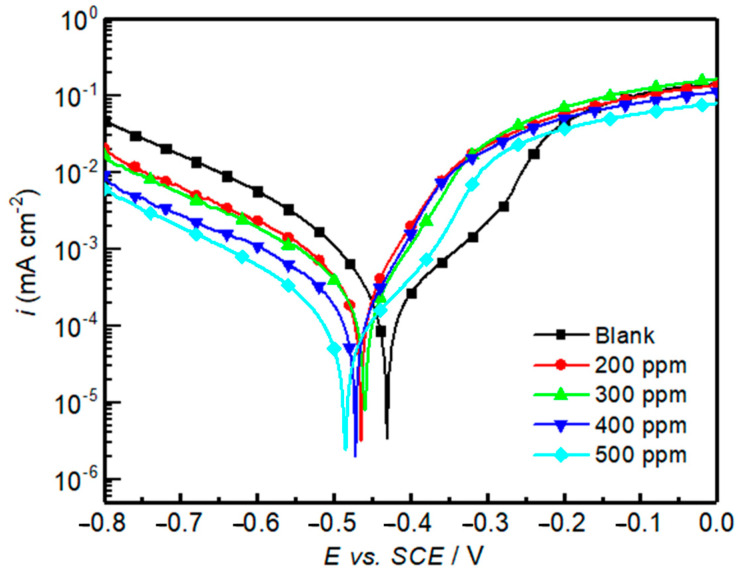
In recent years, the anti-corrosive properties of natural extracts as environmentally friendly inhibitors have gained considerable interest. This study evaluates the potential of Marjoram (Origanum majorana L.) essential oil (OML), collected from Salé, Morocco, as a corrosion inhibitor for mild steel in 1 M HCl medium. The protection performance of OML was assessed using various electrochemical techniques, including potentiodynamic polarization (PDP) and electrochemical impedance spectroscopy (EIS), as well as the weight loss method. The influence of OML concentration and temperature on the inhibition performance were investigated. OML demonstrated pronounced inhibitory benefits via increasing the corrosion resistance of mild steel in the corrosive HCl solution, thus reducing the corrosion rate to 0.11 mg cm-2 h-1 and increasing the inhibition efficiency to 87.1% at an inhibitor concentration of 500 ppm. PDP confirmed that the inhibitor works as a mixed-type inhibitor with cathodic supremacy. EIS revealed that the charge transfer mechanism is the main controlling factor for the corrosion process. The thermodynamic parameters suggested a key role of OML physisorption in inhibition, following the Langmuir isotherm. Importantly, SEM and EDX analyses suggested the formation of a protective layer of the extract onto the steel surface, which shields the surface from corrosive species. This is owed to the functional group-rich phytochemicals of OML. Therefore, the development of bio-based corrosion inhibitors is not only a step towards more eco-friendly industrial practices, but also meets the growing demand for sustainable materials in a world with constrained resources.
Keywords: EIS; adsorption; corrosion inhibition; essential oil; green inhibitors; low-carbon steel; plant extract.
Conflict of interest statement
Authors declare that they have no known conflicts of interest.
Figures


References
-
- Li Y., Chen Y., Wang C., Li Y., Wu Y. Exploring the potential of plant extracts as corrosion inhibitors: A comprehensive review. Prog. Org. Coat. 2025;198:108915. doi: 10.1016/j.porgcoat.2024.108915. - DOI
-
- Paper C., Joseph O.O., Banjo O.S., Babaremu K.O. Global and Economic Effects of Corrosion—An Overview. AIP Conf. Proc. 2022;2437:020149. doi: 10.1063/5.0092286. - DOI
-
- Korniy S.A., Zin I.M., Danyliak M.O.M., Rizun Y.Y. Eco-Friendly Metal Corrosion Inhibitors Based on Natural Polymers (A Review) Mater. Sci. 2023;58:567–578. doi: 10.1007/s11003-023-00700-7. - DOI
-
- Boudalia M., Laourayed M., El Moudane M., Sekkat Z., Campos O.S., Bellaouchou A., Guenbour A., José Garcia A., Amin H.M.A. Phosphate Glass Doped with Niobium and Bismuth Oxides as an Eco-Friendly Corrosion Protection Matrix of Iron Steel in HCl Medium: Experimental and Theoretical Insights. J. Alloys Compd. 2023;938:168570. doi: 10.1016/j.jallcom.2022.168570. - DOI
-
- Al-Amiery A.A., Isahak W.N.R.W., Al-Azzaw W.K. Corrosion Inhibitors: Natural and Synthetic Organic Inhibitors. Lubricants. 2023;11:174. doi: 10.3390/lubricants11040174. - DOI
MeSH terms
Substances
LinkOut - more resources
Full Text Sources
