. 2025 Jan 4;18(1):52.
doi: 10.3390/ph18010052.

Τhiazolidine-4-One Derivatives with Variable Modes of Inhibitory Action Against DPP4, a Drug Target with Multiple Activities and Established Role in Diabetes Mellitus Type II

Affiliations

Τhiazolidine-4-One Derivatives with Variable Modes of Inhibitory Action Against DPP4, a Drug Target with Multiple Activities and Established Role in Diabetes Mellitus Type II

Dionysia Amanatidou et al. Pharmaceuticals (Basel). .

Abstract

Background/Objectives: DPP4 is an enzyme with multiple natural substrates and probable involvement in various mechanisms. It constitutes a drug target for the treatment of diabetes II, although, also related to other disorders. While a number of drugs with competitive inhibitory action and covalent binding capacity are available, undesired side effects exist partly attributed to drug kinetics, and research for finding novel, potent, and safer compounds continues. Despite the research, a low number of uncompetitive and non-competitive inhibitors, which could be of worth for pharmaceutical and mechanism studies, was mentioned. Methods: In the present study sixteen 3-(benzo[d]thiazol-2-yl)-2-aryl thiazolidin-4-ones were selected for evaluation, based on structural characteristics and docking analysis and were tested in vitro for DPP4 inhibitory action using H-Gly-Pro-amidomethyl coumarin substrate. Their mode of inhibition was also in vitro explored. Results: Twelve compounds exhibited IC50 values at the nM range with the best showing IC50 = 12 ± 0.5 nM, better than sitagliptin. Most compounds exhibited a competitive mode of inhibition. Inhibition modes of uncompetitive, non-competitive, and mixed type were also identified. Docking analysis was in accordance with the in vitro results, with a linear correlation of logIC50 with a Probability of Binding Factor(PF) derived using docking analysis to a specific target box and to the whole enzyme. According to the docking results, two probable sites of binding for uncompetitive inhibitors were highlighted in the wider area of the active site and in the propeller loop. Conclusions: Potent inhibitors with IC50 at the nM range and competitive, non-competitive, uncompetitive, and mixed modes of action, one better than sitagliptin, were found. Docking analysis was used to estimate probable sites and ways of binding. However, crystallographic or NMR studies are needed to elucidate the exact way of binding especially for uncompetitive and non-competitive inhibitors.

Keywords: 3-(benzo[d]thiazol-2-yl)-2-aryl thiazolidin-4-ones; DPP4; allosteric center; competitive inhibitors; diabetes mellitus type II; docking analysis; mixed inhibition; non-competitive inhibitors; probability factor for binding PF; uncompetitive inhibitors.


Conflict of interest statement

The authors declare no conflicts of interest.

Figures

Figure 1
Figure 1
Structure of studied compounds.
Figure 2
Figure 2
Lineweaver–Burk blots for the compounds h3 (A), n1 (B), c4 (C), and m2 (D). As shown by the curves, the modes of inhibitory action are competitive for h3, non-competitive for n1, and uncompetitive for c4 and m2.
Figure 3
Figure 3
Docking of the competitive inhibitors h3 (A,A′), n2 (Β,Β′) and c2 (C,C′) in the active site of DPP4. The docked compound is shown in green. The initial ligand is shown in yellow.
Figure 4
Figure 4
Correlation of log IC50 of competitive inhibitors with the Probability Factor (PF). Only competitive inhibitors were taken into account for the estimation of linear regression. The PF is calculated if we modify the Eest exported from docking to the target site box (Eestts), which corresponds to the active site for competitive inhibitors, by abstracting a factor (d) produced using the results of docking to the whole enzyme at all positions (x) with lower binding energy (Eestx) than that of the target site (Eestt) which is the active site for competitive inhibitors. Factor d = (ΔExνx100)10, where ΔΕx = Estx − Eestt and vx is the frequency (%) of binding to the specific site x with the specific pose which corresponds to Estimated binding Energy Estx.
Figure 5
Figure 5
Probable sites of binding of uncompetitive (sites a1, b) and non-competitive (site a2) inhibitors.
Figure 6
Figure 6
Probable binding site (site a2) of the non-competitive inhibitor n1. (A) shows the orientation of n1 (in green) within the active site in relation to a competitive inhibitor (initial ligand of the structure, in yellow). The amino acids participating in interactions with n1 are shown in (B,C).
Figure 7
Figure 7
Probable site of binding (site a1) of the uncompetitive inhibitors m2 (A) and c4 (B) within the active site of DPP4. The docking was applied to the whole enzyme in the presence of the initial ligand.
Figure 8
Figure 8
Docking of the uncompetitive inhibitors m2 (A,B) and c4 (C,D) at the probable site b, between the propeller loop (residues 234–260) and the residues around Phe713 and Thr706 near the catalytic triad (Ser630, Asp708, His740) of the enzyme.
Figure 9
Figure 9
Favorable characteristics of competitive 3-(benzo[d]thiazol-2-yl)-2-aryl thiazolidin-4-one inhibitors. Green: halogens—participation in halogen bonds, Light brown spheres: groups participating in hydrophobic and pi–pi interactions. Blue: nitrogen, yellow: sulfur, red: oxygen.
Figure 10
Figure 10
Characteristics of adamantane derivatives with competitive, non-competitive, and uncompetitive modes of inhibition.
Figure 11
Figure 11
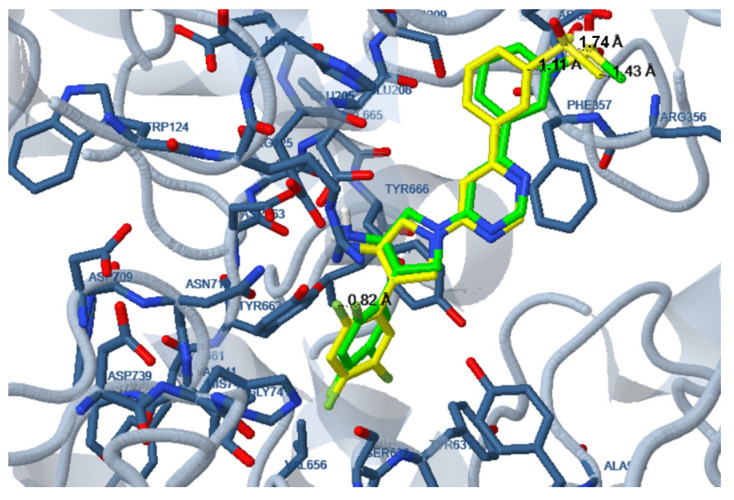
Verification process. Docking of the initial ligand (DLI B) to the enzyme (PDB:2OAG) from which the ligand was abstracted. Docked ligand is shown in green. The position of the initial ligand is shown in yellow. Indicative distances between the same atoms of the initial and docked ligand are shown.

References

    1. Klemann C., Wagner L., Stephan M., von Hörsten S. Cut to the Chase: A Review of CD26/Dipeptidyl Peptidase-4’S (DPP4) Entanglement in the Immune System. Clin. Exp. Immunol. 2016;185:1–21. doi: 10.1111/cei.12781. - DOI - PMC - PubMed
    1. Lu G., Hu Y., Wang Q., Qi J., Gao F., Li Y., Zhang Y., Zhang W., Yuan Y., Bao J., et al. Molecular Basis of Binding between Novel Human Coronavirus MERS-CoV and Its Receptor CD26. Nature. 2013;500:227–231. doi: 10.1038/nature12328. - DOI - PMC - PubMed
    1. Engel M.H., Hoffmann T., Manhart S., Heiser U., Chambre S., Huber R., Demuth H., Bode W. Rigidity and Flexibility of Dipeptidyl Peptidase IV: Crystal Structures of and Docking Experiments with DPIV. J. Mol. Biol. 2006;355:768–783. doi: 10.1016/j.jmb.2005.11.014. - DOI - PubMed
    1. Frayling T.M., Evans J.C., Bulman M.P., Pearson E., Allen L., Owen K., Bingham C., Hannemann M., Shepherd M., Ellard S., et al. Beta-Cell Genes and Diabetes: Molecular and Clinical Characterization of Mutations in Transcription Factors. Diabetes. 2001;50((Suppl. 1)):S94. doi: 10.2337/diabetes.50.2007.S94. - DOI - PubMed
    1. Nauck M.A., Meier J.J. Incretin Hormones: Their Role in Health and Disease. Diabetes Obes. Metab. 2018;20((Suppl. 1)):5–21. doi: 10.1111/dom.13129. - DOI - PubMed

LinkOut - more resources