. 2025 Feb:112:105564.
doi: 10.1016/j.ebiom.2025.105564. Epub 2025 Jan 24.

Topologically constrained DNA-mediated one-pot CRISPR assay for rapid detection of viral RNA with single nucleotide resolution

Affiliations

Topologically constrained DNA-mediated one-pot CRISPR assay for rapid detection of viral RNA with single nucleotide resolution

Yanan Li et al. EBioMedicine. 2025 Feb.

Abstract

Background: The widespread and evolution of RNA viruses, such as the severe acute respiratory syndrome coronavirus 2 (SARS-CoV-2), highlights the importance of fast identification of virus subtypes, particularly in non-laboratory settings. Rapid and inexpensive at-home testing of viral nucleic acids with single-base resolution remains a challenge.

Methods: Topologically constrained DNA ring is engineered as substrates for the trans-cleavage of Cas13a to yield an accelerated post isothermal amplification. The capacity of CRISPR/Cas13a for discriminating single nucleotide variant (SNV) in viral genome is leveraged by designing synthetic mismatches and hairpin structure in CRISPR RNA (crRNA), enabling robust discrimination of different SARS-CoV-2 variants. Via optimisation of CasTDR3pot to be one-pot assay, CasTDR1pot can detect Omicron and its subvariants, with only a few copies in clinical samples in less than 30 min without pre-amplification.

Findings: The detection system boasts high sensitivity (0.1 aM), single-base specificity, and the advantage of a rapid "sample-to-answer" process, which takes only 30 min. In the detection of SARS-CoV-2 clinical samples and their variant strains, CasTDR1pot has achieved 100% accuracy. Furthermore, the design of a portable signal-reading device facilitates user-friendly result interpretation. For the detection needs of different RNA viruses, the system can be adapted simply by designing the corresponding crRNA.

Interpretation: Our study provides a rapid and accurate molecular diagnostic tool for point-of-care testing, epidemiological screening, and the detection of diseases associated with other RNA biomarkers with excellent single nucleotide differentiation, high sensitivity, and simplicity.

Funding: National Key Research and Development Program of China (No. 2023YFB3208302), National Natural Science Foundation of China (No. 22377110, 22034004, 82402749, 82073787, 22122409), National Key Research and Development Program of China (No. 2021YFA1200104), Henan Province Fund for Cultivating Advantageous Disciplines (No. 222301420019).

Keywords: CRISPR diagnostic; One-pot assay; SARS-CoV-2 variants; Single base mutation; Topologically constrained DNA rings.


Conflict of interest statement

Declaration of interests The authors declare no competing interest.

Figures
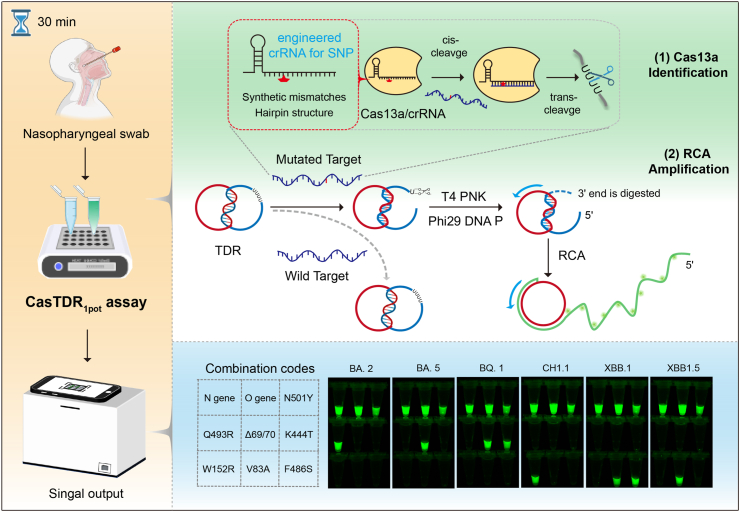
Fig. 1
Fig. 1
Detection of SARS-CoV-2 variants with CasTDR1pot. By combinatorically identifying key mutations in SARS-CoV-2 genome, CasTDR1pot enables rapid determination of Omicron variant and its subvariants. Firstly, the trans-cleavage of Cas13a was selectively activated using engineered crRNAs specific to particular mutants. Topologically constrained DNA ring (TDR) was then engineered as substrates for the trans-cleavage of Cas13a, which triggers the rolling circle amplification (RCA). (The combination of Phi29 DNA polymerase and T4 PNK can remove the single stranded fragment at the 3′-end of the Cas13a-linearised CDNAU from TDR. And the trimmed CDNAU can function as a primer to initiate RCA over the complexed CDNAR template). The resulting signal was then magnified through the TDR-based RCA amplification, allowing for RNA analysis at the single-nucleotide level. Visual detection of variants was performed using the naked eye or a portable detector.
Fig. 2
Fig. 2
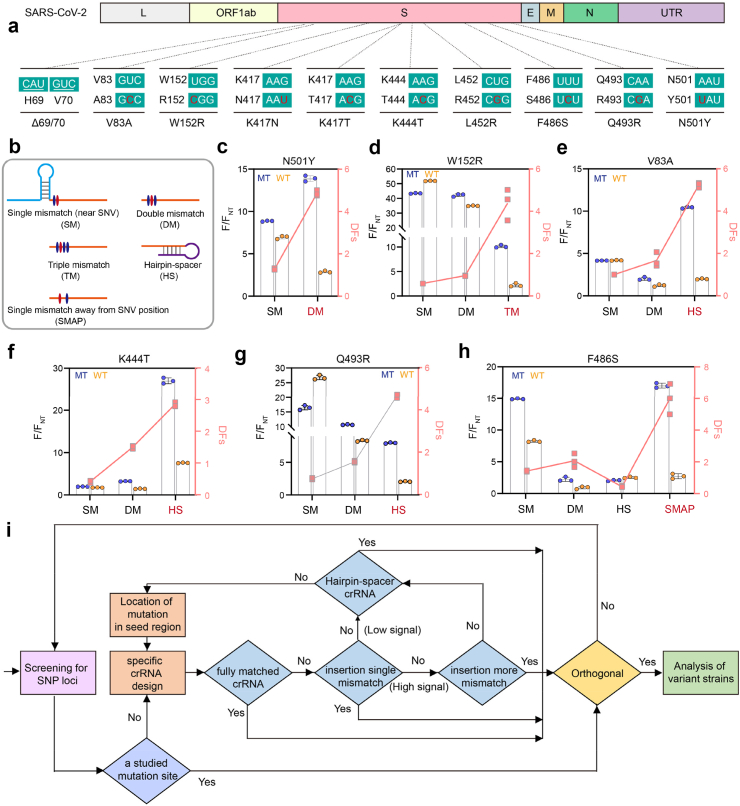
Design of Cas13a probes for SNVs in SARS-CoV-2 genome. (a) Key RNA mutations in the genome of SARS-CoV-2 variants to be detected. (b) Schematic of structures of designed crRNAs. The locus of SNVs were indicated in red. Synthetic mismatches inserted into crRNA are in blue. Hairpin-spacer introduced in crRNA is marked in purple. (c–h) Testing N501Y c), W152R d), V83A e), K444T f), Q493R g), and F486S h) using the designed crRNAs. For each mutation site, crRNAs that yielded highest discrimination factor (DF) are highlighted in red, which was specifically calculated as (FMT/FNT)/(FWT/FNT). (i) Workflow of crRNA design. MT: Mutant Target; WT: Wild Target; NT: No Target Control.
Fig. 3
Fig. 3
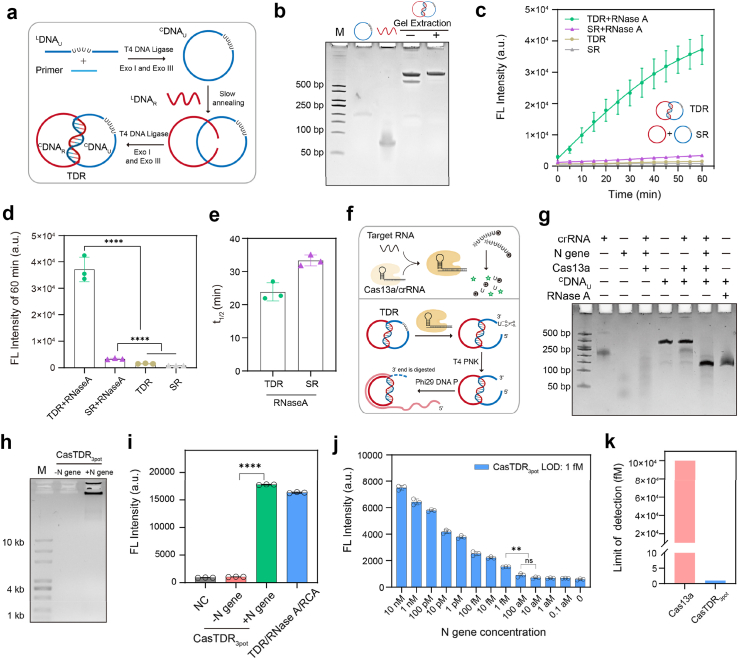
TDR-based post amplification for sensitive detection of viral RNAs. (a) Schematic of the preparation of topologically constrained DNA rings (TDR). (b) PAGE analysis of the self-assembly process of TDR. Line 1: 50 bp DNA Marker; Line 2: CDNAU; Line 3: LDNAR; Line 4: TDR and its tautomer; Line 5: TDR recovered by gel extraction (tautomer removed). (c) Real-time fluorescence profiles of RCA using TDR and two single rings (SR) upon the addition of RNase A. n = 3, data show mean ± SD. (d and e) Fluorescence intensity d) and t1/2 e) of TDR or SR at 60 min. (f) Schematic of TDR response to Cas13a/crRNA trans-cleavage activity and trigged RCA. (g) Cleavage of CDNAU by Cas13a trans-cleavage activity analysed using 12% denaturing PAGE. (h and i) RCA reactions of activating Cas13a-initiated TDR in the presence of N gene were analysed using 1% agarose gel electrophoresis h) and in vitro fluorescence assay i). (j) Fluorescence of CasTDR3pot assay in a dilution series of N gene. n = 3 biologically independent experiments, data show mean ± SD. (k) The limit of detection of Cas13a assay and CasTDR3pot assay. Statistical analysis was calculated via one-way ANOVA with Tukey's post-test (∗∗P < 0.01; ∗∗∗∗P < 0.0001; ns: no significant difference).
Fig. 4
Fig. 4
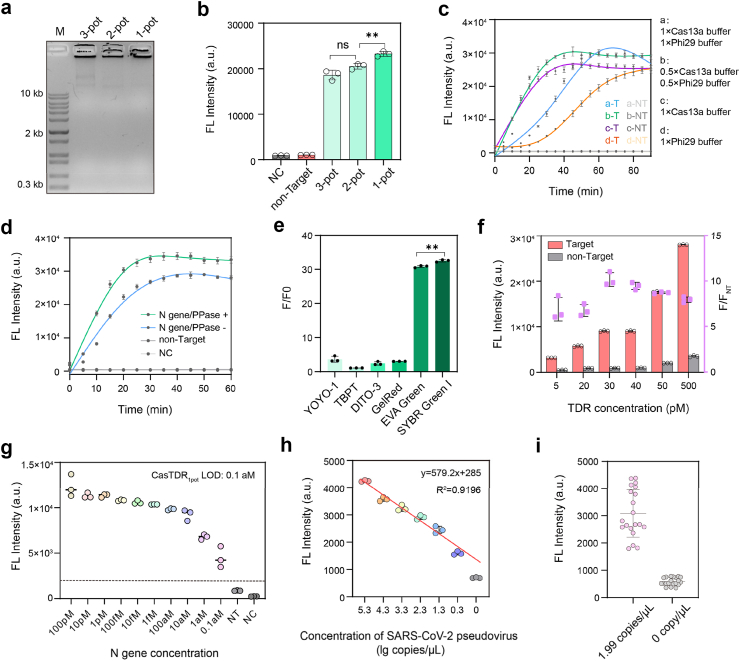
Construction of one-pot CasTDR assay. (a and b) Analysis of the feasibility of integrating the three-step assay into a one-pot method using 1% agarose gel electrophoresis a) and in vitro fluorescence assay b). n = 3, data show mean ± SD. (c) Optimisation of buffering conditions. (d) Fluorescence kinetics of the one-pot assay with or without pyrophosphatase. (e) The signal-to-noise ratio of the assay using different nucleic acid dyes. n = 3, data show mean ± SD. (f) Fluorescence response to the N gene under different concentrations of TDR. n = 3 biologically independent experiments, data show mean ± SD. (g) Fluorescence of the CasTDR1pot assay in a dilution series of N gene. n = 3 biologically independent experiments, data show mean ± SD. (h) Fluorescence of the CasTDR1pot assay in the tested dilution series of SARS-CoV-2 pseudo viruses. (i) Detection of SARS-CoV-2 pseudo virus with a final concentration of 1.99 copies/μL in a 20 μL system using CasTDR1pot assay, 20 biological replicates were determined after 20 min (n = 20). Statistical analysis was calculated via one-way ANOVA with Tukey's post-test (∗∗P < 0.01; ns: no significant difference).
Fig. 5
Fig. 5
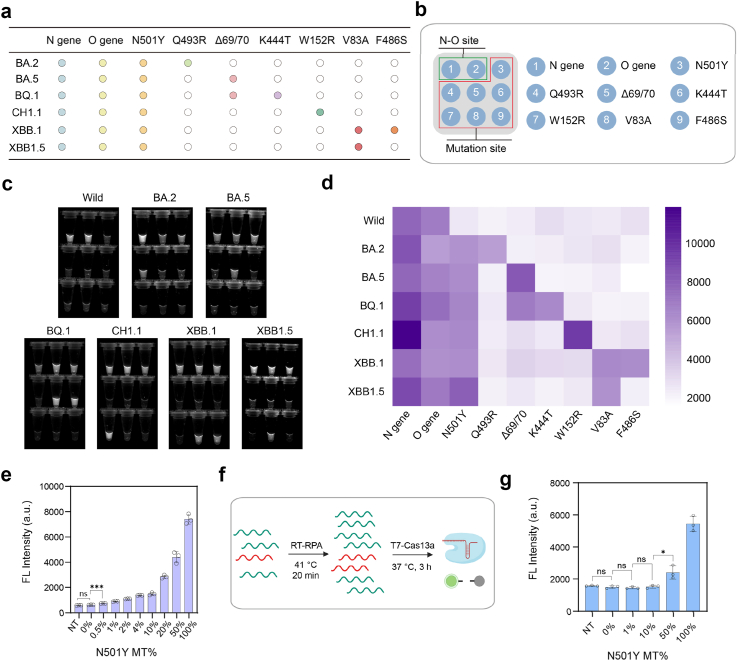
Detection of SARS-CoV-2 Omicron and its subvariants. (a) Mutation information of variants of concern including BA.2, BA.5, BQ.1, CH1.1, XBB.1, and XBB1.5 variants. (b) Schematic of combinatorial coding to determine the subtypes of Omicron. (c) Visual detection of SARS-CoV-2 wild type, BA.2, BA.5, BQ.1, CH1.1, XBB.1, and XBB1.5. (d) Heat map of the fluorescence tested in c). n = 3 biologically independent experiments. (e) Detection of low abundance N501Y mutated RNA using CasTDR1pot. n = 3 biologically independent experiments, data show mean ± SD. (f and g) Detection of serially diluted N501Y RNA using Cas13a-based RPA method. Left, schematic of the assay. Right, fluorescence intensity for testing dilution series of N501Y RNA. n = 3 biologically independent experiments, data show mean ± SD. For e) and g), statistical analysis was calculated via one-way ANOVA with Tukey's post-test (∗P < 0.05; ∗∗∗P < 0.001; ns: no significant difference).
Fig. 6
Fig. 6
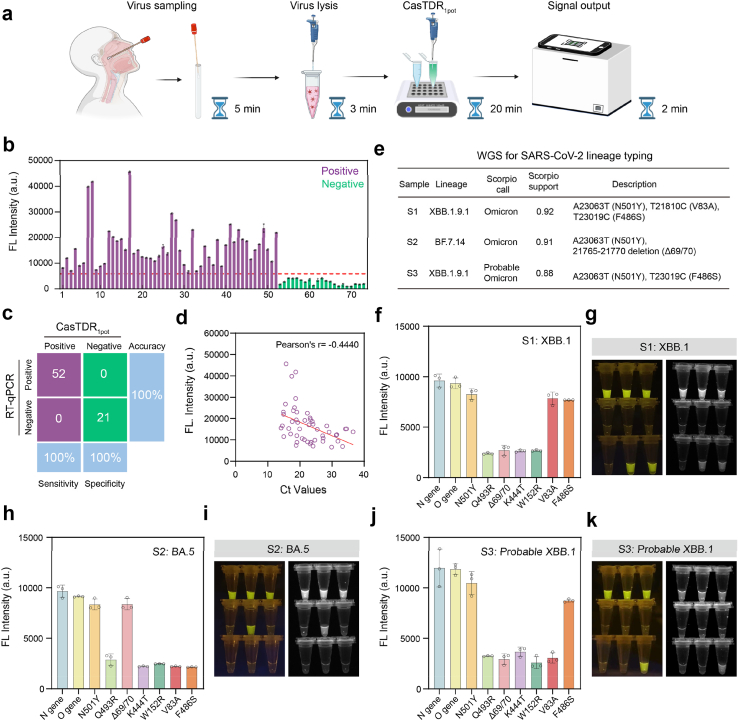
Detection of SARS-CoV-2 and its variants infection in unextracted clinical samples. (a) Streamline detection of SARS-CoV-2 variants in clinical samples using CasTDR1pot. (b) Tested 73 clinical samples using CasTDR1pot. The threshold line is the mean readout value of controls plus 3 standard deviations. (c) Confusion matrix of samples tested by CasTDR1pot and RT-qPCR in panel b). (d) Correlation between the parallel measurements by CasTDR1pot and RT-qPCR for SARS-CoV-2. (e) Whole genome sequencing for SARS-CoV-2 lineage typing of three clinical samples. (f–k) CasTDR1pot identification of XBB.1 (f and g), BA.5 (h and i), and probable XBB.1 (j and k) in clinical samples, which was consistent with whole genome sequencing.

Similar articles

Cited by

References

    1. Singh K., Mehta D., Dumka S., et al. Quasispecies nature of RNA viruses: lessons from the past. Vaccines (Basel) 2023;11(2) - PMC - PubMed
    1. Kockler Z.W., Gordenin D.A. From RNA world to SARS-CoV-2: the edited story of RNA viral evolution. Cells. 2021;10(6) - PMC - PubMed
    1. Xiao M., Tian F., Liu X., et al. Virus detection: from state-of-the-art laboratories to smartphone-based point-of-care testing. Adv Sci (Weinh) 2022;9(17) - PMC - PubMed
    1. Seok Y., Mauk M.G., Li R., et al. Trends of respiratory virus detection in point-of-care testing: a review. Anal Chim Acta. 2023;1264 - PMC - PubMed
    1. Carter L.J., Garner L.V., Smoot J.W., et al. Assay techniques and test development for COVID-19 diagnosis. ACS Cent Sci. 2020;6(5):591–605. - PMC - PubMed

MeSH terms