


Migrasomes derived from human umbilical cord mesenchymal stem cells: a new therapeutic agent for ovalbumin-induced asthma in mice
- PMID: 39865246
- PMCID: PMC11770983
- DOI: 10.1186/s13287-025-04145-4
Migrasomes derived from human umbilical cord mesenchymal stem cells: a new therapeutic agent for ovalbumin-induced asthma in mice
Abstract
Background: Asthma is a prevalent respiratory disease, and its management remains largely unsatisfactory. Mesenchymal stem cells (MSCs) have been demonstrated to be efficacious in reducing airway inflammation in experimental allergic diseases, representing a potential alternative treatment for asthma. Migrasomes are recently identified extracellular vesicles (EVs) generated in migrating cells and facilitate intercellular communication. The objective of this study was to investigate the therapeutic effects of migrasomes obtained from MSC in a model of asthma.
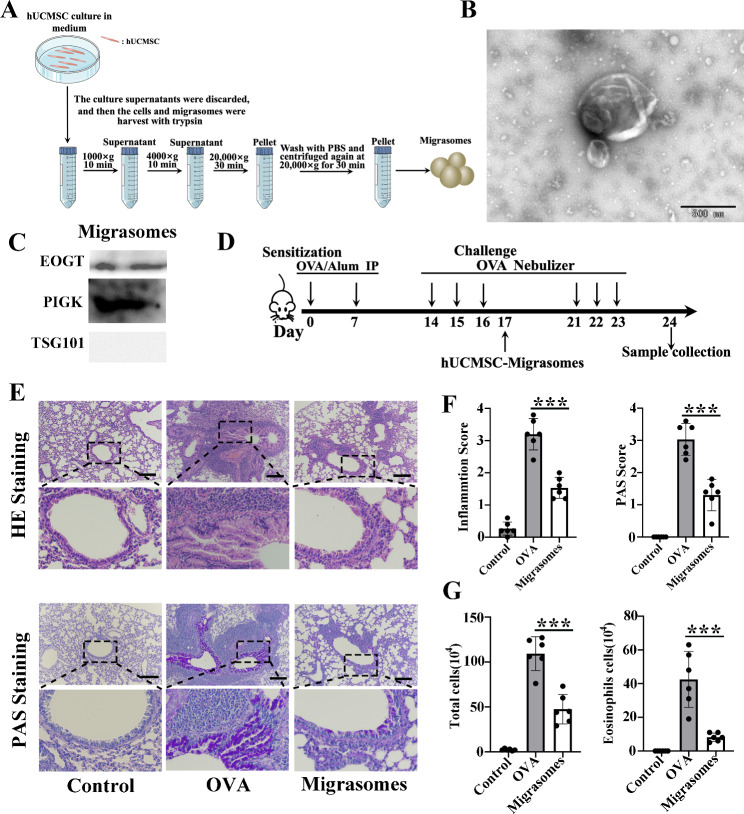
Methods: Migrasomes produced by human umbilical cord MSCs (hUCMSCs) were isolated by sequential centrifugation. Characterization of hUCMSC-derived migrasomes were carried out by transmission electron microscopy and western blot analysis. The therapeutic effects of migrasomes on airway inflammation in ovalbumin (OVA)-induced asthmatic mice were evaluated by hematoxylin-eosin (HE) and periodic-acid schiff (PAS) staining, and their mechanism were further testified by immunofluorescent staining, real-time PCR and flow cytometry.
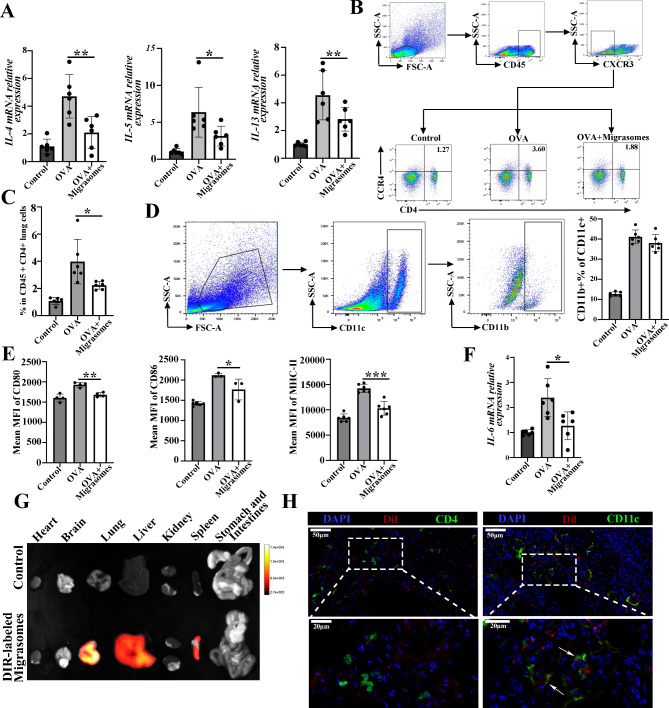
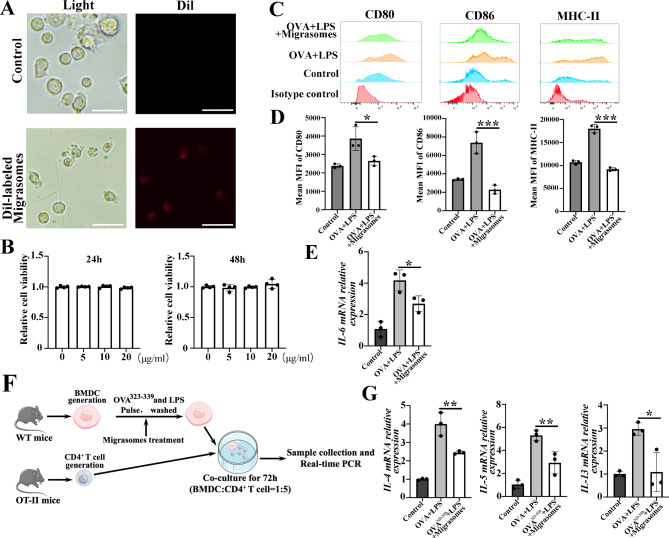
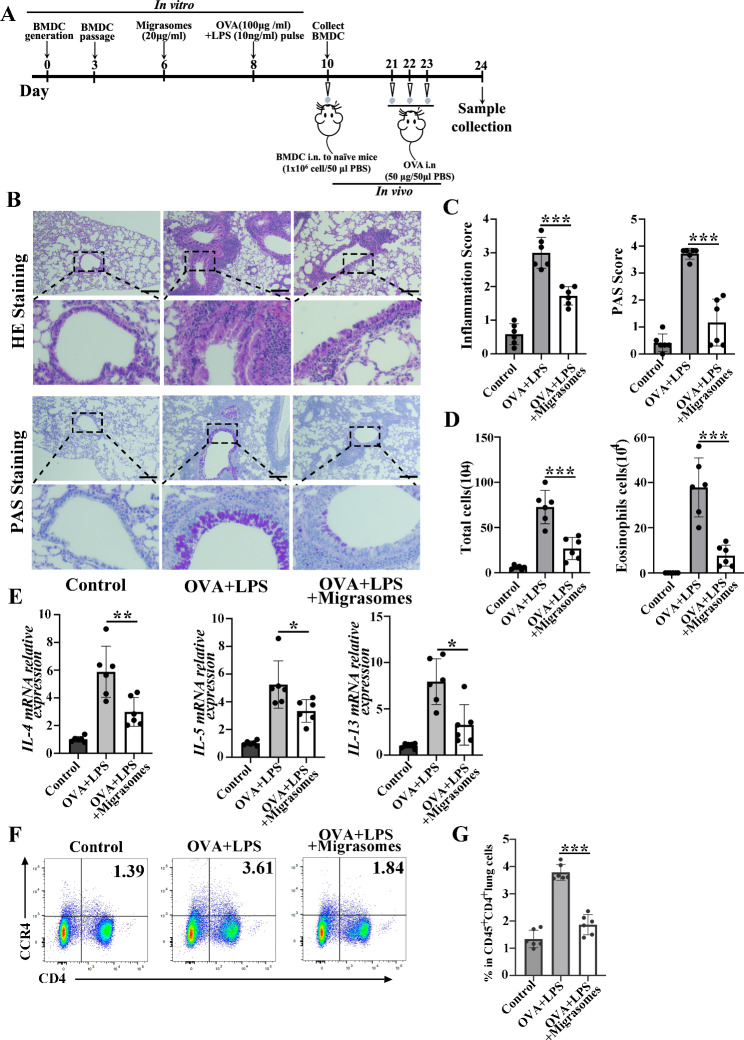
Results: Here, we showed that inhibition of migrasomes' production dramatically impaired the anti-inflammatory effects of hUCMSCs in OVA animals, as evidenced by a notable increase in both the infiltration of inflammatory cells and the number of epithelial goblet cells. We successfully isolated hUCMSC-migrasomes, which were morphologically intact and positive for the specific migrasomes markers. The administration of hUCMSC-migrasomes was observed to significantly ameliorate the symptoms of airway inflammation and mucus production in asthmatic mice. Additionally, the expression of Th2 cytokines (IL-4, IL-5 and IL-13) were found to be reduced, while the activation of dendritic cells (DCs) was inhibited. HUCMSC-migrasomes could possibly be delivered to lung region after injection, and were able to be taken in by DCs both in vivo and in vitro. Notably, in vitro, migraosmes decreased the capacity of BMDCs to stimulate OVA-specific Th2-cell responses. More importantly, we found that adoptive transfer of hUCMSC-migrasomes-treated BMDCs was sufficient to protect mice from allergic airway inflammation. In addition, we found that hUCMSC-migrasomes inhibited the receptor for advanced glycation end-products (RAGE) signal in OVA-treated BMDCs in vitro and in asthma mice lung in vivo.
Conclusion: Our results provided the first evidence that hUCMSC-migrasomes possess anti-inflammatory properties in OVA-induced allergic mice, which may provide a novel "MSC-cell free" therapeutic agent for the management of asthma.
Keywords: Asthma; Dendritic cells; Human umbilical cord mesenchymal stem cells; Migrasomes; Th2 cells.
© 2025. The Author(s).
Conflict of interest statement
Declarations. Ethics approval and consent to participate: Human umbilical cord samples were obtained from mothers who provided informed consent at the Affiliated Hospital of Jiangsu University, and the protocol was reviewed and approved by the Ethics Committee of the Affiliated Hospital of Jiangsu University (Project title: Extracellular vesicles released from hUCMSC inhibit IL-13 mediated HSC activation and alleviate schistosomiasis liver pathology; No: SWYXLL20200121-22; Date of approval: 2020-01-21). Animal experiments were approved by the Institutional Animal Care and Use Committee of Jiangsu University (Project title: Mechanism and clinical translation of hUCMSC-derived extracellular vesicles for asthma intervention; No. UJS-IACUC-AP-2023050902; Date of approval: 2023-05-09). Animal welfare was ensured in accordance with the Guide for the Care and Use of Laboratory Animals. Consent for publication: Not applicable. Competing interests: The authors declare that they have no competing interests.
Figures


References
-
- King-Biggs MB, Asthma. Ann Intern Med. 2019;171(7):ITC49–64. 10.7326/AITC201910010. - PubMed
MeSH terms
Substances
Grants and funding
LinkOut - more resources
Full Text Sources
Medical
