


Experience-based food insecurity in Bangladesh: Evidence from Household Income and Expenditure Survey 2022
- PMID: 39866494
- PMCID: PMC11761291
- DOI: 10.1016/j.heliyon.2024.e41581
Experience-based food insecurity in Bangladesh: Evidence from Household Income and Expenditure Survey 2022
Abstract
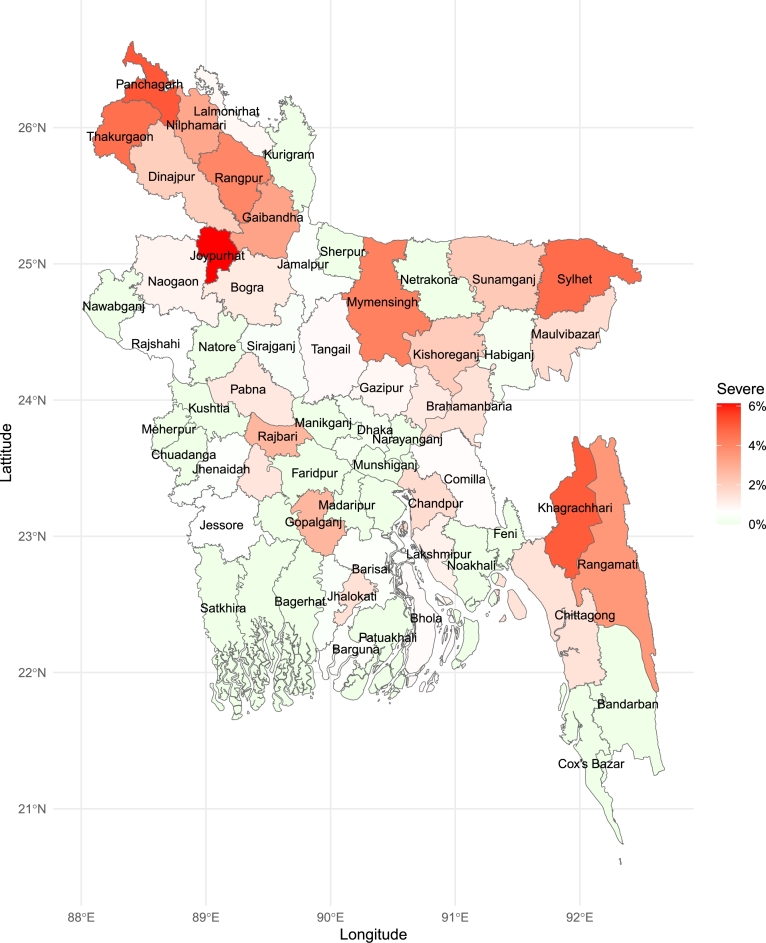
This paper examines the current state of food insecurity in Bangladesh and its socio-economic drivers using data from the latest Household Income and Expenditure Survey (HIES 2022). Unlike previous studies that relied on less precise measures of food insecurity, such as food expenditure, diversity, and calorie intake, this study employs the internationally recognized Food Insecurity Experience Scale (FIES) and Rasch model-based thresholds to classify households as food secure or insecure. Multilevel logistic regression is used to identify significant predictors of moderate and severe food insecurity, considering the hierarchical structure of the data, with households nested within geographical clusters. Key factors found to be significantly associated with food security include the wealth index, land ownership, education of the household head, family size, remittance income and exposure to shocks. A classification tree, a popular machine learning method, is also applied to explore important interactions among these determinants. The tree analysis confirms the importance of several regression-based predictors and identifies households at the highest risk of food insecurity through variable interactions. Factors such as poverty, lack of land ownership, low education levels, and high dependency ratios collectively increase a household's vulnerability to moderate food insecurity to around 51% while the national prevalence is 19%. District-level maps of food insecurity prevalence reveal significant regional disparities, underscoring the need for targeted, district-specific interventions to effectively combat food insecurity. More broadly, policies promoting education and family planning, training in better shock management, and facilitating remittance flows through simplified processes may contribute to addressing the food insecurity challenge.
Keywords: Bangladesh; Classification tree; Food insecurity; Food insecurity experience scale; Multilevel logistic regression; Rasch model; Variable importance.
© 2025 The Author(s).
Conflict of interest statement
The authors declare that they have no known competing financial interests or personal relationships that could have appeared to influence the work reported in this paper.
Figures


References
-
- UN, Transforming our world: the 2030 agenda for sustainable development, United Nations: New York, NY, USA, 2015.
-
- FAO, IFAD, UNICEF, WFP, WHO . Food & Agriculture Org; 2023. The State of Food Security and Nutrition in the World 2023: Urbanization, Agrifood Systems Transformation and Healthy Diets Across the Rural–Urban Continuum, vol. 2023.
-
- Avery A. Food insecurity and malnutrition. Komp. Nutr. Diet. 2021;1(2):41–43.
LinkOut - more resources
Full Text Sources
