


An evolutionary perspective for the exposome
- PMID: 39867564
- PMCID: PMC7617335
- DOI: 10.1093/exposome/osae008
An evolutionary perspective for the exposome
Abstract
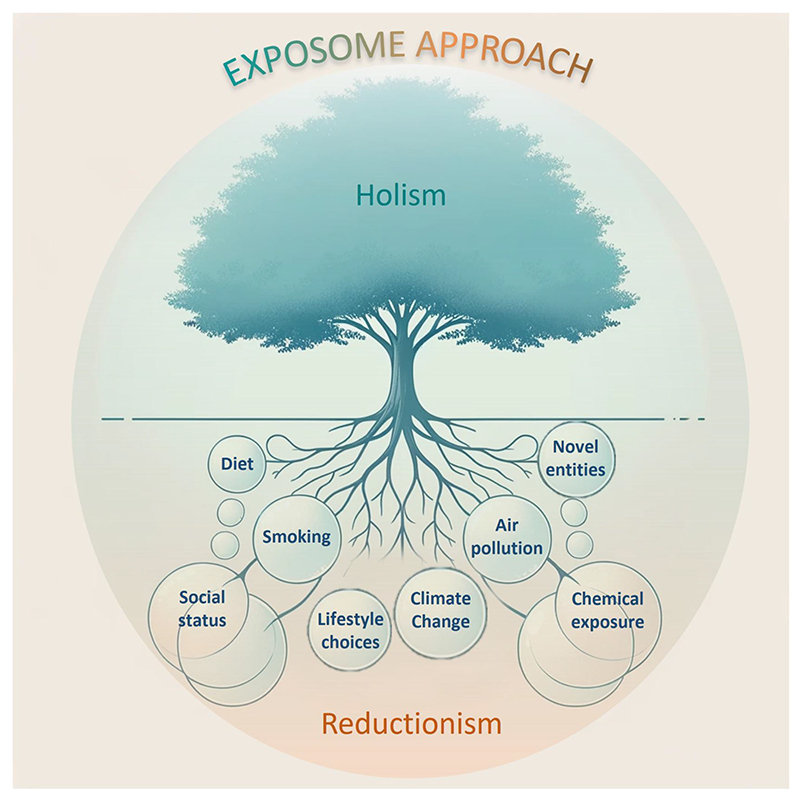
The exposome was proposed following the realization that most human diseases have an environmental rather than a genetic (hereditary) origin. Non-communicable diseases are, in fact, the consequence of multiple exposures that activate a sequence of stages in a multistage process that already starts in early life. This attracted attention to both the multiplicity (in fact, potentially the totality) of exposures humans are exposed to since conception and to the life-long perspective of disease causation. In this paper, we examine an extension of the exposome concept that incorporates a Darwinian approach based on the concept of phenotypic plasticity. One of the theses is that interpreting exposome science as "precision environmental research" is only a partial interpretation, largely focused on chemical exposures, while a broadening of the perspective is needed, also in light of the planetary crisis. Such broadening involves the incorporation of basic concepts from evolutionary biology and medicine, including the ability of organisms to adapt to rapidly changing environments. We refer in particular to cancer and "Darwinian carcinogenesis."
Keywords: agnostic research; environment; evolutionary theory; human health; phenotypic plasticity; theory-driven research.
Conflict of interest statement
Conflict of interest statement None declared.
Figures
References
-
- Wild CP. The exposome: from concept to utility. Int J Epidemiol. 2012;41(1):24–32. - PubMed
-
- Haenszel W, Kurihara M, Segi M, Lee RK. Stomach cancer among Japanese in Hawaii. J Natl Cancer Inst. 1972;49(4):969–988. - PubMed
-
- Ahmedin J, Vineis P, Bray F, Torre L, Forman D. Cancer Atlas, American Cancer Society. 2014
LinkOut - more resources
Full Text Sources