


Time-dependent recovery of renal impairment in patients with newly diagnosed multiple myeloma
- PMID: 39870910
- PMCID: PMC11868295
- DOI: 10.1007/s00277-025-06201-8
Time-dependent recovery of renal impairment in patients with newly diagnosed multiple myeloma
Abstract
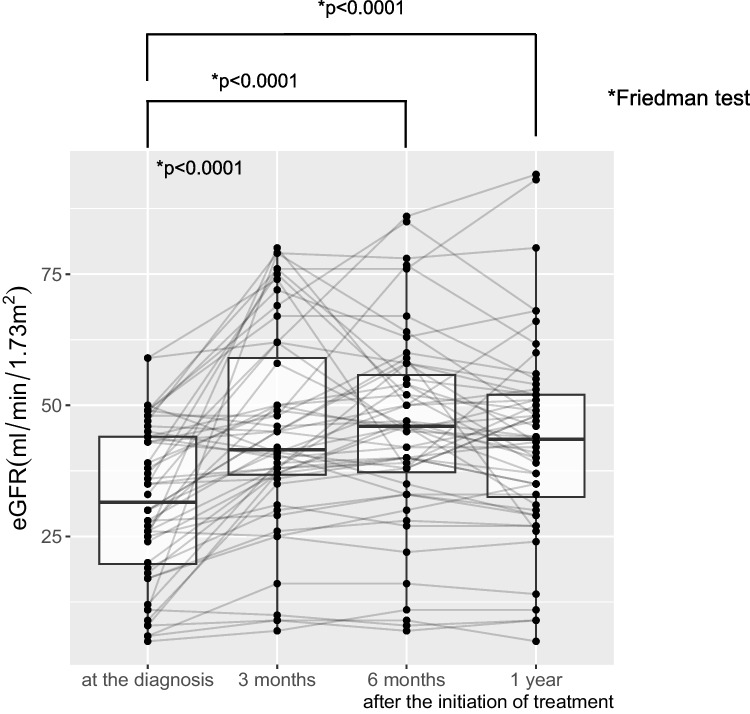
Renal impairment is reported in 20%-50% of patients with newly diagnosed multiple myeloma and is known as a poor prognostic factor. Although several studies have demonstrated that treatment with novel antimyeloma agents improves renal impairment and myeloma itself, the time-dependent clinical course of recovery of renal function has not been extensively studied. We retrospectively collected the data of characteristics and outcomes in consecutive unselected patients diagnosed with and treated for symptomatic multiple myeloma between January 2015 and December 2022, and extracted and analyzed the cases with renal impairment. Among 234 patients with multiple myeloma, 67 (28.6%) had renal impairment (estimated glomerular filtration rate (eGFR) < 60 ml/min/1.73m2) at the time of diagnosis. The median eGFR at diagnosis was 28 ml/min/1.73m2, and the eGFR significantly improved to 41.5 ml/min/1.73m2, which corresponds to a 42.9% increase, at 3 months after the initiation of treatment for myeloma (p < 0.0001). Further improvement in renal function was not observed at 6 months (eGFR 46 ml/min/1.73m2) and 1 year (eGFR 43.5 ml/min/1.73m2) after treatment initiation. The primary treatment was a bortezomib-containing regimen in approximately 90% of patients. A post hoc analysis revealed a positive correlation between the serum calcium concentration at diagnosis and improvement in renal function. In conclusion, renal function can partially recover through the treatment of multiple myeloma, and the treatment response during the first 3 months may predict the renal function prognosis. Further accumulation of cases is needed to identify the predictive factors for renal recovery.
Keywords: Multiple myeloma; Myeloma kidney; Renal function; Renal impairment; eGFR.
© 2025. The Author(s).
Conflict of interest statement
Declarations. Ethics approval: This study was approved by the review board of our institution (approval no. 834–01; approval date: 27th April 2023) and was performed in accordance with the ethical standards as laid down in the 1964 Declaration of Helsinki and its later amendments or comparable ethical standards. Informed consent: Opt-out information was prominently displayed on the web page of Japanese Red Cross Narita Hospital. Conflict of interest: The authors declare no competing interests.
Figures

References
-
- Knudsen LM, Hjorth M, Hippe E (2000) Renal failure in multiple myeloma: reversibility and impact on the prognosis. Nordic Myeloma Study Group. Eur J Haematol 65(3):175–181 - PubMed
-
- Kyle RA, Gertz MA, Witzig TE, Lust JA, Lacy MQ, Dispenzieri A, Fonseca R, Rajkumar SV, Offord JR, Larson DR et al (2003) Review of 1027 patients with newly diagnosed multiple myeloma. Mayo Clin Proc 78(1):21–33 - PubMed
-
- Eleutherakis-Papaiakovou V, Bamias A, Gika D, Simeonidis A, Pouli A, Anagnostopoulos A, Michali E, Economopoulos T, Zervas K, Dimopoulos MA et al (2007) Renal failure in multiple myeloma: incidence, correlations, and prognostic significance. Leuk Lymphoma 48(2):337–341 - PubMed
-
- Fotiou D, Dimopoulos MA, Kastritis E (2016) Managing renal complications in multiple myeloma. Expert Rev Hematol 9(9):839–850 - PubMed
-
- Augustson BM, Begum G, Dunn JA, Barth NJ, Davies F, Morgan G, Behrens J, Smith A, Child JA, Drayson MT (2005) Early mortality after diagnosis of multiple myeloma: analysis of patients entered onto the United kingdom Medical Research Council trials between 1980 and 2002–Medical Research Council Adult Leukaemia Working Party. J Clin Oncol 23(36):9219–9226 - PubMed
MeSH terms
Substances
LinkOut - more resources
Full Text Sources
Medical
Research Materials
Miscellaneous
