. 2025 Jan 27;26(1):75.
doi: 10.1186/s12864-025-11209-5.

The multi-omics signatures of telomere length in childhood

Affiliations

The multi-omics signatures of telomere length in childhood

Congrong Wang et al. BMC Genomics. .

Abstract

Background: Telomere length is an important indicator of biological age and a complex multi-factor trait. To date, the telomere interactome for comprehending the high-dimensional biological aspects linked to telomere regulation during childhood remains unexplored. Here we describe the multi-omics signatures associated with childhood telomere length.

Methods: This study included 1001 children aged 6 to 11 years from the Human Early-life Exposome (HELIX) project. Telomere length was quantified via qPCR in peripheral blood of the children. Blood DNA methylation, gene expression, miRNA expression, plasma proteins and serum and urinary metabolites were measured through microarrays or (semi-) targeted assays. The association between each individual omics feature and telomere length was assessed in omics-wide association analyses. In addition, a literature-guided, sparse supervised integration method was applied to multiple omics, and latent components were extracted as predictors of child telomere length. The association of these latent components with early-life aging risk factors (child lifestyle, body mass index (BMI), exposure to smoking, etc.), were interrogated.

Results: After multiple-testing correction, only two CpGs (cg23686403 and cg16238918 at PARD6G gene) out of all the omics features were significantly associated with child telomere length. The supervised multi-omics integration approach revealed robust associations between latent components and child BMI, with metabolites and proteins emerging as the primary contributing features. In these latent components, the contributing molecular features were known as involved in metabolism and immune regulation-related pathways.

Conclusions: Findings of this multi-omics study suggested an intricate interplay between telomere length, metabolism and immune responses, providing valuable insights into the molecular underpinnings of the early-life biological aging.

Keywords: Biological aging; Early-life; Multi-omics; Telomere length.


Conflict of interest statement

Declarations. Ethics approval and consent to participate: The HELIX study complies with the Declaration of Helsinki. All six cohorts existed for several years before HELIX started, and had undergone the required evaluation by national ethics committees: EDEN received approval from the ethics committee (CCPPRB) of Kremlin Bicêtre and from CNIL (Commission Nationale Informatique et Liberté), the French data privacy institution; BiB received ethics approval from the Bradford Research Ethics Committee; INMA obtained the approval of the ethics committee of each involved hospital or health center; the research protocol of KANC was approved by the Lithuanian Bioethics Committee; MoBa received approval from a Norwegian regional committee for medical and health research ethics; and the ethics committee of the university hospital at Heraklion approved the study protocols of RHEA. An informed consent has been signed by all participants at recruitment and at the follow-up visit for clinical examinations and biospecimen collection. Each cohort also confirmed that relevant informed consent and approval were in place for the secondary use of data from pre-existing data. The work in HELIX was covered by new ethics approvals in each country. The HELIX project received ethical approvals from the Comité Ético de investigación Clínica Parc de Salut MAR. At follow-up enrolment in the HELIX subcohort and panel studies, participants were asked to sign an informed consent for clinical examination and biospecimen collection and analysis. Consent for publication: Not applicable. Competing interests: The authors declare no competing interests.

Figures

Fig. 1
Fig. 1
Flowchart of the participant inclusion. Sample sizes and inclusion/exclusion criteria of the Human Early Life Exposome (HELIX) project and the study populations of the current study
Fig. 2
Fig. 2
Data analysis procedures of the current study. (A) The statistical analyses using two approaches. In Approach I (grey color in the left half), omics-wide association analyses were conducted within each omics to assess the association between each individual feature and telomere length. In Approach II (green color in the right half), multiple (pre-selected) omics were analyzed via a supervised method, multi-block sparse Partial Least Squares (sPLS), against four telomere length measures. (B) The literature-based omics feature pre-selection in genome-wide CpG methylation and gene expression. All green boxes represent procedures based on literature or databases, while the blue box stands for a data-driven filtering of gene transcripts where the transcript with the highest variance within the same gene was selected. Stage ①: significant SNPs from published genome-wide association studies (GWAS’s) of telomere length (TL) were used to extract DNA methylation quantitative trait loci (mQTL) and gene expression quantitative trait loci (eQTL) from publicly accessible databases, which were in turn used to select a first set of CpGs in the DNA methylation data and a first set of transcripts in the gene expression data. Stage ②: genes involved in telomere regulation and two cellular aging-related signaling pathways, mTOR and AMPK pathways, were used to select a second set of gene transcripts, and to extract gene expression quantitative trait methylation (eQTM) from a published study which were then used to select a second set of CpGs. Stage ③: an epigenome-wide association study (EWAS) of TL was used to select a third set of CpGs. All selected CpGs were further filtered considering the probe reliability in the Illumina 450 K array
Fig. 3
Fig. 3
Summary of significance of the omics-wide association analyses with telomere length in HELIX children. All omics features are shown as points by -log10-transformed nominal p-value versus the omics and the type of model. Omics-wide significant features under Bonferroni correction are colored red. The top molecular features were labeled with the corresponding gene/metabolite names. Models were adjusted for key covariates: child age, sex, the first four genetic PCs and the estimated blood cell compositions
Fig. 4
Fig. 4
The proportion of variance explained by the six-component multi-block sPLS model. The model derived six components in each omics block. Displayed are the proportion of variance of each omics explained by each of the components
Fig. 5
Fig. 5
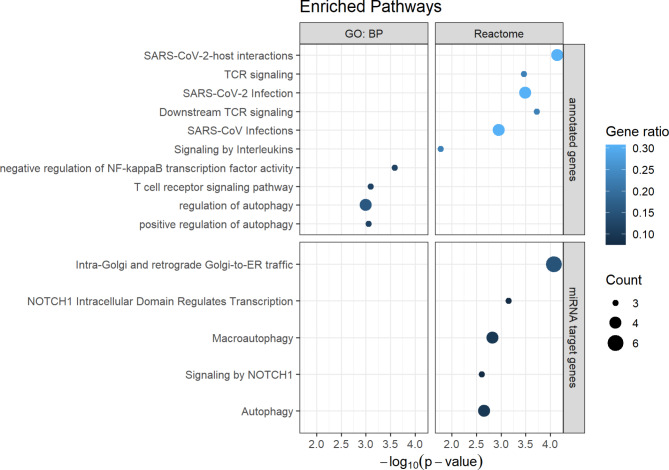
Pathways enriched in the genes suggested by the components mostly related to telomere length. Genes annotated to features from DNA methylation component 2 and component 3, gene expression component 2 and component 5 and miRNA component 4 (upper panels) and target genes of miRNAs in miRNA component 4 (lower panels) were analyzed separately. Enriched pathways shown are with at least 3 genes from the pathways in the query list, and adjusted p-value < 0.10. Databases used for pathway enrichment analyses were gene ontology (GO) of biological process (BP), cellular component (CC) and molecular function (MF), the Reactome pathway database and KEGG. A database is not shown in the figure if no pathways from the database were identified
Fig. 6
Fig. 6
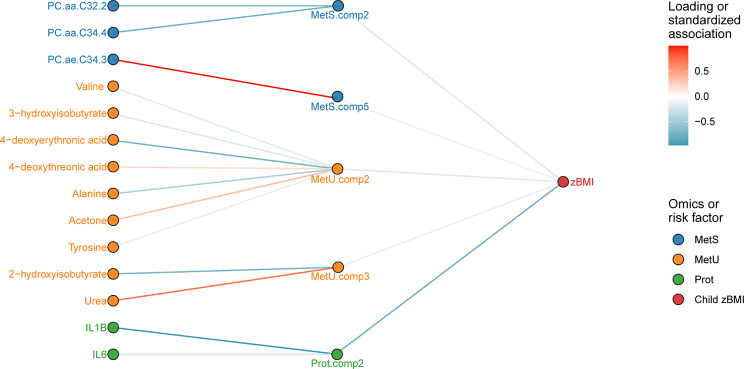
A summary of the relationships of features, components, and aging-related risk factors. Features shown in the left column are those with absolute loadings higher than 0.1 on the corresponding component. Components are in the middle and the early-life aging risk factors are in the right column. Links between the features and components stand for the loadings. Links between the components and risk factors stand for the standardized associations which were identified as significant under Bonferroni correction. The association with the only risk factor, child body mass index (BMI) z-score (zBMI), was estimated in a multiple regression model adjusted for all the other risk factors (gestational age, birth weight, maternal pre-pregnancy BMI, maternal smoking status, maternal education level, parental smoking in the children’s household, family affluence score, child physical activity level and child Mediterranean diet score). MetS: serum metabolites. MetU: urinary metabolites. Prot: plasma proteins

References

    1. Shammas MA. Telomeres, lifestyle, cancer, and aging. Curr Opin Clin Nutr Metab Care. 2011;14(1):28–34. - PMC - PubMed
    1. McHugh D, Gil J. Senescence and aging: causes, consequences, and therapeutic avenues. J Cell Biol. 2018;217(1):65–77. - PMC - PubMed
    1. Fasching CL. Telomere length measurement as a clinical biomarker of aging and disease. Crit Rev Clin Lab Sci. 2018;55(7):443–65. - PubMed
    1. Codd V, Mangino M, van der Harst P, Braund PS, Kaiser M, Beveridge AJ, et al. Common variants near TERC are associated with mean telomere length. Nat Genet. 2010;42(3):197–9. - PMC - PubMed
    1. Lu AT, Seeboth A, Tsai PC, Sun D, Quach A, Reiner AP, et al. DNA methylation-based estimator of telomere length. Aging. 2019;11(16):5895–923. - PMC - PubMed

LinkOut - more resources