


Relationships between orofacial pain and sleep: Analysis of UK biobank and genome-wide association studies data
- PMID: 39873079
- PMCID: PMC11762203
- DOI: 10.1016/j.jds.2024.04.027
Relationships between orofacial pain and sleep: Analysis of UK biobank and genome-wide association studies data
Abstract
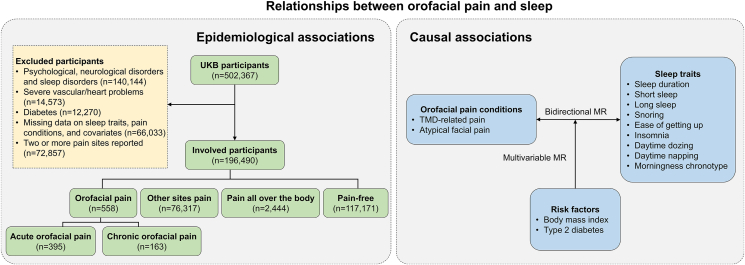
Background/purpose: Orofacial pain is common in dental practices. This study aimed to explore relationships between orofacial pain and sleep using the UK Biobank dataset and, based on epidemiological associations, to investigate the causal association using genome-wide association studies data.
Materials and methods: First, a cross-sectional study was conducted with 196,490 participants from UK Biobank. Information on pain conditions and sleep traits was collected. Multivariable models were used to explore the relationships with odds ratio (OR). Second, Mendelian randomization analyses were conducted using data for orofacial pain, including temporomandibular joint disorders-related pain (n = 377,277) and atypical facial pain (n = 331,749), and sleep traits, including sleep duration (n = 446,118), short sleep (n = 411,934), long sleep (n = 339,926), snoring (n = 359,916), ease of getting up (n = 385,949), insomnia (n = 453,379), daytime dozing (n = 452,071), daytime napping (n = 452,633), and chronotype (n = 403,195).
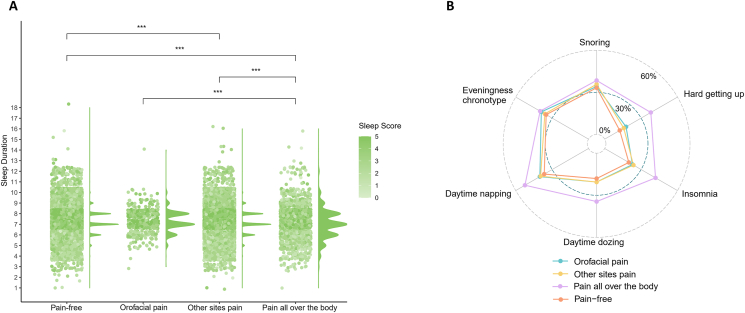
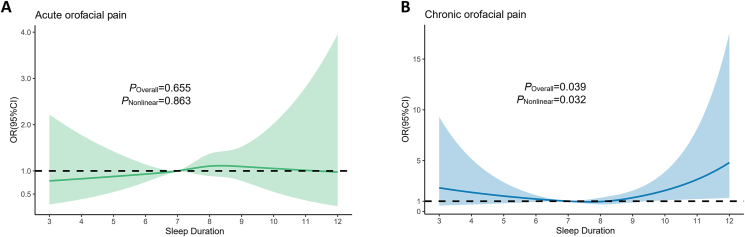
Results: The cross-sectional study confirmed the bidirectionality between pain and sleep. Participants experiencing pain all over the body showed a significant association with an unhealthy sleep pattern (OR = 1.18, P < 0.001) and other sleep traits (P < 0.05). Risks of chronic orofacial pain were associated with sleep duration in a non-linear relationship (P = 0.032). The Mendelian randomization analyses indicated that long sleep was causally associated with temporomandibular joint disorders-related pain (OR = 6.77, P = 0.006).
Conclusion: The relationship between pain and sleep is bidirectional. Long sleep is found to be causally associated with chronic orofacial pain.
Keywords: Orofacial pain; Public health; Sleep; Temporomandibular joint disorders.
© 2024 Association for Dental Sciences of the Republic of China. Publishing services by Elsevier B.Vé.
Conflict of interest statement
The authors have no conflicts of interest relevant to this article.
Figures


References
-
- Linh T.T.D., Ho D.K.N., Nguyen N.N., Hu C.J., Yang C.H., Wu D. Global prevalence of post-COVID-19 sleep disturbances in adults at different follow-up time points: a systematic review and meta-analysis. Sleep Med Rev. 2023;71 - PubMed
-
- Husak A.J., Bair M.J. Chronic pain and sleep disturbances: a pragmatic review of their relationships, comorbidities, and treatments. Pain Med. 2020;21:1142–1152. - PubMed
-
- Andersen M.L., Araujo P., Frange C., Tufik S. Sleep disturbance and pain: a tale of two common problems. Chest. 2018;154:1249–1259. - PubMed
LinkOut - more resources
Full Text Sources
