. 2025 Jan 28;25(1):159.
doi: 10.1186/s12885-025-13510-8.

Refining MR-guided thermal ablation for HCC within the Milan criteria: a decade of clinical outcomes and predictive modeling at a single institution

Affiliations

Refining MR-guided thermal ablation for HCC within the Milan criteria: a decade of clinical outcomes and predictive modeling at a single institution

Fu-Qun Wei et al. BMC Cancer. .

Abstract

Background: The appropriateness of ablation for liver cancer patients meeting the Milan criteria remains controversial.

Purpose: This study aims to evaluate the long-term outcomes of MR-guided thermal ablation for HCC patients meeting the Milan criteria and develop a nomogram for predicting survival rates.

Methods: A retrospective analysis was conducted from January 2009 to December 2021 at a single institution. Patients underwent MR-guided thermal ablation. Factors influencing progression-free survival (PFS) and overall survival (OS) were identified using univariate and multivariate Cox regression and stepwise regression. A nomogram was developed for survival prediction, followed by risk stratification and internal validation. Adverse events (AEs) were also analyzed.

Results: A total of 181 patients were included, with a mean follow-up of 73.8 ± 31.7 months. The cumulative local tumor progression rates at 1, 3, and 5 years were 0.80%, 1.27%, and 1.86%, respectively. The 1-, 3-, and 5-year PFS rates were 81.8%, 57.4%, and 38.1%, and OS rates were 98.3%, 87.8%, and 62.9%. Poorer outcomes were associated with age ≤ 60 years, tumor size > 2 cm, multiple tumors, cirrhosis, proximity to major vessels, and narrow ablation margins (P < 0.05). The nomogram accurately predicted 3- and 5-year survival, and internal validation confirmed the results. AEs occurred in 33.7% of patients, with pain being the most common.

Conclusion: MR-guided ablation is effective for HCC patients within the Milan criteria, especially for those with smaller tumors and better liver function. The nomogram and risk stratification model are valuable tools for predicting patient outcomes and guiding treatment.

Keywords: Hepatocellular carcinoma; Magnetic resonance imaging; Milan criteria; Thermal ablation.


Conflict of interest statement

Declarations. Competing interests: The authors declare no competing interests.

Figures
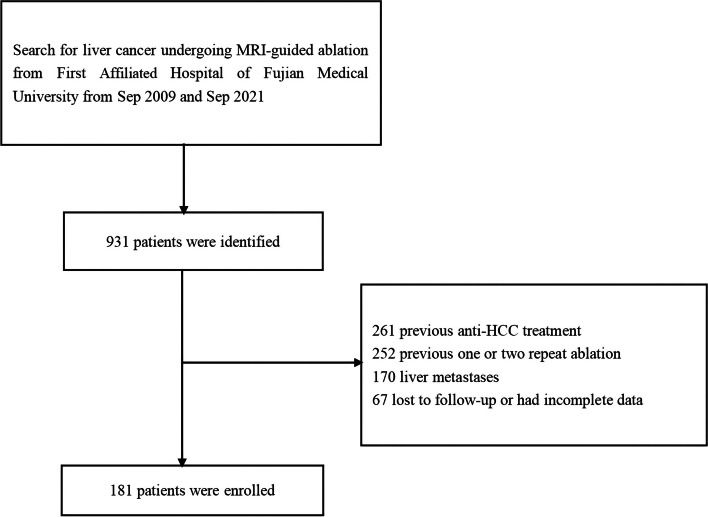
Fig. 1
Fig. 1
Enrollment flow chart
Fig. 2
Fig. 2
MR-guided microwave ablation in a 63-year-old male patient with hepatocellular carcinoma. a Axial enhanced arterial phase MRI shows significant enhancement in the tumor nodule. b Axial non-contrast CT and (c) axial T1-weighted imaging show unclear nodule delineation. d Localization with gadolinium-ethoxybenzyl-diethylenetriaminepentaacetic acid demonstrates the tumor clearly in hepatobiliary phase imaging. Post-ablation, (e) axial T1-weighted imaging reveals the nodule encompassed by a hyperintense rim, and (f) the ablation zone appears hypointense on axial T2-weighted imaging
Fig. 3
Fig. 3
MR-guided RFA in a 59-year-old male patient with hepatocellular carcinoma. Pre-RFA, (a) axial T2-weighted imaging reveals high signal intensity within the tumor. b Axial T1-weighted imaging demonstrates low signal intensity. c Contrast-enhanced MRI shows high signal intensity in the area. Following the placement of the radiofrequency electrode at the nodule's edge, (d) axial T1-weighted and coronal 3D T1-weighted imaging (e) confirms complete nodule overlap. Immediately after RFA, axial T2-weighted imaging showed the nodule fully replaced by low signal intensity (f). Complete tumor ablation was confirmed at the 2-month follow-up using enhanced MRI (g, h, i)
Fig. 4
Fig. 4
MR-guided MWA in a 45-year-old female patient with hepatocellular carcinoma. Pre-MWA, (a) axial T2-weighted imaging reveals high signal intensity within the tumor. b Axial T1-weighted imaging demonstrates low signal intensity. c Contrast-enhanced MRI shows high signal intensity in the area. The microwave electrode was precisely inserted into the tumor nodule, as seen on (d) axial T1-weighted imaging. Immediately after MWA, (e) axial T1-weighted imaging shows the nodule encompassed by a hyperintense rim, and (f) the ablation zone appears hypointense on axial T2-weighted imaging. Complete tumor ablation is confirmed at the 2-month follow-up using enhanced MRI (g, h, i)
Fig. 5
Fig. 5
Kaplan-Meier survival analysis for all patients. a Overall survival probability. b Progression-free survival. c Cumulative incidence plot of local tumor progression. d Survival curves stratified by different relapse patterns
Fig. 6
Fig. 6
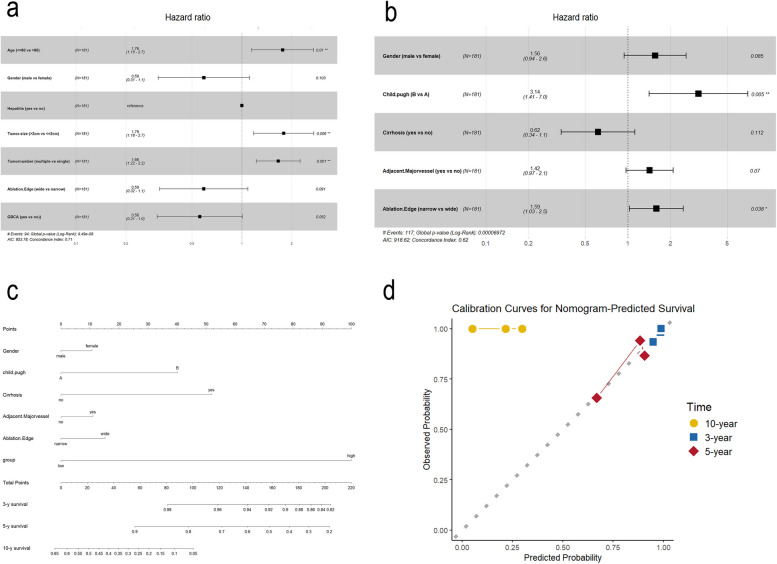
Prognostic factors influencing overall and progression-free survival. a Forest plot of hazard ratios for PFS. b Forest plot showing hazard ratios for additional prognostic factors impacting OS. c Nomogram predicting 3-, 5-, and 10-year survival probabilities based on key variables. d Calibration curves for nomogram-predicted survival at 3, 5, and 10 years
Fig. 7
Fig. 7
Kaplan-Meier analysis of OS and PFS in all patients and the internal validation cohort based on risk scores. a Overall survival curves by risk groups. b Progression-free survival curves by risk groups. c Overall survival curves for the internal validation cohort. d Progression-free survival curves for the internal validation cohort

References

    1. Yang JD, Hainaut P, Gores GJ, Amadou A, Plymoth A, Roberts LR. A global view of hepatocellular carcinoma: trends, risk, prevention and management. Nat Rev Gastroenterol Hepatol. 2019;16(10):589–604. - DOI - PMC - PubMed
    1. Siegel RL, Miller KD, Fuchs HE, Jemal A. Cancer Statistics, 2021. CA Cancer J Clin. 2021;71(1):7–33. - DOI - PubMed
    1. Vogel A, Meyer T, Sapisochin G, Salem R, Saborowski A. Hepatocellular carcinoma. Lancet. 2022;400(10360):1345–62. - DOI - PubMed
    1. Koga H, Iwamoto H, Suzuki H, Shimose S, Nakano M, Kawaguchi T. Clinical practice guidelines and real-life practice in hepatocellular carcinoma: a Japanese perspective. Clin Mol Hepatol. 2023;29(2):242–51. - DOI - PMC - PubMed
    1. Song KD, Lee MW, Rhim H, Kang TW, Cha DI, Sinn DH, Lim HK. Percutaneous US/MRI fusion-guided radiofrequency ablation for recurrent subcentimeter hepatocellular carcinoma: technical feasibility and therapeutic outcomes. Radiology. 2018;288(3):878–86. - DOI - PubMed

MeSH terms

LinkOut - more resources