


Private sector delivery of care for maternal and newborn health: trends over a decade in the Indian state of Bihar
- PMID: 39875877
- PMCID: PMC11776212
- DOI: 10.1186/s12916-025-03894-6
Private sector delivery of care for maternal and newborn health: trends over a decade in the Indian state of Bihar
Abstract
Background: We synthesised the current evidence in coverage and quality of delivery care, change in neonatal mortality (NMR), and causes of neonatal death in the private sector deliveries in the Indian state of Bihar from 2011 to 2021.
Methods: Women aged 15-49 years with livebirths were interviewed in three household surveys involving state-representative samples in 2011, 2016 and 2020-2021 designed to document the coverage of maternal and newborn health services and change in NMR over time. Verbal autopsy interviews were used to assign the cause of neonatal death. The coverage of private sector facilities for livebirths in each survey and the percent change over time by 38 districts in the state and select socio-demographic characteristics, along with trends in NMR and causes of neonatal death across years are reported.
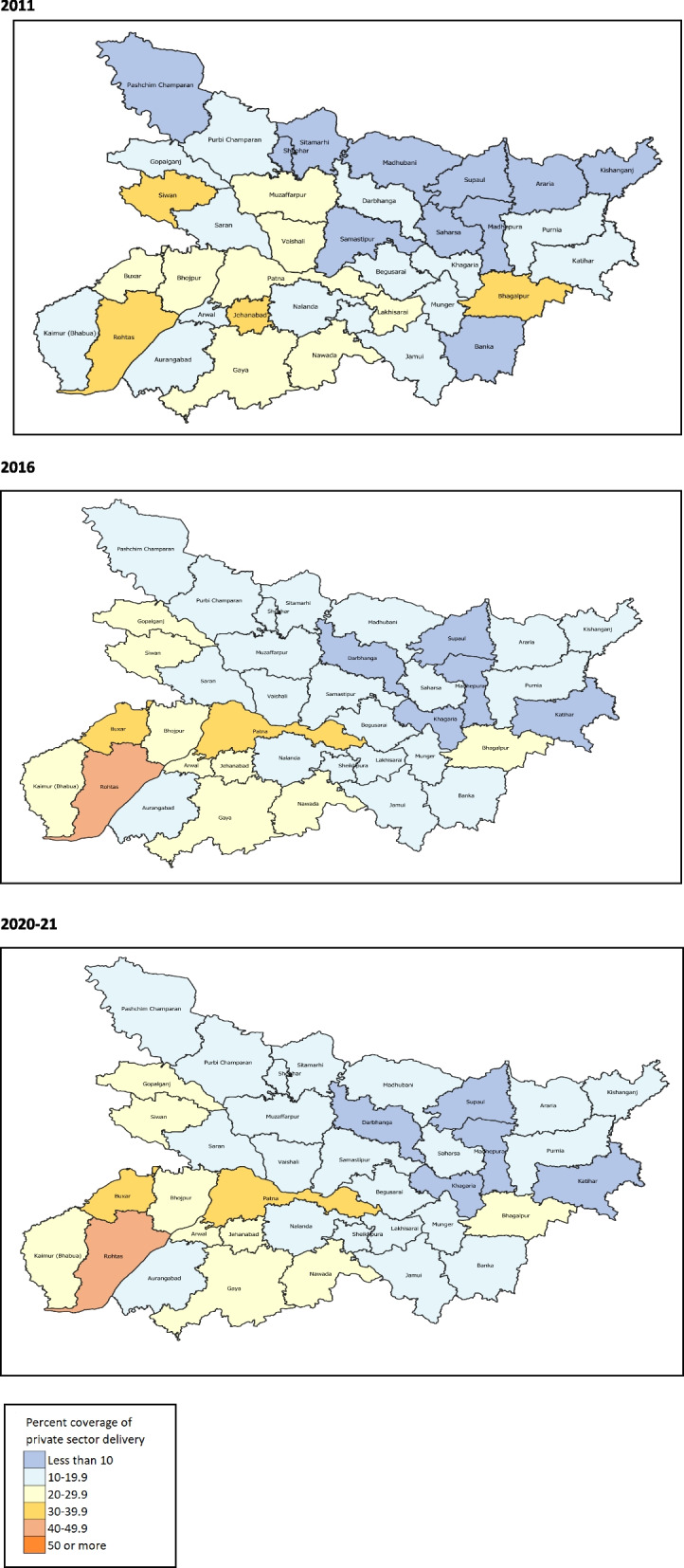
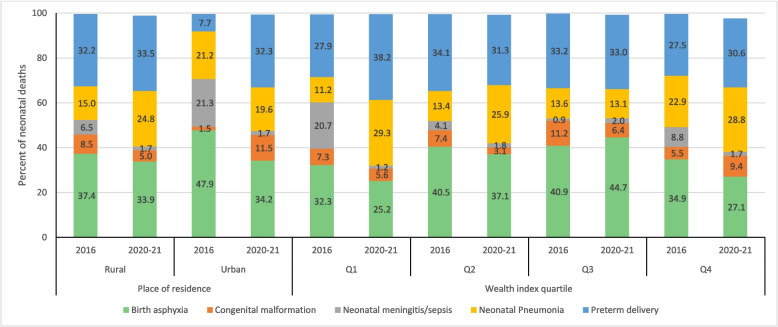
Results: Private sector delivery coverage was 17.3% (95% CI = 16.6-17.9), 16.7% (95% CI = 16.2-17.2) and 26.1 (95% CI = 25.6-26.6) in 2011, 2016 and 2020-2021, respectively. A significant increase of 56.3% (95% CI = 49.3 to 63.3) in this coverage was documented between 2016 and 2020-2021 with the highest increase in the lowest wealth index quartile in urban areas. The district-wise coverage of private sector delivery ranged from 4.6% to 34.9%, 5.5% to 40.7%, and 5.9% to 62.0% in 2011, 2016 and 2020-2021, respectively. NMR was estimated at 41.3 (95% CI = 31.4-51.2), 36.6 (95% CI = 29.4-43.8), 38.6 (95% CI = 34.4-43.3) per 1000 livebirths in 2011, 2016 and 2020-2021, with no significant change over the years. Birth asphyxia was the leading cause of death in 2016 (37.8%) and 2020-2021 (33.9%) followed by preterm delivery and neonatal pneumonia; a statistically significant reduction was seen in meningitis/sepsis between 2016 and 2020-2021 (77.8%; 95% CI = - 145.4 to - 10.1).
Conclusions: This analysis contributes to a nuanced understanding of the changes in the private sector delivery in a given population over time to facilitate appropriate actions and interventions to improve newborn survival and maternal services.
Keywords: Bihar; Cause of neonatal death; India; Maternal; Neonatal mortality; Newborn; Private sector; Quality; Services.
© 2025. The Author(s).
Conflict of interest statement
Declarations. Ethics approval and consent to participate: The surveys were approved by the Institutional Ethics Committee of the Public Health Foundation of India (study numbers TRC-IEC 104/11, TRC-IEC 327/17 and TRC-IEC 462/21). Participants gave informed consent to participate in the study. Consent for publication: Not applicable. Competing interests: The authors declare no competing interests.
Figures
References
-
- World Health Organization. Engaging the private health service delivery sector through governance in mixed health systems: strategy report of the WHO Advisory Group on the Governance of the Private Sector for Universal Health Coverage. Geneva: WHO; 2020.
-
- Campbell OM, Benova L, MacLeod D, Baggaley RF, Rodrigues LC, Hanson K, Powell-Jackson T, Penn-Kekana L, Polonsky R, Footman K, et al. Family planning, antenatal and delivery care: cross-sectional survey evidence on levels of coverage and inequalities by public and private sector in 57 low- and middle-income countries. Tropical Med Int Health. 2016;21(4):486–503. - DOI - PubMed
MeSH terms
LinkOut - more resources
Full Text Sources
