


Independent risk factors for twin pregnancy adverse fetal outcomes before 28 gestational week by first trimester ultrasound screening
- PMID: 39876883
- PMCID: PMC11755904
- DOI: 10.4329/wjr.v17.i1.103111
Independent risk factors for twin pregnancy adverse fetal outcomes before 28 gestational week by first trimester ultrasound screening
Abstract
Background: The incidence of multiple pregnancies has increased worldwide recently and women with a twin pregnancy are at higher risk of adverse outcomes compared with women with a singleton pregnancy. It is important to understand the risk factors for adverse fetal outcomes in twin pregnancy in order to guide clinical management.
Aim: To identify the independent risk factors, including maternal personal and family medical histories and first trimester ultrasound screening findings, for adverse fetal outcomes of twin pregnancy before 28 weeks of gestation.
Methods: The data of 126 twin pregnancies in our hospital, including pregnancy outcomes, first trimester ultrasound screening findings and maternal medical history, were retrospectively collected. Twenty-nine women with adverse outcomes were included in the abnormal group and the remaining 97 women were included in the control group.
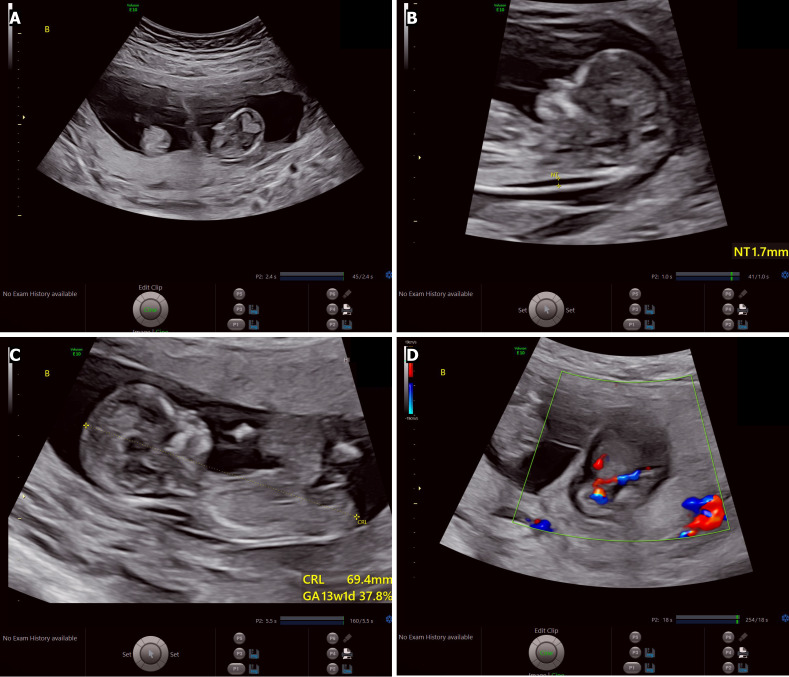
Results: Patients in the abnormal group were more likely to be monochorionic diamniotic (13/29 vs 20/97, P= 0.009), with a higher mean pulsatility index (PI, 1.57 ± 0.55 vs 1.28 ± 0.42, P = 0.003; cutoff value: 1.393) or a higher mean resistance index (0.71 ± 0.11 vs 0.65 ± 0.11, P = 0.008; cutoff value: 0.683) or early diastolic notch of bilateral uterine arteries (UtAs, 10/29 vs 15/97, P = 0.024) or with abnormal ultrasound findings (13/29 vs 2/97, P < 0.001), compared with the control group. Monochorionic diamnioticity, higher mean PI of bilateral UtAs and abnormal ultrasound findings during first trimester screening were independent risk factors for adverse fetal outcomes (P < 0.05).
Conclusion: First trimester ultrasound screening for twin pregnancy identifies independent risk factors and is useful for the prediction of fetal outcomes.
Keywords: First trimester ultrasound screening; Monochorionic diamniotic twin; Pulsatility index; Twin pregnancy; Uterine artery.
©The Author(s) 2025. Published by Baishideng Publishing Group Inc. All rights reserved.
Conflict of interest statement
Conflict-of-interest statement: The authors declare that they have no conflicts of interests.
Figures

References
-
- Martin JA, Hamilton BE, Osterman MJK, Driscoll AK. Births: Final Data for 2019. Natl Vital Stat Rep. 2021;70:1–51. - PubMed
-
- Wei J, Liu CX, Cui H, Zhang LJ, Chen J, Liu SS, Chang L, Zheng DM. [Guidelines for diagnosis, treatment and health care of premature twin birth (2020 edition)] Zhongguo Shiyong Fukeyuchanke Zazhi. 2020;36:949–956.
-
- Gibson JL, Castleman JS, Meher S, Kilby MD. Updated guidance for the management of twin and triplet pregnancies from the National Institute for Health and Care Excellence guidance, UK: What's new that may improve perinatal outcomes? Acta Obstet Gynecol Scand. 2020;99:147–152. - PubMed
-
- Mor N, Machtinger R, Yinon Y, Toussia-Cohen S, Amitai Komem D, Levin M, Sivan E, Meyer R. Outcome of two sequential singleton pregnancies and twin pregnancies among primiparous women at advanced age undergoing IVF. Arch Gynecol Obstet. 2020;302:1113–1119. - PubMed
-
- Southwest Thames Obstetric Research Collaborative (STORK) Prospective risk of late stillbirth in monochorionic twins: a regional cohort study. Ultrasound Obstet Gynecol. 2012;39:500–504. - PubMed
LinkOut - more resources
Full Text Sources
Research Materials
Miscellaneous
