


Co-infections of rickettsiales in clinically healthy, Leishmania infantum seropositive and seronegative dogs: a systematic literature review and new findings from Southern Italy
- PMID: 39878800
- PMCID: PMC11779695
- DOI: 10.1007/s00436-025-08458-4
Co-infections of rickettsiales in clinically healthy, Leishmania infantum seropositive and seronegative dogs: a systematic literature review and new findings from Southern Italy
Abstract
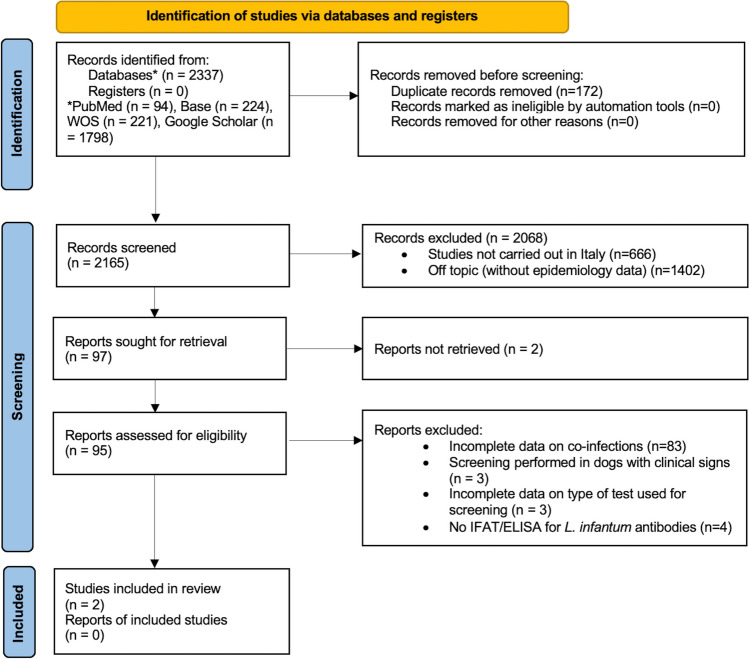
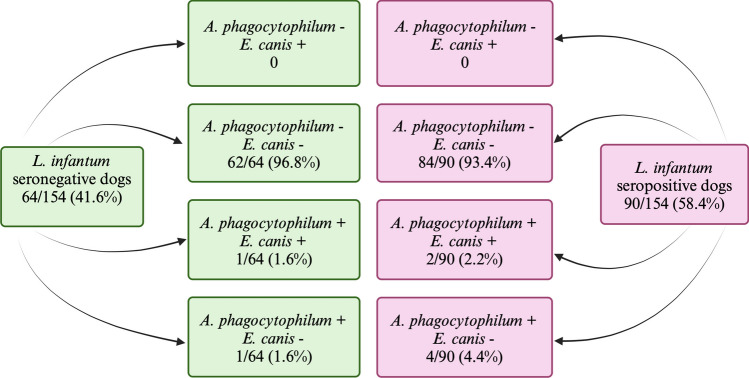
Canine leishmaniosis (CanL), caused by Leishmania infantum, is a widespread vector-borne disease. In Italy, an endemic region for CanL, overlapping transmission of L. infantum and tick-borne pathogens (TBPs) like Anaplasma phagocytophilum and Ehrlichia canis is increasingly reported. Dogs with clinical leishmaniosis often show higher co-infection rates and pronounced clinicopathological abnormalities. This study presents a systematic literature review and new findings from southern Italy, focusing on co-infections with E. canis and A. phagocytophilum in clinically healthy L. infantum seropositive and seronegative dogs. The systematic review identified two eligible studies. The first reported 34/488 (7%) dogs L. infantum seropositive, with 11.8% also seropositive for A. phagocytophilum. Among 454 seronegative dogs, 3% were seropositive for A. phagocytophilum and 2.4% for E. canis. The second study identified 154/1260 (12.2%) dogs L. infantum seropositive, with co-infection rates of 0.6% and 1.9% for A. phagocytophilum and E. canis, respectively. Among 1106 seronegative dogs, 1.3% were seropositive for A. phagocytophilum and 2.3% for E. canis. In the retrospective study from southern Italy, 90/154 (58.4%) dogs were L. infantum seropositive, with co-infection rates of 4.4% for A. phagocytophilum and 2.2% for A. phagocytophilum and E. canis. Among 64 seronegative dogs, 1.6% showed similar co-infections. This is the first systematic review in Italy, documenting low and comparable co-infection rates with A. phagocytophilum and E. canis in clinically healthy dogs, regardless of L. infantum serostatus. These findings suggest that co-infections may occur independently, offering insights into vector-borne disease dynamics in endemic areas.
Keywords: Anaplasma phagocytophilum; Ehrlichia canis; Leishmania infantum; Canine vector-borne disease; Co-infection; Serology.
© 2025. The Author(s).
Conflict of interest statement
Declarations. Ethics approval: Not applicable. Clinical trial number: Not applicable. Competing interests: The authors declare no competing interests.
Figures
References
Publication types
MeSH terms
LinkOut - more resources
Full Text Sources
