IMPACT OF COVID-19 PANDEMIC ON THE SURGICAL TREATMENT OF GASTRIC CANCER: A 3-YEAR ANALYSIS
- PMID: 39879512
- PMCID: PMC11774094
- DOI: 10.1590/0102-6720202400074e1868
IMPACT OF COVID-19 PANDEMIC ON THE SURGICAL TREATMENT OF GASTRIC CANCER: A 3-YEAR ANALYSIS
Abstract
Background: The COVID-19 pandemic has overloaded healthcare systems worldwide. Other diseases, such as neoplasms, including gastric cancer, remained prevalent and had their treatment compromised.
Aims: The aim of this study was to evaluate the impact of the COVID-19 pandemic on the treatment of gastric cancer and adherence to the recommended preoperative COVID-19 screening protocol.
Methods: A retrospective study evaluated patients diagnosed with gastric adenocarcinoma who underwent surgical treatment between 2015 and 2023.
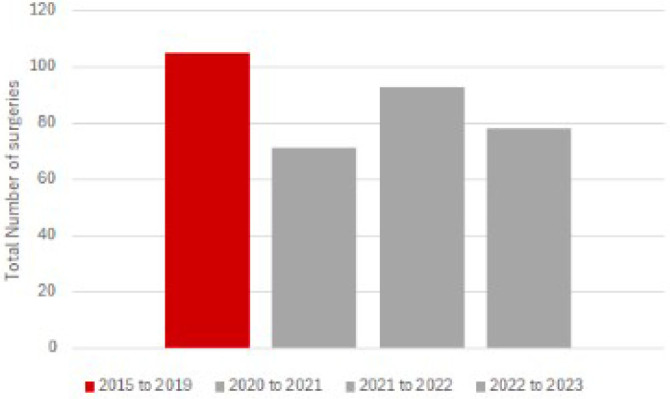
Results: A total of 769 patients with gastric cancer were evaluated and organized into two groups: (i) pre-COVID group and (ii) COVID group. The pre-COVID group consisted of 527 patients operated on between 2015 and 2019, and the COVID group consisted of 242 patients from 2020 to 2023. The average number of surgical procedures per year in the pre-COVID group was 105 and 81 in the COVID group. There was a statistically significant difference between ASA classification (p=0.002) and clinical staging (p=0.015), which were worse in the COVID group. We observed an increase in diagnostic surgeries (p=0.026), with an increase in the minimally invasive route (p<0.001). In patients undergoing curative surgery, there was a greater indication for postoperative ICU (p=0.022) and neoadjuvant chemotherapy (p<0.001). There was no difference in 30- and 90-day mortality.
Conclusions: The surgical and oncological outcomes for patients operated on during the pandemic remained uncompromised, even though many presented with more advanced initial stages and poorer clinical performance. High adherence to protocols and a low rate of complications related to coronavirus indicate that surgeries were performed safely during this period.
RACIONAL:: A pandemia de COVID-19 levou a sobrecarga dos sistemas de saúde em todo o mundo. Outras doenças como as neoplasias, dentre elas o câncer gástrico, continuaram prevalentes e tiveram seu tratamento comprometido.
OBJETIVOS:: Avaliar o impacto da pandemia de COVID-19 no tratamento do câncer gástrico e a adesão ao protocolo de triagem pré-operatória de COVID-19 recomendado.
MÉTODOS:: Estudo retrospectivo que avaliou pacientes com diagnóstico de adenocarcinoma gástrico submetidos a tratamento cirúrgico no período 2015 a 2023.
RESULTADOS:: Foram avaliados 769 pacientes com câncer gástrico. O Grupo Pré-COVID, foi composto por 527 pacientes operados entre 2015 e 2019 e Grupo COVID, formado por 242 pacientes de 2020 a 2023. A média de procedimentos cirúrgicos por ano no Grupo Pré-COVID foi de 105 e 81 no Grupo COVID. Houve diferença estatisticamente significativa entre Classificação ASA (p=0,002) e estadiamento clínico (p=0,015), piores no Grupo COVID. Observamos aumento de cirurgias diagnósticas (p=0,026), com aumento da via minimamente invasiva (p<0,001). Nos pacientes submetidos a cirurgia curativa, observa-se maior indicação de UTI pós-operatória (p=0,022) e quimioterapia neoadjuvante (p<0,001). Não houve diferença na mortalidade 30 e 90 dias.
CONCLUSÕES:: Não houve comprometimento dos resultados cirúrgicos e oncológicos dos pacientes operados durante a pandemia, apesar do estádio inicial mais avançado e pior performance clínica. A boa adesão ao protocolo e a baixa taxa de complicações pelo coronavírus demonstram que houve segurança na realização das cirurgias no período.
Conflict of interest statement
Figures
References
-
- Al-Batran SE, Homann N, Pauligk C, Goetze TO, Meiler J, Kasper S, et al. Perioperative chemotherapy with fluorouracil plus leucovorin, oxaliplatin, and docetaxel versus fluorouracil or capecitabine plus cisplatin and epirubicin for locally advanced, resectable gastric or gastro-oesophageal junction adenocarcinoma (FLOT4): a randomised, phase 2/3 trial. Lancet. 2019;393(10184):1948–57. doi: 10.1016/S0140-6736(18)32557-1. - DOI - PubMed
MeSH terms
LinkOut - more resources
Full Text Sources
Medical