Meta-Analysis
. 2025 Jan 30;14(1):4.
doi: 10.1186/s40249-025-01274-z.

An updated systematic review with meta-analysis and meta-regression of the factors associated with human visceral leishmaniasis in the Americas

Affiliations
Meta-Analysis

An updated systematic review with meta-analysis and meta-regression of the factors associated with human visceral leishmaniasis in the Americas

Anna Gabryela Sousa Duarte et al. Infect Dis Poverty. .

Abstract

Background: Human visceral leishmaniasis (VL) is a systemic disease with high case-fatality rates and a widespread distribution. Continuous evaluation of the risk factors for VL is essential to ensure the effective implementation of prevention and control measures. The present study reviews the factors associated with VL in the Americas.

Methods: This systematic review updates a previous 2013 report by including cross-sectional, cohort and case-control studies published between July 2011 and April 2024. Associations between VL and risk factors were analyzed using random-effects meta-analysis, subgroup analysis, and meta-regression models. Studies were classified according to level of evidence using the GRADE approach and the evolution in the quality of investigations was assessed.

Results: Forty-six studies were included in the review and 21 variables were evaluated in the meta-analyses. Combination of all study types revealed that men had greater chances of VL than women, but the association was strong and significant only in case-control studies. Although higher chances of VL in children and in households with dogs or chickens/other fowl were identified in case-control studies, an inverse association was observed in cross-sectional and cohort studies. Higher chances of VL were associated with poor economic/living conditions, individuals living in domiciles with backyards or with seropositive dogs, and individuals with prior contact with infected household members/relatives/neighbors. The level of evidence for associations of VL with sex and age was classified as moderate whilst that for all other associations was either low or very low. The methodological quality of recent studies showed a positive progression but shortcomings were still evident regarding selection criteria and methods of data analysis.

Conclusion: While there is a higher incidence of symptomatic VL among men and children, the likelihood of infection is similar between the groups. There is insufficient evidence to support the claim that the presence of dogs or fowl at the domicile increases the chances of VL. However, socioeconomic and living conditions, as well as previous occurrence of human and canine VL, are influential factors. Future research should be conducted with greater statistical power and using molecular diagnostic techniques, preferably involving cohort studies in diverse Latin American countries.

Keywords: Epidemiology; Leishmaniasis; Quality data reporting; Risk factor; Systematic review.


Conflict of interest statement

Declarations. Ethics approval and consent to participate: Not applicable. Consent for publication: Not applicable. Competing interests: The authors declare that they have no competing interests.

Figures

Fig. 1
Fig. 1
PRISMA flowchart showing the process of selection of articles included in the present review
Fig. 2
Fig. 2
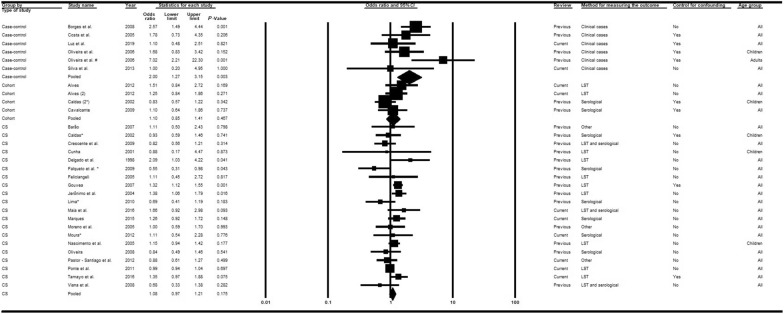
Forest plot for the variable sex in studies separated according to study type. CS cross-sectional, LST Leishmania skin test. Superscripts: (*) result of serological test in a study involving two diagnostic tests; (#) results in adults; (2) second result in a single article. The squares represent the weight of each study, whereas the diamonds represent the summary measurement of each subgroup. Category of reference: Females, Odds ratio = 1 [, , , , , –, –, , –58, 60, 63, 65, 66, 68, 69]
Fig. 3
Fig. 3
Forest plot for the variable sex in studies separated according to diagnostic method. CS cross-sectional, LST Leishmania skin test. Superscripts: (*) result of serological test in a study involving two diagnostic tests; (#) results in adults; (2) second result in a single article. The squares represent the weight of each study, whereas the diamonds represent the summary measurement of each subgroup. Category of reference: female, Odds ratio = 1 [, , , –, –, , –58, 60, 63, 65, 66, 68, 69]
Fig. 4
Fig. 4
Forest plot for the variable age (< 10-years old to ≥ 10-years old) in studies separated according to study type. CS cross-sectional, LST Leishmania skin test. Superscripts: (*) result of serological test in a study involving two diagnostic tests; (#) results in adults; (2) second result in a single article. The squares represent the weight of each study, whereas the diamonds represent the summary measurement of each subgroup. Category of reference: ≥ 10 years of age, Odds ratio = 1 [, , , , –, , –, , –60, 63]
Fig. 5
Fig. 5
Forest plot for the variable age (< 10-years old to ≥ 10-years old) in studies separated according to diagnostic method. CS cross-sectional, LST Leishmania skin test. Superscripts: (*) result of serological test in a study involving two diagnostic tests; (#) results in adults; (2) second result in a single article. The squares represent the weight of each study, whereas the diamonds represent the summary measurement of each subgroup. Category of reference: ≥ 10 years of age, Odds ratio = 1 [, , , , –, , –, , –60, 63]
Fig. 6
Fig. 6
Forest plot for the variable age (< 10-years old to > 50-years old). CS cross-sectional, LST Leishmania skin test. Superscripts: (*) result of serological test in a study involving two diagnostic tests; (#) results in adults; (2) second result in a single article. The squares represent the weight of each study, whereas the diamonds represent the summary measurement of each subgroup. Category of reference: < 10 years of age, Odds ratio = 1 [14, 28, 48, 50, 56, 57, 59, 60]
Fig. 7
Fig. 7
Forest plot for the variable presence of dogs in the domicile in studies separated according to study type. CS cross-sectional, LST Leishmania skin test. Superscripts: (*) result of serological test in a study involving two diagnostic tests; (#) results in adults; (2) second result in a single article. The squares represent the weight of each study, whereas the diamonds represent the summary measurement of each subgroup. Category of reference: absence of dogs, Odds ratio = 1 [, , , , , , , , , , –, , , –69]
Fig. 8
Fig. 8
Forest plot for the variable previous presence of VL-positive dog. CS cross-sectional, LST Leishmania skin test; VL visceral leishmaniasis. Superscripts: (*) result of serological test in a study involving two diagnostic tests; (#) results in adults; (2) second result in a single article. The squares represent the weight of each study, whereas the diamonds represent the summary measurement of each subgroup. Category of reference: absence of VL-positive dog, Odds ratio = 1 [15, 59, 64, 67]
Fig. 9
Fig. 9
Forest plot for the variable presence of chickens/other fowl in studies separated according to study type. CS cross-sectional, LST Leishmania skin test. Superscripts: (*) result of serological test in a study involving two diagnostic tests; (#) results in adults; (2) second result in a single article. The squares represent the weight of each study, whereas the diamonds represent the summary measurement of each subgroup. Category of reference: absence of chickens/other fowl, Odds ratio = 1 [, , , , , , , –60, 63, 65, 68, 69]
Fig. 10
Fig. 10
Forest plot for the variable occurrence of VL among household members, relatives or neighbors. CS cross-sectional, LST Leishmania skin test; VL visceral leishmaniasis. Superscripts: (*) result of serological test in a study involving two diagnostic tests; (#) results in adults; (2) second result in a single article. The squares represent the weight of each study, whereas the diamonds represent the summary measurement of each subgroup. Category of reference: absence of VL-positive household members, relatives or neighbors, Odds ratio = 1 [14, 29, 37, 43, 47, 48, 60, 64]
Fig. 11
Fig. 11
Forest plot for the variable presence of a backyard. CS cross-sectional, LST Leishmania skin test. Superscripts: (*) result of serological test in a study involving two diagnostic tests; (#) results in adults; (2) second result in a single article. The squares represent the weight of each study, whereas the diamonds represent the summary measurement of each subgroup. Category of reference: absence of backyard, Odds ratio = 1 [48, 59, 65, 66, 68]
Fig. 12
Fig. 12
Funnel plots for the variables sex; age; presence of chickens/other fowl at the domicile; presence of dogs in the domicile, and home finishing. Closed dots correspond to imputed studies using the “trim and fill” method of Duval and Tweedie

References

    1. Michalick MSM, Genaro O. Leishmaniose Visceral Americana. In: Neves DP, Melo AL, Linardi PM, Vitor RWA, editors. Parasitologia humana. São Paulo: Atheneu; 2016. p. 69–90.
    1. Brasil. Ministério da Saúde (MS). Guia de vigilância em saúde. 3rd ed. Brasília. 2019; 270. (in Portuguese).
    1. Pan-American Health Organization (PAHO). Leishmaniases: Epidemiological Report of the Americas. 2023. https://iris.paho.org/handle/10665.2/51742. Accessed 31 July 2024.
    1. Brasil. Ministério da Saúde (MS), Secretaria de Vigilância em Saúde, Departamento de Vigilância Epidemiológica. Manual de vigilância e controle da leishmaniose. Brasília: Ministério da Saúde. 2014; 120. (in Portuguese).
    1. Werneck GL, Figueiredo FB, Pires e Cruz MSP. Impact of 4% deltamethrin-impregnated dog collars on the incidence of human visceral leishmaniasis: A community intervention trial in Brazil. Pathogens. 2024;13(2):135. - PMC - PubMed

LinkOut - more resources