


Identifying key blood markers for bacteremia in elderly patients: insights into bacterial pathogens
- PMID: 39885965
- PMCID: PMC11779733
- DOI: 10.3389/fcimb.2024.1472765
Identifying key blood markers for bacteremia in elderly patients: insights into bacterial pathogens
Abstract
Background: This study aimed to assess the distribution of bacteremia pathogens in elderly patients, examine the impact of gender on pathogen distribution, and evaluate the predictive value of routine blood parameters for diagnosing bacteremia.
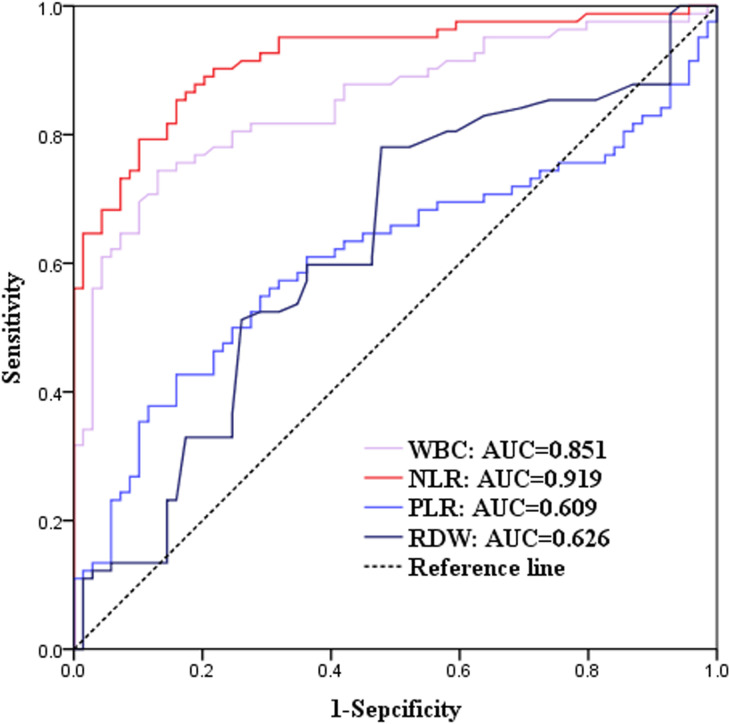
Methods: A retrospective analysis was conducted on 151 elderly patients (≥60 years old) admitted to Fuding Hospital, Fujian University of Traditional Chinese Medicine between October 2022 and June 2023. Comprehensive routine blood tests and blood cultures were performed. The diagnostic efficacy of routine blood parameters, including white blood cell (WBC), neutrophil-to-lymphocyte ratio (NLR), platelet-lymphocyte ratio (PLR), and red blood cell distribution width (RDW), was evaluated using receive operating characteristic (ROC) curve analysis. Patients were categorized into either the culture-positive group (82 cases) or the culture-negative group (69 cases) according to blood culture results.
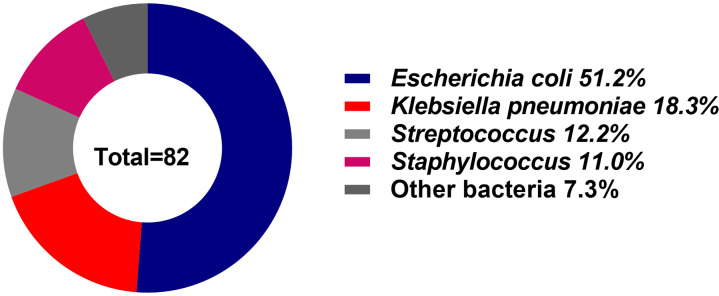
Results: No significant differences in age and gender were found between the culture-positive and culture-negative groups. The primary bacterial pathogens of bacteremia in the elderly were Escherichia coli, Klebsiella pneumoniae and Streptococcus. Elderly female patients demonstrated a significantly higher culture positivity rate for E. coli compared to their male counterparts (P = 0.021). The areas under the ROC curve (AUC) for the four parameters were as follows: WBC, 0.851 (95% confidence interval (CI) 0.790 - 0.912); NLR, 0.919 (95% CI 0.875 - 0.963); PLR, 0.609 (95% CI 0.518 - 0.700); and RDW was 0.626 (95% CI 0.563 - 0.717).
Conclusions: E. coli was identified as the predominant pathogenic microorganism causing bacteremia in the elderly, with a significantly higher culture positivity rate among female patients. Routine blood parameters (WBC, NLR, PLR, and RDW) demonstrated a predictive potential for diagnosing bacteremia in elderly patients.
Keywords: Escherichia coli; ROC analysis; bacteremia; blood culture; elderly; neutrophil-to-lymphocyte ratio.
Copyright © 2025 Zhang, Zhuo, Li, Jiang, Zhang, Cai and Yang.
Conflict of interest statement
The authors declare that the research was conducted in the absence of any commercial or financial relationships that could be construed as a potential conflict of interest.
Figures
References
-
- Berhane M., Melku M., Amsalu A., Enawgaw B., Getaneh Z., Asrie F. (2019). The role of neutrophil to lymphocyte count ratio in the differential diagnosis of pulmonary tuberculosis and bacterial community-acquired pneumonia: a cross-sectional study at ayder and mekelle hospitals, Ethiopia. Clin. Lab. 65. doi: 10.7754/Clin.Lab.2018.180833 - DOI - PubMed
-
- Dambroso-Altafini D., Menegucci T. C., Costa B. B., Moreira R. R. B., Nishiyama S. A. B., Mazucheli J., et al. (2022). Routine laboratory biomarkers used to predict Gram-positive or Gram-negative bacteria involved in bloodstream infections. Sci. Rep. 12, 15466. doi: 10.1038/s41598-022-19643-1 - DOI - PMC - PubMed
MeSH terms
Substances
LinkOut - more resources
Full Text Sources
