


Early administration of romosozumab prevents rebound of bone resorption related to denosumab withdrawal in fractured post-menopausal women: a real-world prospective study
- PMID: 39888498
- PMCID: PMC12049335
- DOI: 10.1007/s40618-025-02542-3
Early administration of romosozumab prevents rebound of bone resorption related to denosumab withdrawal in fractured post-menopausal women: a real-world prospective study
Abstract
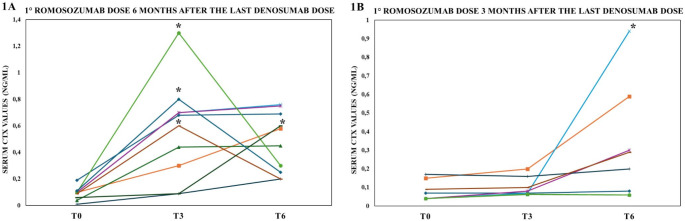
Purpose: The real-world effectiveness of switching from denosumab to romosozumab remains controversial. Sequential therapy with romosozumab was shown to be associated with inadequate suppression of bone resorption and there was anecdotal evidence of major osteoporotic fractures (MOFs) after transitioning from denosumab to romosozumab. This study evaluated the effects on bone resorption of early romosozumab administration 3 months after denosumab withdrawal in fractured women with post-menopausal osteoporosis.
Methods: This prospective, single-center cohort study included 39 post-menopausal women with osteoporosis experiencing either MOFs or decrease in bone mineral density during long-term treatment with anti-resorptive drugs. Eighteen received romosozumab either 6 months (Group A) or 3 months (Group B) after their last denosumab dose, while 21 women switched from bisphosphonates to romosozumab and were enrolled as controls (Group C). Serum C-terminal telopeptide of type I collagen (CTX) levels were measured at baseline, 3 and 6 months.
Results: All women of group A and 4 out of 8 women of group B showed a clinically significant increase of CTX values (i.e., change above the least significant change) (p = 0.023), which occurred earlier in group A as compared to group B. Moreover, 9/10 women of group A and 2/8 women of group B achieved values above the mean of reference range for pre-menopausal women (p = 0.013). In group C, serum CTX values did not change significantly during the follow-up. Two women in Group A experienced MOFs during the follow-up.
Conclusions: Early romosozumab administration after denosumab withdrawal may control bone turnover rebound and possibly prevent incidence of fractures in post-menopausal osteoporosis.
Keywords: Denosumab; Fractures; Osteoporosis; Post-menopausal women; Romosozumab; Sequential therapies.
© 2025. The Author(s).
Conflict of interest statement
Declarations. Competing interests: The Authors declare the following competing financial interests: Andrea G. Lania received grants from Pfizer and consultancy fees from Ipsen, outside the submitted work; Gherardo Mazziotti received consultancy fees from Sanofi and UCB and lecture fees from Amgen, Theramex and Abiogen, outside the submitted work; moreover, Gherardo Mazziotti serves as Associate Editor for Journal of Endocrinological Investigation. Walter Vena is a member of the editorial board of Journal of Endocrinological Investigation. The other authors have nothing to declare. Ethical approval: The study was approved by the Ethics Committee of IRCCS Humanitas Research Hospital. Consent to participate: The study was conducted in accordance with the Declaration of Helsinki, and all participants gave their written informed consent.
Figures
References
-
- Marini F, Giusti F, Palmini G, Brandi ML (2023) Role of wnt signaling and sclerostin in bone and as therapeutic targets in skeletal disorders. Osteoporos International: J Established as Result Cooperation between Eur Foundation Osteoporos Natl Osteoporos Foundation USA 34(2):213–238. 10.1007/s00198-022-06523-7 - PubMed
-
- Curtis EMRJ, Al–Daghri N, Biver E, Brandi ML, Cavalier E, Hadji P, Halbout P, Harvey NC, Hiligsmann M, Javaid MK, Kanis JA, Kaufman JM, Lamy O, Matijevic R, Perez AD, Radermecker RP, Rosa MM, Thomas T, Thomasius F, Vlaskovska M, Rizzoli R, Cooper C (2022) Management of patients at very high risk of osteoporotic fractures through sequential treatments. Aging Clin Exp Res 34(695–714). 10.1007/s40520-022-02100-4 - PMC - PubMed
-
- Cosman FNJ, Dempster DW (2016) Treatment sequence matters: anabolic and antiresorptive therapy for osteoporosis. J Bone Min Res 32(2):198–202. 10.1002/jbmr.3051 - PubMed
MeSH terms
Substances
LinkOut - more resources
Full Text Sources
Medical
