Review
. 2025 Feb 1;26(2):e100-e114.
doi: 10.1542/neo.26-2-011.

Applications of Metabolomics and Lipidomics in the Neonatal Intensive Care Unit

Affiliations
Review

Applications of Metabolomics and Lipidomics in the Neonatal Intensive Care Unit

Jonathan D Reiss et al. Neoreviews. .

Abstract

The metabolome and lipidome comprise the thousands of molecular compounds in an organism. Molecular compounds consist of the upstream metabolic components of intracellular reactions or the byproducts of cellular pathways. Molecular and biochemical perturbations are associated with disorders in newborns and infants. The diagnosis of inborn errors of metabolism has relied on targeted metabolomics for several decades. Newer approaches offer the potential to identify novel biomarkers for common diseases of the newborn and infant. They may also elucidate novel predictive or diagnostic measures for a variety of health trajectories. Here, we review the relevance of the metabolome and lipidome for common disorders and highlight challenges and opportunities for future investigations.


Figures

FIGURE 1.
FIGURE 1.
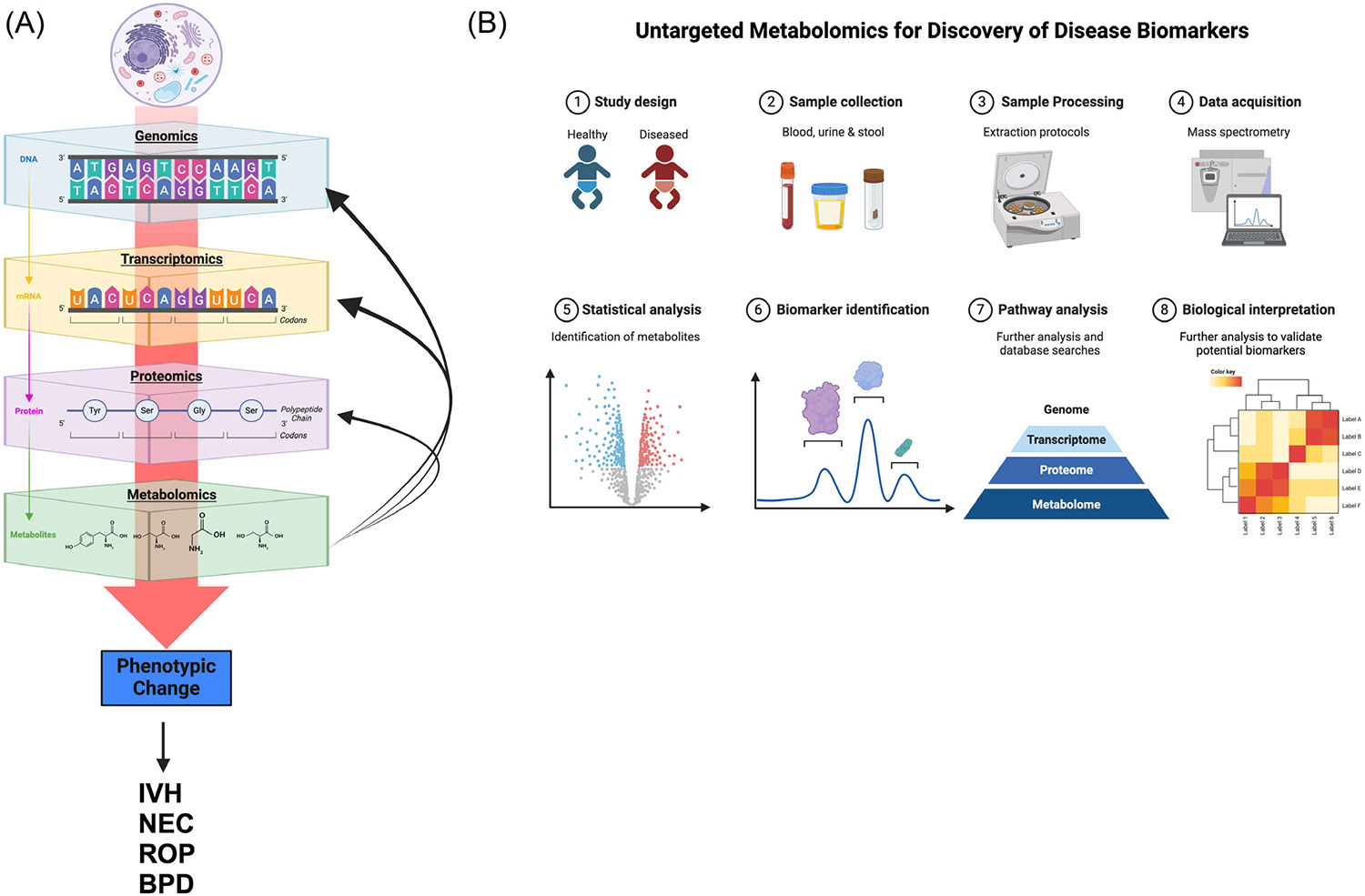
Overview of omics approaches and workflows. (A) The sequential layers of omics technologies, starting from genomics (DNA sequencing) to transcriptomics (messenger RNA analysis), proteomics (protein profiling), and metabolomics (metabolite identification). The arrows originating from metabolomics to the different layers signify feedback mechanisms, in which changes in metabolite levels can influence gene expression, protein activity, and messenger RNA level. (B) Workflow for untargeted metabolomics in the discovery of disease biomarkers for a hypothetical retrospective case-control study design. (1) Study design involves selecting healthy individuals and diseased patients. (2) Sample collection encompasses obtaining biological samples such as blood, stool, or urine. (3) Pretreatment includes extraction protocols to prepare the samples for analysis. (4) Data acquisition utilizes mass spectrometry to generate metabolic profiles. (5) Statistical analysis is performed to identify statistically significant metabolites. (6) Biomarker identification focuses on pinpointing potential biomarkers from the data. (7) Pathway analysis integrates further analysis and database searches to understand metabolic pathways. (8) Biological interpretation involves validating the potential biomarkers through additional studies, aiding in the comprehensive understanding of disease mechanisms and potential therapeutic targets. Figure created at BioRender.com. Abbreviations: BPD, bronchopulmonary dysplasia; IVH, intraventricular hemorrhage; NEC, necrotizing enterocolitis; ROP, retinopathy of prematurity.
FIGURE 2.
FIGURE 2.
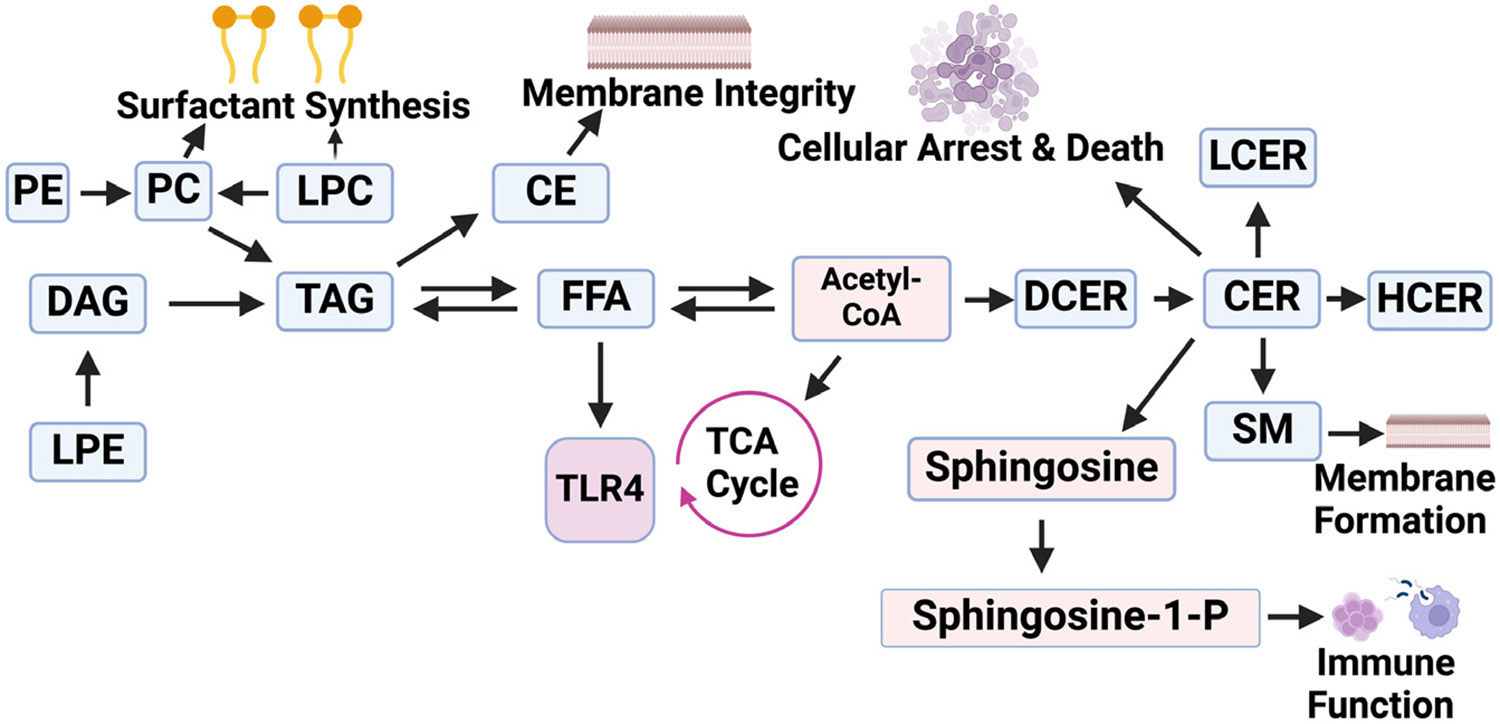
Lipid classes illustrating known relationships and mechanistic pathways. All lipid species are light blue. Metabolites are pink. Figure created at BioRender.com. Abbreviations: CE, cholesterol esters; CER, ceramides; DAG, diacylglycerols; DCER, dihydroceramides; FFA, free fatty acids; HCER, hexosylceramides; LCER, lactosylceramides; LPC, lysophosphatidylcholines; LPE, lysophosphatidylethanolamines; PC, phosphatidylcholines; PE, phosphatidylethanolamines; SM, sphingomyelins; TAG, triacylglycerols; TCA, tricarboxylic acid.

References

    1. Noto A, Fanos V, Dessì A. Metabolomics in newborns. Adv Clin Chem. 2016;74:35–61. doi: 10.1016/bs.acc.2015.12.006 - DOI - PubMed
    1. Xia J, Broadhurst DI, Wilson M, Wishart DS. Translational biomarker discovery in clinical metabolomics: an introductory tutorial. Metabolomics. 2013;9(2):280–299. doi: 10.1007/s11306-012-0482-9 - DOI - PMC - PubMed
    1. Johnson CH, Ivanisevic J, Siuzdak G. Metabolomics: beyond biomarkers and towards mechanisms. Nat Rev Mol Cell Biol. 2016;17(7):451–459. doi: 10.1038/nrm.2016.25 - DOI - PMC - PubMed
    1. Johnson CH, Gonzalez FJ. Challenges and opportunities of metabolomics. J Cell Physiol. 2012;227(8):2975–2981. doi: 10.1002/jcp.24002 - DOI - PMC - PubMed
    1. Beger RD, Dunn W, Schmidt MA, et al. ; for “Precision Medicine and Pharmacometabolomics Task Group”-Metabolomics Society Initiative. Metabolomics enables precision medicine: “A White Paper, Community Perspective”. Metabolomics. 2016;12(10): 149. doi: 10.1007/s11306-016-1094-6 - DOI - PMC - PubMed

LinkOut - more resources