Clinical Profile and Outcomes of Pulmonary Embolism in Central Iran: A Retrospective Cohort Study
- PMID: 39891454
- PMCID: PMC11786213
- DOI: 10.34172/aim.31907
Clinical Profile and Outcomes of Pulmonary Embolism in Central Iran: A Retrospective Cohort Study
Abstract
Background: Pulmonary embolism (PE) is a significant public health concern. This retrospective cohort study examines the clinical profiles and outcomes of patients diagnosed with PE at a medical center in central Iran, aiming to identify mortality predictors during hospitalization and follow-up.
Methods: Data from 109 patients diagnosed with PE were analyzed, with a median follow-up of 23 months. The collected information included demographic and clinical characteristics, laboratory findings, treatment protocols, and outcomes. Logistic regression and Kaplan-Meier survival analysis were used to identify independent mortality predictors and assess survival impact.
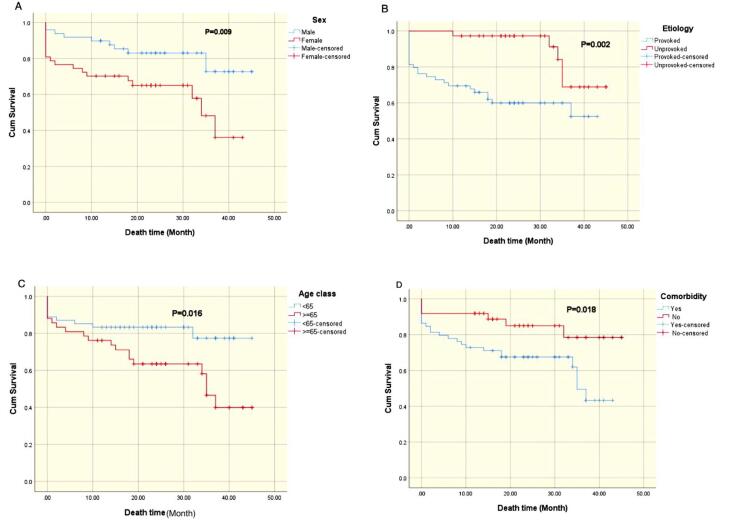
Results: The mean age was 59.2 years (±19.7), with 51.4% male. Common symptoms included dyspnea (86%) and chest pain (53%), with non-massive PE being the most prevalent (63%). Independent mortality predictors identified were age (odds ratio [OR] 1.065 per year, P<0.001), female sex (OR 4.421, P=0.009), and PE severity (OR 0.262, P=0.023). Kaplan-Meier analysis showed reduced survival probabilities in females (P=0.009), those with provoked PE (P=0.002), patients over 65 (P=0.016), and individuals with comorbidities (P=0.018). In-hospital mortality was 10.1%, linked to provoked massive PE, absence of thrombolytic therapy, and reduced left ventricular ejection fraction (LVEF).
Conclusion: In this cohort, age, sex, and PE severity were significant mortality predictors, while provoked PE, advanced age, and comorbidities were associated with lower mid-term survival probabilities.
Keywords: Mortality; Pulmonary embolism; Thrombolytic therapy; Venous thromboembolism.
© 2024 The Author(s). This is an open-access article distributed under the terms of the Creative Commons Attribution License (https://creativecommons.org/licenses/by/4.0), which permits unrestricted use, distribution, and reproduction in any medium, provided the original work is properly cited.
Conflict of interest statement
The authors declare that they have no conflicts of interest, including any financial interests, related to the conduct or publication of this study.
References
MeSH terms
LinkOut - more resources
Full Text Sources
Medical