


Clinical characteristics and risk factors to high-grade vaginal intraepithelial neoplasia: a single-institution study
- PMID: 39893434
- PMCID: PMC11786430
- DOI: 10.1186/s12905-025-03585-7
Clinical characteristics and risk factors to high-grade vaginal intraepithelial neoplasia: a single-institution study
Abstract
Background: To date, few studies have investigated the factors associated with high-grade vaginal intraepithelial neoplasia (VaIN). This study aimed to analyze the characteristics of high-grade VaIN and identify its underlying risk factors.
Methods: This cross-sectional study included women with histologically confirmed high-grade VaIN and high-grade cervical intraepithelial neoplasia (CIN), conducted between 2017 and 2021 at a single center. Baseline clinical characteristics, human papillomavirus (HPV) infection status, cytology results, and pathology findings were analyzed using standard statistical methods.
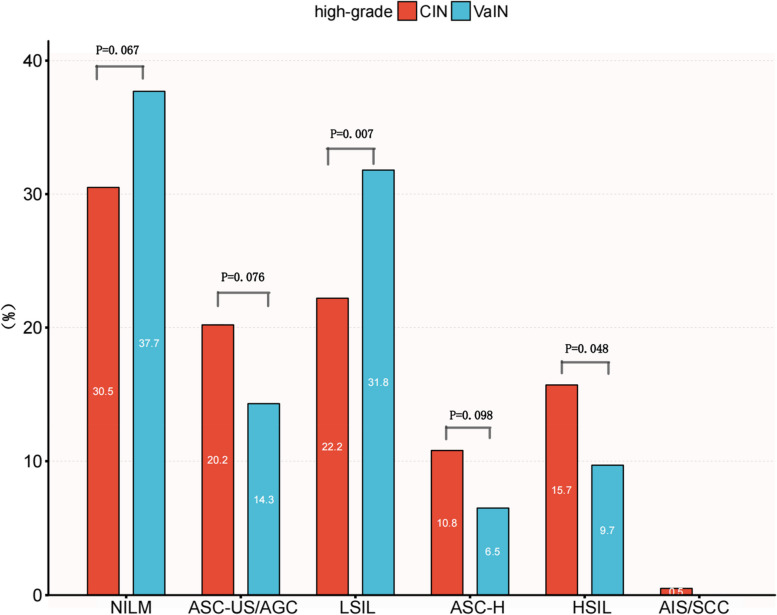
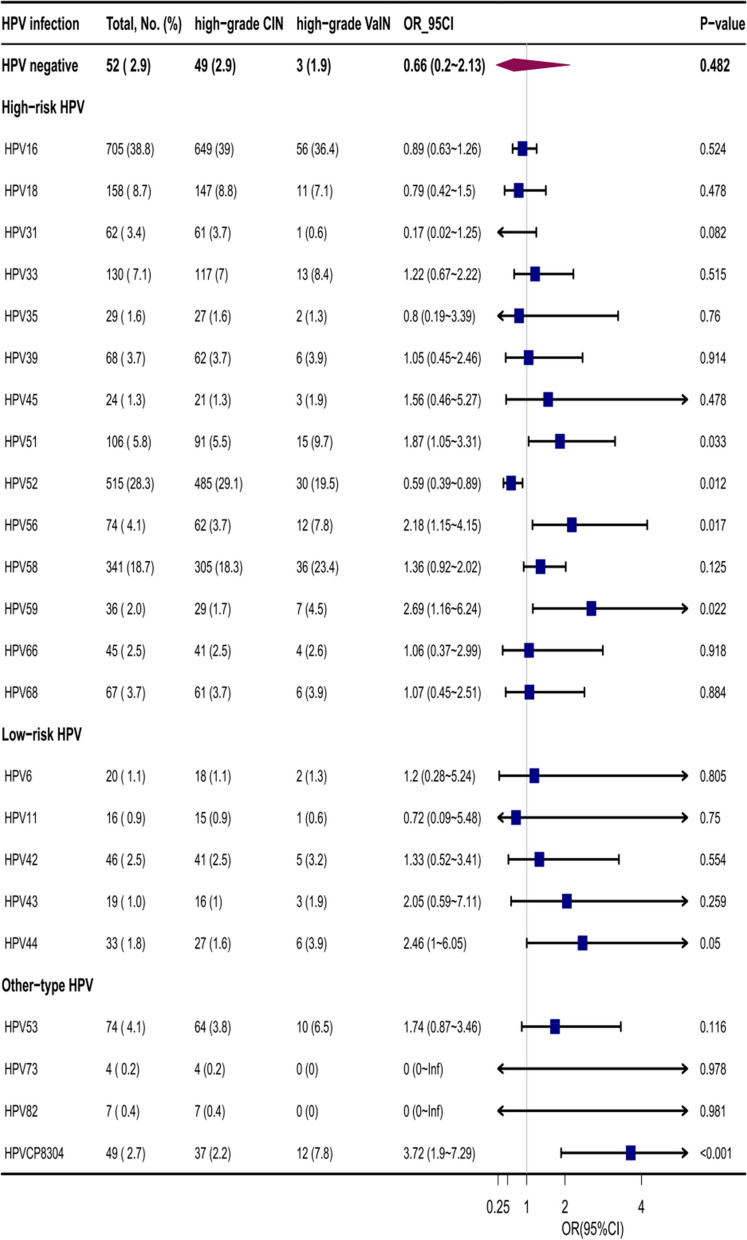
Results: Among 1819 patients, 8.47% (154/1819) were diagnosed with high-grade VaIN (mean age: 42.1 ± 12.4 years), while 91.53% (1665/1819) had high-grade CIN (mean age: 36.7 ± 10.0 years). Older age, longer sexual life duration, higher gravidity and parity, menopause, and prior cervical treatment were identified as risk factors for high-grade VaIN (p < 0.001). High-grade VaIN was more likely to present with low-grade squamous intraepithelial lesion (LSIL) cytology among abnormal cytological results (p = 0.007). HPV was detected in 98.1% of VaIN2/3 cases (151/154), with HPV 16 being the most prevalent genotype, accounting for 39.89% (705/1767) of all infections, 36.4% of high-grade VaIN, and 39% of high-grade CIN cases. Single-genotype HPV infections were observed in 58.4% of high-grade VaIN and 64.3% of high-grade CIN, while multiple infections were found in 39.6% and 32.8%, respectively. The sensitivities of cytology for detecting high-grade VaIN and high-grade CIN were 62.3% and 69.5%, respectively (p = 0.067). HPV testing sensitivities were 98.4% and 97.1%, respectively (p = 0.578). Combined cytology and HPV testing improved sensitivities to 100% and 99.8%, respectively.
Conclusions: High-grade VaIN is significantly associated with older age. The sensitivity of cytology and HPV testing for detecting high-grade VaIN is comparable to that for high-grade CIN. Thus, these tests may facilitate early detection of high-grade VaIN.
Keywords: Cervical intraepithelial neoplasia; Cytology; High‐grade vaginal intraepithelial neoplasia; Human papillomavirus.
© 2025. The Author(s).
Conflict of interest statement
Declarations. Ethics approval and consent to participate: This study was approved by the Ethics Committee of Guangdong Women and Children Hospital and conducted in accordance with the Declaration of Helsinki. Written informed consent was obtained from all participants. Consent for publication: Not applicable. Competing interests: The authors declare no competing interests.
Figures

References
MeSH terms
LinkOut - more resources
Full Text Sources
Medical
