


Evidence for alpha-synuclein aggregation in older individuals with hyposmia: a cross-sectional study
- PMID: 39893720
- PMCID: PMC11835612
- DOI: 10.1016/j.ebiom.2025.105567
Evidence for alpha-synuclein aggregation in older individuals with hyposmia: a cross-sectional study
Abstract
Background: Synuclein pathology in neurodegenerative diseases, such as Parkinson's disease (PD) and Dementia with Lewy bodies (DLB), begins years before motor or cognitive symptoms arise. Alpha-Synuclein seed amplification assays (α-syn SAA) may detect aggregated synuclein before symptoms occur.
Methods: Data from the Parkinson Associated Risk Syndrome Study (PARS) have shown that individuals with hyposmia, without motor or cognitive symptoms, are enriched for dopamine transporter imaging (DAT) deficit and are at high risk to develop clinical parkinsonism or related synucleinopathies. α-syn aggregates in CSF were measured in 100 PARS participants using α-syn SAA.
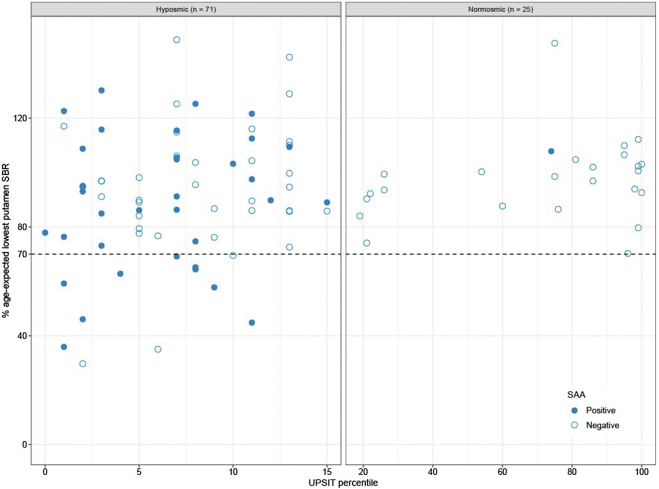
Findings: CSF α-syn SAA was positive in 48% (34/71) of hyposmic compared to 4% (1/25) of normosmic PARS participants (relative risk, 11.97; 95% CI, 1.73-82.95). Among α-syn SAA positive hyposmics 65% remained without a DAT deficit for up to four years follow-up. α-syn SAA positive hyposmics were at higher risk of having DAT deficit (12 of 34) compared to α-syn SAA negative hyposmics (4 of 37; relative risk, 3.26; 95% CI, 1.16-9.16), and 7 of 12 α-syn SAA positive hyposmics with DAT deficit developed symptoms consistent with synucleinopathy.
Interpretation: Approximately fifty percent of PARS participants with hyposmia, easily detected using simple, widely available tests, have synuclein pathology detected by α-syn SAA. Approximately, one third (12 of 34) α-syn SAA positive hyposmic individuals also demonstrate DAT deficit. This study suggests a framework to investigate screening paradigms for synuclein pathology that could lead to design of therapeutic prevention studies in individuals without symptoms.
Funding: The study was funded by the U.S. Department of Defense, the Helen Graham Foundation and the Michael J. Fox Foundation for Parkinson's Research.
Keywords: Biomarkers; Dopamine transporter imaging; Parkinson’s disease; Prodromal.
Copyright © 2025. Published by Elsevier B.V.
Conflict of interest statement
Declaration of interests Marek reports payments to his institution from The Michael J. Fox Foundation and the Department of Defense as well as consulting fees from Invicro, The Michael J. Fox Foundation, Roche, Calico, Coave, Neuron23, Orbimed, Biohaven, Ixico, Koneksa, Merck, Lilly, Inhibikase, Neuramedy, IRLabs, Prothena and Mitro and stock ownership in Mitro, Realm. Russell declares employment at Invicro, LLC. Concha-Marambio declares employment for and employee stock options in Amprion, grants 16712 and 21233 from The Michael J. Fox Foundation to his institution; grant U44NS111672 from NIH to his institution; and patents or patent application numbers US 20210277076A1, US 20210311077A1, US 20190353669A1 and US 20210223268A1. Choi has no disclosures to report. Jennings declares employment for and employee stock options from Denali Therapeutics. Brumm declares travel grants and payments to his institution from The Michael J. Fox Foundation. Coffey declares grants to his institution from The Michael J. Fox Foundation and NIH/NINDS. Brown declares grant support to his institution from The Michael J. Fox Foundation, National Institute of Health and Gateway LLC, consulting fees from Guidepoint Consulting, and travel support for meeting attendance from The Michael J. Fox Foundation. Seibyl declares consultancies from Invicro, Biogen, and Abbvie; and stock ownership from RealmIDX, MNI Holdings, and LikeMinds as well as grants from The Michael J. Fox Foundation. Stern declares consultancies for Mediflix, Inc., Health and Wellness Partners; Neurocrine, Luye Pharma and Acorda; honoraria from Atria Foundation, International Parkinsons and Movement Disorder Society; serves on advisory board at Neuroderm, Alexza, Alexion and Biogen. Soto declares employment for Amprion; stock ownership for Amprion; honoraria (will receive royalties for the sale of seed amplification assay [SAA]) from Amprion; and patents or patent applications, awarded and amplified in conjunction with Amprion for the SAA assay, NIH grants RO1AG055053, U24AG079685, RO1AG079685. Siderowf declares consultancies for SPARC Therapeutics, Capsida Therapeutics and Parkinson Study Group; honoraria from Bial; grants from National Institutes of Health and The Michael J. Fox Foundation (member of PPMI Steering Committee); and participation on board at Wave Life Sciences, Inhibikase, Prevail, Huntington Study Group and Massachusetts General Hospital.
Figures

References
-
- Horimoto Y., Matsumoto M., Nakazawa H., et al. Cognitive conditions of pathologically confirmed dementia with Lewy bodies and Parkinson's disease with dementia. J Neurol Sci. 2003;216(1):105–108. - PubMed
-
- Savica R., Rocca W.A., Ahlskog J.E. When does Parkinson disease start? Arch Neurol. 2010;67(7):798–801. - PubMed
MeSH terms
Substances
Grants and funding
LinkOut - more resources
Full Text Sources
Medical
Miscellaneous
