


Beta-hydroxy-beta-methylbutyrate (HMB) improves daily activity and whole-body protein metabolism in Duchenne muscular dystrophy dogs: a pilot study
- PMID: 39894866
- PMCID: PMC11788438
- DOI: 10.1038/s41598-025-88651-8
Beta-hydroxy-beta-methylbutyrate (HMB) improves daily activity and whole-body protein metabolism in Duchenne muscular dystrophy dogs: a pilot study
Abstract
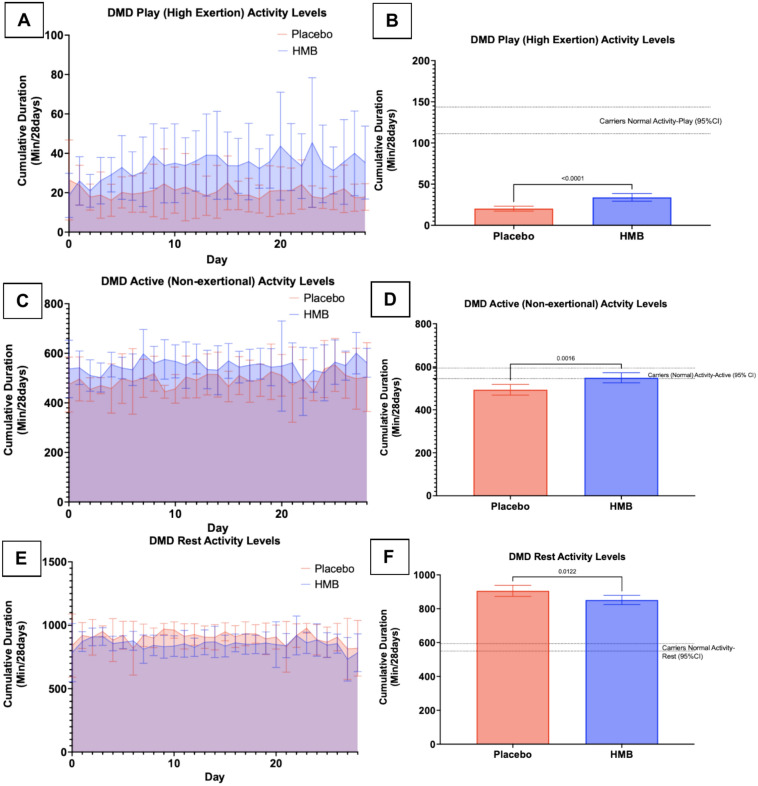
Duchenne muscular dystrophy (DMD) is a severe neuromuscular disease due to loss of dystrophin, leading to progressive muscle wasting and physical inactivity. In this pilot study, we studied the effect of daily supplementation of the anabolic substrate beta-hydroxy-beta-methylbutyrate (HMB) on whole body protein and amino acid kinetics using novel isotope methods and daily activity in a canine model of DMD. Six DMD dogs were administered 3 g daily of HMB or placebo for 28 days according to a randomized, placebo-controlled, double-blinded crossover design. We measured pre- and post-intervention daily activity, biochemistry markers, and whole-body amino acid kinetics. We tracked daily activity with an activity monitoring device and measured plasma creatine kinase and standard clinical biochemistry panels to monitor muscle and organ function. To calculate whole body and intracellular amino acid production, we administered in the postabsorptive state an IV stable isotope solution containing 20 amino acid tracers. We collected blood before and six times after until two hours post tracer pulse administration and measured amino acid enrichments and concentrations by LC-MS/MS, subsequently followed by (non) compartmental modeling of the decay enrichment curves. Results were expressed as mean with 95% CI. Whole body production, plasma concentrations, and intra-/extracellular compartmental analyses of various amino acids were attenuated in HMB-dosed DMD dogs. Specifically, the plasma concentration of hydroxyproline (marker of collagen breakdown) was significantly higher in the placebo group compared to the HMB group. The intra- and extracellular pool sizes and flux between the two compartments of hydroxyproline was reduced in HMB treated dogs. DMD dogs treated with HMB as compared to placebo had a respective 40% increase in exertional (play) (951 [827, 1075] versus 569 [491, 647]; p < 0.0001) and 10.5% increase in non-exertional (active) activity (15,366 [14742, 15990] versus 13,806 [13148,14466]; p = 0.0016). In addition, a 6% reduction was found in rest time after HMB supplementation compared to placebo (23,857 [23,130, 24,584], versus 25,363 [24500, 26225]; p = 0.0122). Creatine kinase was not statistically different between groups. We did not observe any adverse clinical or biochemical-related effects of HMB dosing. Daily HMB supplementation in DMD dogs can safely and positively influence protein and amino acid metabolism and improve overall daily activity.
Keywords: Dog; Duchenne; Dystrophin; Dystrophy; HMB; Muscle.
© 2025. The Author(s).
Conflict of interest statement
Declarations. Competing interests: PPN is a paid consultant of Agada Biosciences, a scientific advisory board member of Bioramics, LLC, and has an equity stake in SCRM-Bio. The other authors do not report any competing interests.
Figures



References
-
- Hoffman, E. P., Brown, R. H. & Kunkel, L. M. Dystrophin: the protein product of the Duchenne muscular dystrophy locus. Cell219(2), 402–414 (1987). - PubMed
MeSH terms
Substances
LinkOut - more resources
Full Text Sources
