. 2024 Dec 21;33(1):200927.
doi: 10.1016/j.omton.2024.200927. eCollection 2025 Mar 20.

Combinatorial immunotherapy with anti-ROR1 CAR NK cells and an IL-21 secreting oncolytic virus against neuroblastoma

Affiliations

Combinatorial immunotherapy with anti-ROR1 CAR NK cells and an IL-21 secreting oncolytic virus against neuroblastoma

Yaya Chu et al. Mol Ther Oncol. .

Abstract

Children with recurrent/metastatic neuroblastoma (NB) have a dismal survival (<25%). Novel therapies are desperately needed. Receptor tyrosine kinase-like orphan receptor 1 (ROR1) is highly expressed on NB. C021 is a selective oncolytic herpes simplex virus modified to overexpress human interleukin-21 (hIL-21), a cytokine that enhances natural killer (NK) cell cytotoxicity. In the current study, we successfully engineered ex-vivo-expanded NK cells to express a chimeric antigen receptor (CAR) against ROR1 using mRNA electroporation and investigated the efficacy of anti-ROR1-CAR-NK cells combined with C021 in targeting ROR1+ NB. We found that C021-infected NB cells secreted hIL-21 in vitro and in vivo. Compared to the non-cytokine-secreting parental virus C134, C021 significantly enhanced the in vitro cytotoxicity (p < 0.05) of anti-ROR1-CAR-NK cells with increased interferon (IFN)-γ (p < 0.05), granzyme B (p < 0.05), and perforin (p < 0.05) secretion against NB cells. Furthermore, the combination of C021 and anti-ROR1-CAR-NK cells significantly extended the survival of human NB xenografted NSG mice compared to controls (mock NK, ROR1-CAR-NK, C134, C021, C134+ROR1-CAR-NK, and C021+mock NK). Our results suggest that cytokine-secreting oncolytic virus in combination with CAR-NK cells is a novel, effective immunotherapeutic approach for high-risk NB.

Keywords: CAR; IL-21; ROR1; chimeric antigen receptor; interleukin-21; natural killer cells; neuroblastoma; oncolytic herpes simplex virus.


Conflict of interest statement

This work was presented in part at the Pediatric Transplantation & Cellular Therapy Consortium (2023), Fort Worth, TX; International Society for Cell & Gene Therapy (2022), San Francisco, CA; and Transplantation & Cellular Therapy Meetings of the American Society for Transplantation and Cellular Therapy (2022), Salt Lake City, Utah. M.S.C. has served as a consultant for Jazz Pharmaceuticals, Omeros Pharmaceuticals, Servier Pharmaceuticals, Abbvie, and Novartis Pharmaceuticals; on speakers bureau for Jazz Pharmaceuticals, Servier Pharmaceuticals, Amgen, Inc., Sanofi, and Sobi; and on the advisory board for Astra Zeneca and has received research funding from Celularity, Merck, Miltenyi Biotec, Servier, Omeros, Jazz, and Janssen. D.A.L. reports personal fees and other fees from Kiadis Pharma, CytoSen Therapeutics, Courier Therapeutics, and Caribou Biosciences outside the submitted work. In addition, D.A.L. has a patent broadly related to NK cell therapy of cancer with royalties paid to Kiadis Pharma. T.P.C. recently served as a one-time consultant to Blueprint, Incyte, and Oncopeptides and a DSMB chair for SpringWorks and is a cofounder of Vironexis Biotherapeutics, Inc.

Figures

None
Graphical abstract
Figure 1
Figure 1
The effects of C134 and C021 on NB cells and ex-vivo-expanded NK cells in vitro (A) Schematic representation of C134 and C021 constructs. C021 contains the hIL-21 gene and dsRed (linked by a 2A element) within both copies of the γ134.5 deletion locus of C134. (B) C021-infected CHLA-255 cells secreted significantly higher levels of hIL-21 on day 2 at MOI = 0.0001 (p < 0.001) compared to day 1, 3, or 6. n = 3. In this and the subsequent panels, markers represent the mean values, error bars indicate the standard deviation (SD) of triplicate samples in a representative experiment. The same trend was seen in three independent biological replicates. Results were compared using the two-tailed Student t-test with p < 0.05 considered as significant. (C) C021-infected CHLA-255 cells secreted significantly higher levels of hIL-21 on day 2 at MOI = 0.001 (p < 0.001) compared to day 1, 3, or 6. n = 3. (D) C021 significantly reduced the viability of CHLA-255 cells at day 2, 3, or 6 (p < 0.001) compared to day 1 at MOI = 0.0001. n = 3. (E) C021 significantly reduced the viability of CHLA-255 cells at day 2, 3, or 6 (p < 0.001) compared to day 1 at MOI = 0.001. n = 3. (F) At MOI = 0.025, C021-infected SKNFI cells secreted significantly higher levels of hIL-21 on day 3 (p < 0.001) compared to day 1, 2, 5, 7, 9, or 11. n = 3. (G) Both C134 and C021 infections significantly reduced the viability of SKNFI cells at 24 h at MOI = 0.01, 0.1, or 1 compared to MOI = 0.001 (p < 0.001). n = 3. (H) Ex-vivo-expanded NK cells were incubated with C134 or C021 at the indicated MOI. NK viability was measured at 24 and 48 h by CellTiter 96 AQueous one solution cell proliferation assay. n = 3. ∗p < 0.05 and ∗∗∗p < 0.001.
Figure 2
Figure 2
C021 significantly enhanced in vitro cytotoxicity with the enhanced release of granzyme B, IFN-γ, and perforin of anti-ROR1-CAR-NK cells against NB cells (A) Mock NK or anti-ROR1-CAR-NK cells (CAR) were incubated with SKNFI cells at E:T = 3:1 with or without C134 or C021 (MOI = 0.025) for 24 h. The percentage of killing of SKNFI cells was measured by Britelite plus reporter gene assay. C021 significantly enhanced the in vitro cytotoxicity of anti-ROR1-CAR-NK cells against SKNFI cells compared to controls. In this and the subsequent panels, columns represent the mean values, error bars indicate the standard deviation (SD) of triplicate samples in a representative experiment. The same trend was seen in three independent biological replicates. Results were compared using the two-tailed Student t-test with p < 0.05 considered as significant. (B–D) After 24 h co-culture under the condition as described in (A), the supernatants were collected for ELISAs to determine the released granzyme B (B), IFN-γ (C), and perforin (D) levels. (E) Mock NK or anti-ROR1-CAR-NK cells (CAR) were incubated with CHLA-255 cells at E:T = 1:1 with or without C134 or C021 (MOI = 0.001) for 24 h. The percentage of killing of CHLA-255 cells was measured by Britelite plus reporter gene assay. C021 significantly enhanced the in vitro cytotoxicity of anti-ROR1-CAR-NK cells against CHLA-255 cells compared to controls (p = 0.0286 vs. CAR and CAR+C134, p < 0.0001 vs. C021). (F–H) After 24 h co-culture under the condition as described in (E), the supernatants were collected for ELISAs to determine the released granzyme B (F), IFN-γ (G), and perforin (H) levels. n = 4.
Figure 3
Figure 3
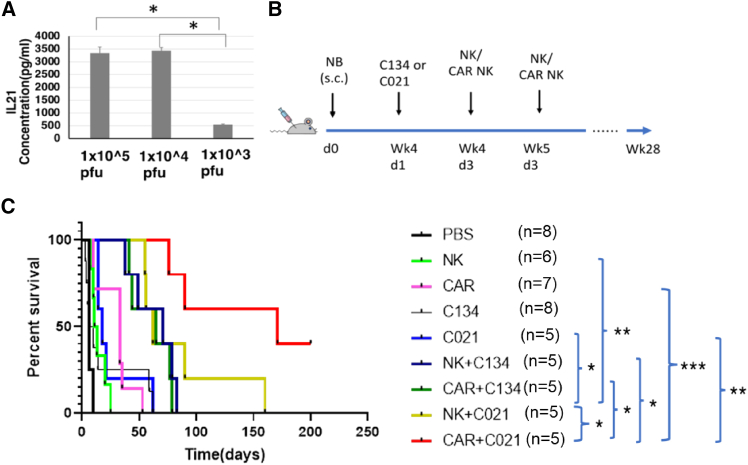
The combination of anti-ROR1 CAR NK+C021 significantly extended the survival of NB xenografted NSG mice (A) hIL-21 expression in C021-injected NB xenograft tumors. 2 × 107 of CHLA-255-Luc cells were subcutaneously injected into the right flank of NSG mice. After the tumor diameter reached 1 ± 0.3 cm, one dose of 1 × 103, 104, or 105 PFU C021 was intratumorally injected into CHLA-255-Luc xenografted NSG mice. Two days later, tumors were collected and homogenized in 1 mL RPMI1640 medium. The tumor samples were centrifuged, and the supernatant was collected and used for IL-21 ELISAs. Columns represent the mean values, error bars indicate the standard deviation (SD) of all the samples. Results were compared using the two-tailed Student t-test with p < 0.05 considered as significant. (B) Experimental schema. 2 × 107 of CHLA-255-Luc cells were subcutaneously injected into the right flank of NSG mice. After the tumor diameter reached 1 ± 0.3 cm, one dose of PBS or 1 × 104 PFU C134 or C021 was intratumorally injected into CHLA-255-Luc xenografted mice. PBS, 5 × 106 expanded peripheral blood natural killer (exPBNK) cells, or 5 × 106 anti-ROR1-CAR-NK cells were intraperitoneally injected to each mouse 2 or 9 days after viral injection. (C) The Kaplan-Meier survival curves of mice receiving treatment are shown using animal sacrifice as the terminal event. Survival curves were analyzed using the log rank (Mantel-Cox) test. The mice treated with anti-ROR1-CAR-NK+C021 (n = 5) significantly extended the survival of CHLA255 xenografted mice as compared to the control groups, which were treated with mock NK+C021 (n = 5, p < 0.05), anti-ROR1-CAR-NK cells alone (n = 5, p < 0.05), or C021 alone (n = 5, p < 0.01). NK, mock NK; CAR, anti-ROR1-CAR-NK. ∗p < 0.05, ∗∗p < 0.01, and ∗∗∗p < 0.001.

References

    1. Maris J.M., Hogarty M.D., Bagatell R., Cohn S.L. Neuroblastoma. Lancet. 2007;369:2106–2120. doi: 10.1016/S0140-6736(07)60983-0. - DOI - PubMed
    1. Smith V., Foster J. High-Risk Neuroblastoma Treatment Review. Children. 2018;5 doi: 10.3390/children5090114. - DOI - PMC - PubMed
    1. Kipps T.J. ROR1: an orphan becomes apparent. Blood. 2022;140:1583–1591. doi: 10.1182/blood.2021014760. - DOI - PMC - PubMed
    1. Shabani M., Naseri J., Shokri F. Receptor tyrosine kinase-like orphan receptor 1: a novel target for cancer immunotherapy. Expert Opin. Ther. Targets. 2015;19:941–955. doi: 10.1517/14728222.2015.1025753. - DOI - PubMed
    1. Vivier E., Raulet D.H., Moretta A., Caligiuri M.A., Zitvogel L., Lanier L.L., Yokoyama W.M., Ugolini S. Innate or adaptive immunity? The example of natural killer cells. Science. 2011;331:44–49. doi: 10.1126/science.1198687. - DOI - PMC - PubMed

LinkOut - more resources