


Glial activation among individuals with neurological post-acute sequelae of coronavirus disease 2019: A positron emission tomography study of brain fog using [18F]-FEPPA
- PMID: 39897172
- PMCID: PMC11786203
- DOI: 10.1016/j.bbih.2025.100945
Glial activation among individuals with neurological post-acute sequelae of coronavirus disease 2019: A positron emission tomography study of brain fog using [18F]-FEPPA
Abstract
Background: This study examined the regional distribution of glial activation in essential workers with neurological post-acute sequelae of coronavirus disease 2019 (COVID-19) infections (N-PASC).
Methods: We injected ≤185 MBq of [18F]-FEPPA as an intravenous bolus and positron-emission tomography over 2 h. To measure distribution volume (VT) we recruited 24 essential workers (14 N-PASC, 10 Never-COVID-19 Controls, of whom 22 successfully placed arterial lines). Individuals with low binding affinity were excluded from this study, and VT was adjusted for translocator protein genotype. Analyses that passed the false discovery rate are reported.
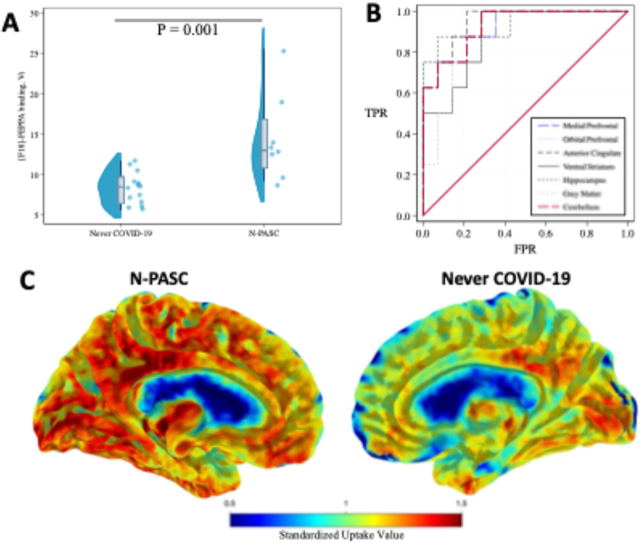
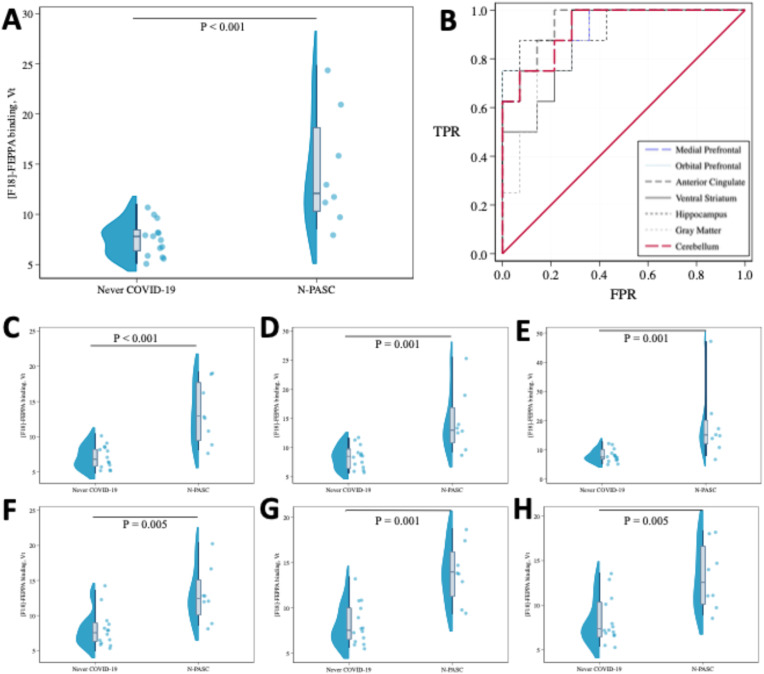
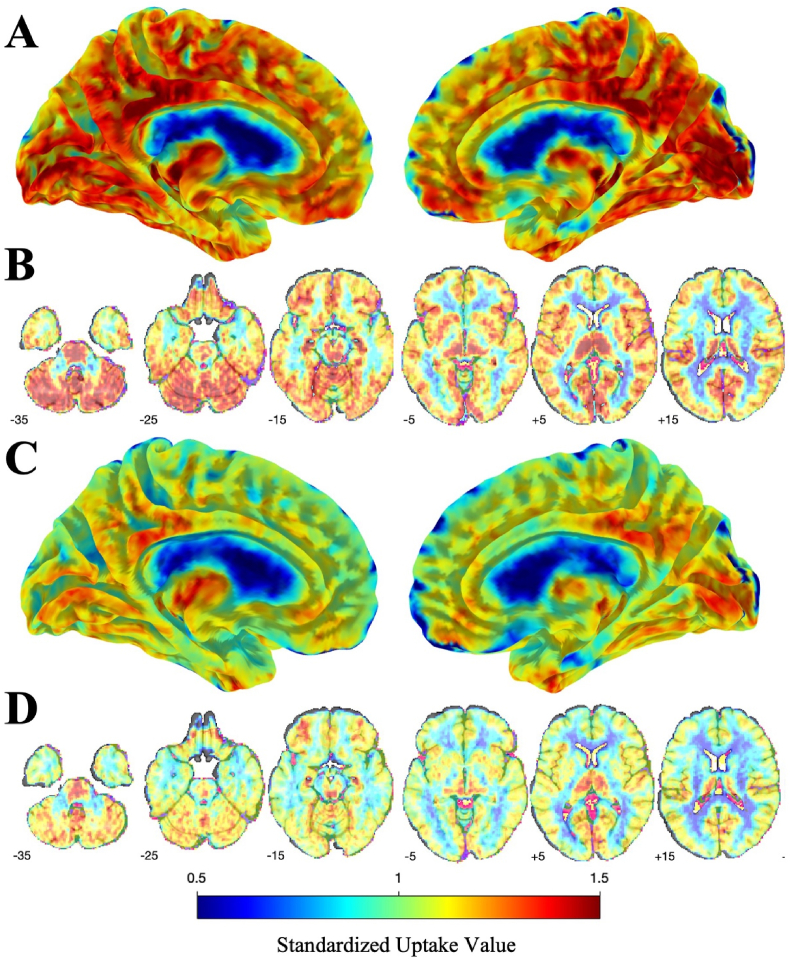
Results: Participants at midlife survived mild to moderate COVID-19 without hospitalization but reported onset of post-acute sequelae of COVID-19 (PASC) for, on average, 22 months before undergoing neuroimaging. Hippocampal VT was higher (VT = 1.70, 95% C.I. = [1.30-2.21], p = 0.001) in participants with persistent brain fog after COVID-19, reflecting an increase of 10.58 mL/cm3 in VT (area under the receiver-operating curve, AUC = 0.95 [0.85-1.00]). At a cutoff of 10.6, sensitivity/specificity/accuracy were 0.88/0.93/0.91.
Conclusion: The results from this study imply that neuroimmune response is a distinct and identifiable characteristic of brain fog after COVID-19. Results suggest that [18F]-FEPPA could be used to support N-PASC diagnosis.
Keywords: Brain Fog; COVID-19; Essential Workers; FEPPA; Glial activation; Positron emission tomography; Post-acute sequelae of COVID-19; Respiratory infection; Translocator protein.
© 2025 The Authors.
Conflict of interest statement
The authors declare the following financial interests/personal relationships which may be considered as potential competing interests: Sean Clouston reports financial support was provided by 10.13039/100000049National Institute on Aging. Benjamin Luft reports financial support was provided by 10.13039/100000125National Institute for Occupational Safety and Health. If there are other authors, they declare that they have no known competing financial interests or personal relationships that could have appeared to influence the work reported in this paper.
Figures
References
-
- Benjamini Y., Hochberg Y. Controlling the false discovery rate - a practical and powerful approach to multiple testing. Journal of the Royal Statistical Society Series B-Methodological. 1995;57(1):289–300.
Grants and funding
LinkOut - more resources
Full Text Sources
