


Data impacts of changes in U.S. Census Bureau procedures for race and ethnicity data
- PMID: 39897609
- PMCID: PMC11783112
- DOI: 10.1016/j.ssmph.2024.101742
Data impacts of changes in U.S. Census Bureau procedures for race and ethnicity data
Abstract
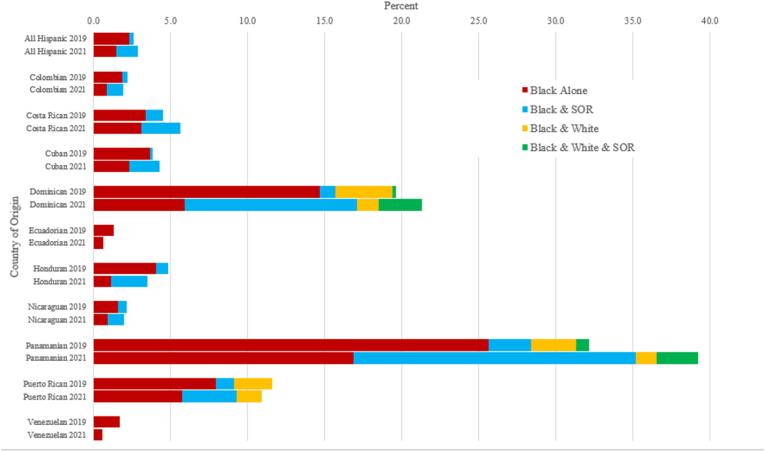
Beginning with the 2020 decennial census and the 2020 American Community Survey (ACS), the U.S. Census Bureau implemented changes in question design, data processing, and coding procedures for the race and ethnicity data they collect that appear to have resulted in major data discontinuity. However, the Census Bureau has not released nor plans to release research showing the impact of these changes. We explore the impact of the Census Bureau's procedural changes on the racial and ethnic distributions of the Hispanic (generally and by country of origin) and the American Indian and Alaska Native populations, the two populations most impacted by these changes. We use the 2019 and 2021 one-year ACS public-use microdata and 2019 and 2021 NCHS mortality data to compare racial distributions and estimate and compare select demographic and socioeconomic characteristics, and mortality measures across the two years. Our results show that changes the Census Bureau implemented beginning with the 2020 decennial census and ACS appear to have had a significant impact on the comparability of Census Bureau race and ethnicity data. We find a significant data discontinuity impacting a wide variety of demographic, socioeconomic, and mortality statistics and analyses that rely on U.S. Census Bureau data as input for calculations. To mitigate these effects, methods that bridge race and ethnicity data between pre- and post-2020 census data are needed. Our research brings new attention and clarity to the race and ethnicity data discontinuity in Census Bureau data that started in 2020.
Keywords: Census race coding changes; Census race question; Ethnicity; Hispanic; Latino; Multiple race; Race; Racial population composition; Some Other Race.
Conflict of interest statement
The authors declare that they have no known competing financial interests or personal relationships that could have appeared to influence the work reported in this paper.
Figures


References
-
- Arias E., Heron M., Hakes J.K. Vital health stat 2(172) National Center for Health Statistics; Hyattsville, MD: 2016. The validity of race and Hispanic origin reporting on death certificates in the United States: An update.https://www.cdc.gov/nchs/data/series/sr_02/sr02_172.pdf Available from: - PubMed
-
- Arias E., Schauman W.S., Eschbach K., Sorlie P.D., Backlund E. The validity of race and Hispanic origin reporting on death certificates in the United States. National Center for Health Statistics. Vital Health Stat. 2008;2(148) https://www.cdc.gov/nchs/data/series/sr_02/sr02_148.pdf Available from: - PubMed
-
- Arias E., Tejada-Vera B., Kochanek K.D., Ahmad F.B. National Center for Health Statistics; Hyattsville, MD: 2022. Provisional life expectancy estimates for 2021. National vital statistics rapid release, no 23.https://www.cdc.gov/nchs/data/vsrr/vsrr023.pdf Available from:
LinkOut - more resources
Full Text Sources
