


Patient-reported outcomes after immediate and delayed DIEP-flap breast reconstruction in the setting of post-mastectomy radiation therapy-results of the multicenter UMBRELLA breast cancer cohort
- PMID: 39899162
- PMCID: PMC11953195
- DOI: 10.1007/s10549-025-07613-w
Patient-reported outcomes after immediate and delayed DIEP-flap breast reconstruction in the setting of post-mastectomy radiation therapy-results of the multicenter UMBRELLA breast cancer cohort
Abstract
Purpose: Timing of Deep Inferior Epigastric artery Perforator (DIEP)-flap breast reconstruction in the context of post-mastectomy radiotherapy for breast cancer patients is topic of debate. We compared the impact of immediate (before radiotherapy) versus delayed (after radiotherapy) DIEP-flap breast reconstruction (IBR versus DBR) on short- and long-term patient-reported outcomes (PROs).
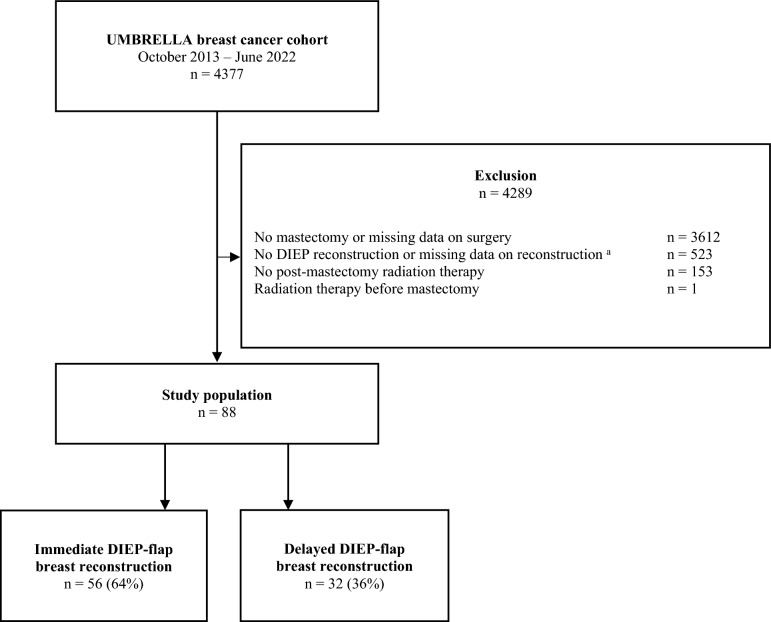
Methods: Within the prospective, multicenter breast cancer cohort (UMBRELLA), we identified 88 women who underwent immediate or delayed DIEP-flap breast reconstruction and received PMRT. At 6 and 12 months post-mastectomy, as well as on long-term (≥ 12 months post-reconstruction) body image, breast symptoms, physical functioning, and pain were measured by EORTC-QLQ-30/BR23. Additionally, long-term evaluation included satisfaction with breast(s), physical well-being and self-reported adverse effects of radiation as measured by BREAST-Q, and late treatment toxicity. PROs were compared between groups using independent sample T-test.
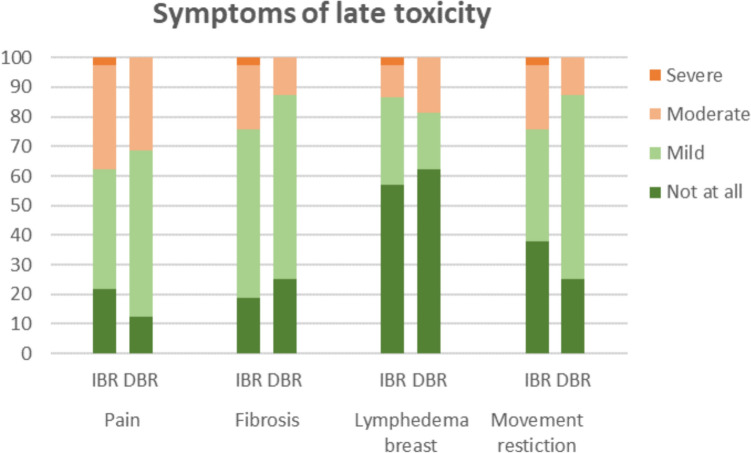
Results: IBR was performed in 56 patients (64%) and DBR in 32 patients (36%), with 15 months of median time to reconstruction. At 6 and 12 months post-mastectomy, better body image and physical functioning were observed after IBR. No statistically nor clinically relevant differences were observed in long-term EORTC and BREAST-Q outcomes (median follow-up 37-41 months for IBR vs. 42-46 months for DBR). Patients with IBR reported more fibrosis and movement restriction (median follow-up 29 vs. 61 months, resp.).
Conclusion: Long-term PROs were comparable for patients with IBR and DBR, despite more patient-reported fibrosis and movement restriction after IBR. Therefore, both treatment pathways can be considered when opting for autologous breast reconstruction in the setting of PMRT.
Keywords: Breast cancer; DIEP-flap breast reconstruction; Late radiation toxicity; Oncoplastic breast surgery; Patient-reported outcome.
© 2025. The Author(s).
Conflict of interest statement
Declarations. Competing interests: The authors declare no competing interests. Ethical approval: This study was performed in line with the principles of the Declaration of Helsinki. Approval was granted by the Medical Research Ethics Committee (MREC) Utrecht (NL52651.041.15, MEC15/165). Consent to participate: Informed consent was obtained from all individual participants included in the study.
Figures
Comment in
-
Key considerations for interpreting patient-reported outcomes in deep inferior epigastric artery perforator flap reconstruction with post-mastectomy radiotherapy.Transl Cancer Res. 2025 Jun 30;14(6):3292-3294. doi: 10.21037/tcr-2025-423. Epub 2025 Jun 13. Transl Cancer Res. 2025. PMID: 40687226 Free PMC article. No abstract available.
References
-
- Zehra S, Doyle F, Barry M, Walsh S, Kell MR (2020) Health-related quality of life following breast reconstruction compared to total mastectomy and breast-conserving surgery among breast cancer survivors: a systematic review and meta-analysis. Breast Cancer 27(4):534–566. 10.1007/s12282-020-01076-1 - PubMed
Publication types
MeSH terms
LinkOut - more resources
Full Text Sources
Medical
Miscellaneous
