


Perineural Invasion Unveiled: Deciphering the Prognostic Impact of Diameter and Quantity Subcategories in Oral Cancer
- PMID: 39902557
- PMCID: PMC11792026
- DOI: 10.1177/19160216251316219
Perineural Invasion Unveiled: Deciphering the Prognostic Impact of Diameter and Quantity Subcategories in Oral Cancer
Abstract
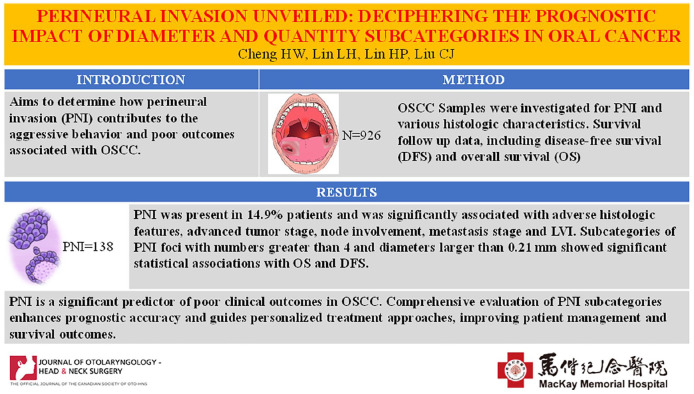
Importance: Perineural invasion (PNI) is an established prognostic factor in oral squamous cell carcinoma (OSCC), but the impact of its subcategories on survival is not fully understood. This study quantifies the number and diameter of PNI foci to assess their prognostic relevance in OSCC.
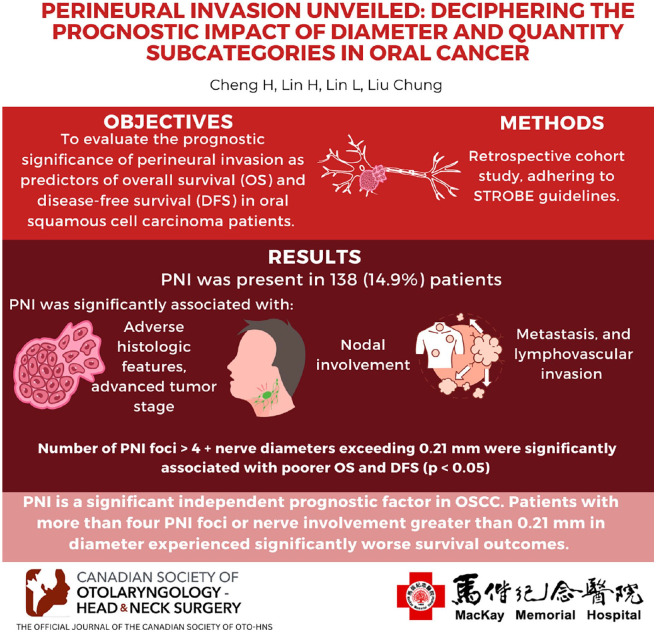
Objective: To evaluate the prognostic significance of PNI subcategories, specifically the number and diameter of PNI foci, as predictors of overall survival (OS) and disease-free survival (DFS) in OSCC patients.
Design: Retrospective cohort study, adhering to STROBE guidelines.
Setting: Single-center study at MacKay Memorial Hospital, Taiwan, including patients diagnosed with OSCC from 2005 to 2018.
Participants: Nine hundred twenty-six patients with biopsy-proven OSCC, excluding those with perioperative mortality or incomplete follow-up.
Exposure: Histological evaluation of PNI, including quantifying the number and diameter of invaded nerves, along with clinicopathological features such as tumor stage and lymphovascular invasion (LVI).
Main outcome measures: OS and DFS, assessed via Cox proportional hazards models, Kaplan-Meier survival analysis, and receiver operating characteristic curve analysis for PNI foci subcategories.
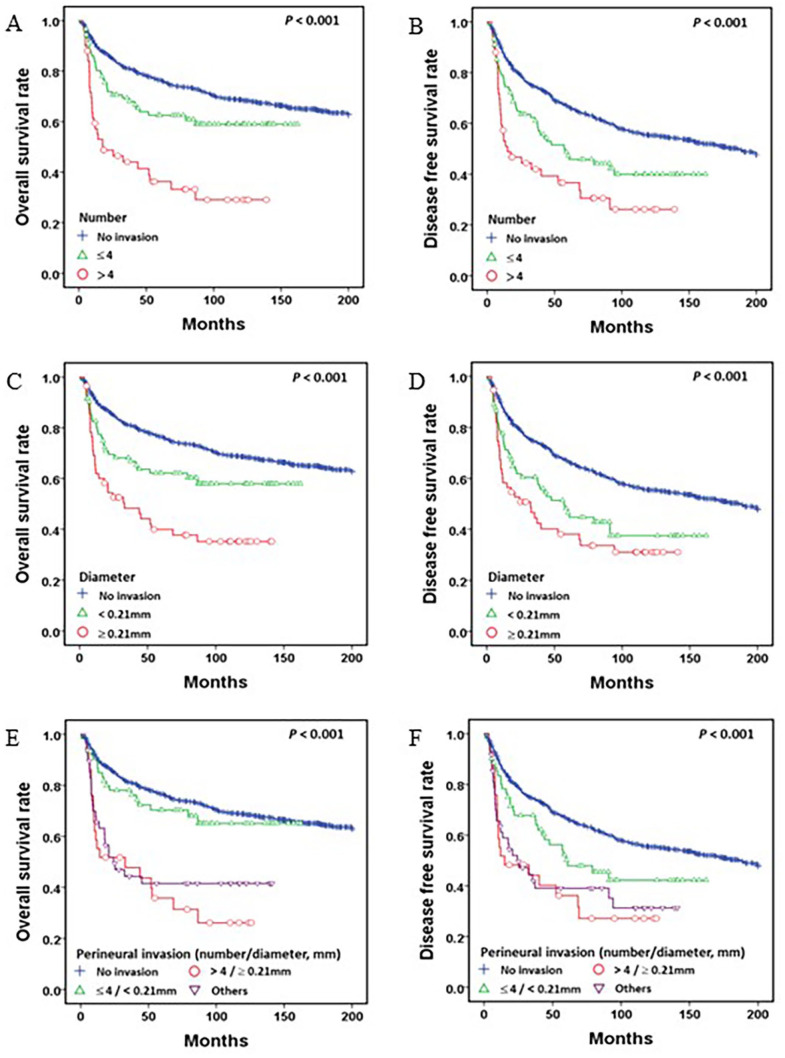
Results: PNI was present in 138 (14.9%) patients and was significantly associated with adverse histologic features, advanced tumor stage, nodal involvement, metastasis, and LVI. Multivariate analysis revealed that both the number of PNI foci greater than 4 and nerve diameters exceeding 0.21 mm were significantly associated with poorer OS and DFS (P < .05). After adjusting for clinical variables, PNI remained an independent predictor of worse OS [hazard ratio (HR): 1.37] and DFS (HR: 1.46).
Conclusions and relevance: PNI is a significant independent prognostic factor in OSCC. Patients with more than 4 PNI foci or nerve involvement greater than 0.21 mm in diameter experienced significantly worse survival outcomes. These findings suggest that detailed assessment of PNI subcategories should be incorporated into OSCC management, guiding treatment decisions and potentially informing the need for adjuvant therapies.
Keywords: oral cancer; perineural invasion; prognosis; survival.
Conflict of interest statement
Declaration of Conflicting InterestsThe author(s) declared no potential conflicts of interest with respect to the research, authorship, and/or publication of this article.
Figures
References
-
- Boute P, Page C, Biet A, Cuvelier P, Strunski V, Chevalier D. Epidemiology, prognosis and treatment of simultaneous squamous cell carcinomas of the oral cavity and hypopharynx. Eur Ann Otorhinolaryngol Head Neck Dis. 2014;131(5):283-287. - PubMed
-
- World Health Organization. Cancer Today. GLOBOCAN 2022; 2022. Accessed May 30, 2024. https://gco.iarc.fr/today/online-analysis-table?v=2020&mode=cancer&mode_...
-
- Carvalho AL, Ikeda MK, Magrin J, Kowalski LP. Trends of oral and oropharyngeal cancer survival over five decades in 3267 patients treated in a single institution. Oral Oncol. 2004;40(1):71-76. - PubMed
-
- Brandwein-Gensler M, Teixeira MS, Lewis CM, et al. Oral squamous cell carcinoma: histologic risk assessment, but not margin status, is strongly predictive of local disease-free and overall survival. Am J Surg Pathol. 2005;29(2):167-178. - PubMed
MeSH terms
LinkOut - more resources
Full Text Sources
Medical
