


Depicting "arms race" of Rhipicephalus microplus and its host on a single frame platform
- PMID: 39903310
- PMCID: PMC11794405
- DOI: 10.1007/s00436-025-08459-3
Depicting "arms race" of Rhipicephalus microplus and its host on a single frame platform
Abstract
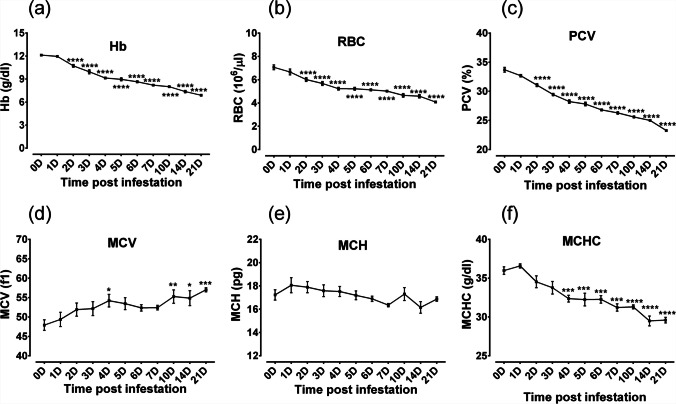
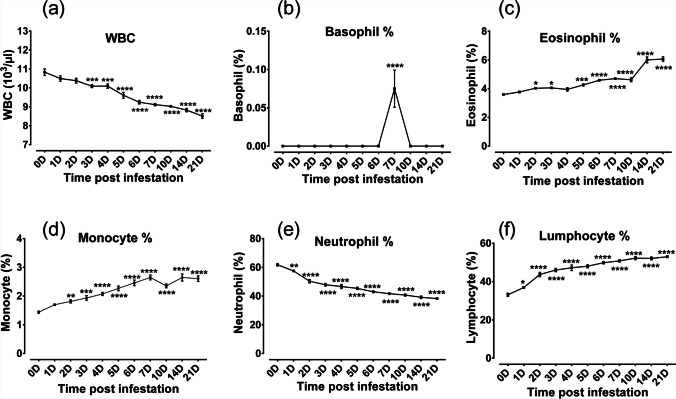
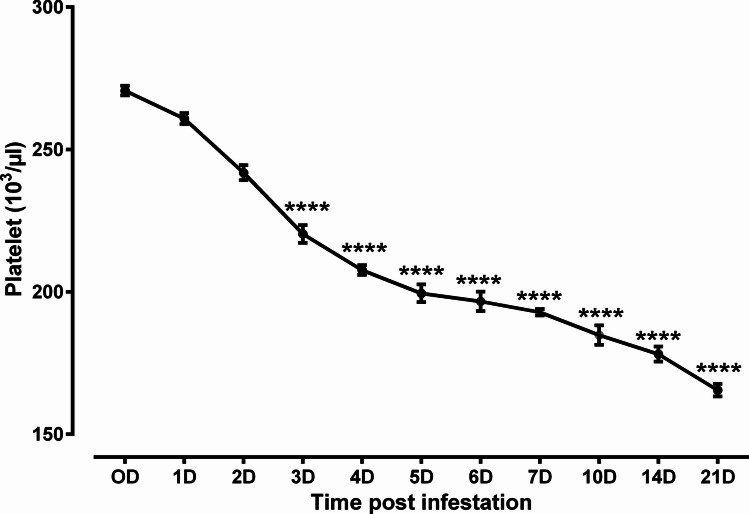
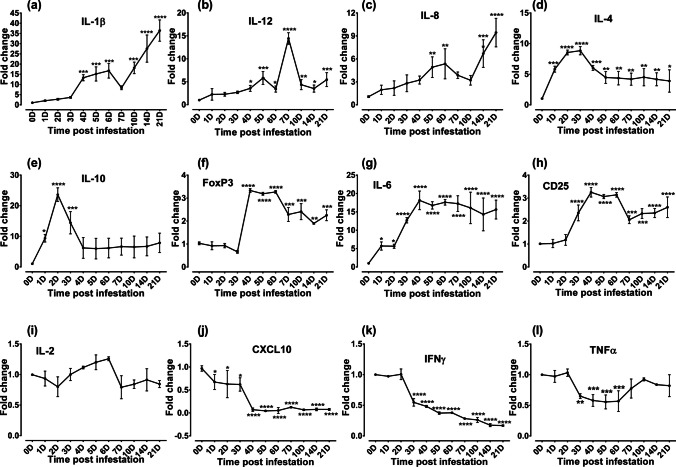
To improve our knowledge on host-parasite interaction, the study was undertaken on Rhipicephalus microplus infestation in cross breed cattle. This tick, being a voracious blood sucker, remains attached to the skin for prolonged period and inoculates saliva during blood feeding. Biomolecules present in the saliva have detrimental effects on host system. The present study deals with the effects of R. microplus in artificially infected nine months old cattle for a period of 21 days. There was physiological alteration during tick infestation in terms of body temperature, pulse, and respiration rate. There was drop in haemoglobin gram percentage, platelet count, total red and white blood cell count. Thrombocytopenia in infested animals was suggestive of iron deficient anaemia after artificial infestation. R. microplus infestation was found to induce stress in experimental animals. Our study on peripheral blood gene expression was suggestive of Th2 polarization since there was increased IL-4 response. Increased IL-6 response indicated skin damage due to R. microplus infestation and we further correlate eosinophilia with up-regulation of IL-6 and IL-8 responses. Increased IL-10 response and decreased IFN-γ response were suggestive of immunosuppressive and anti-inflammatory properties of tick saliva.
Keywords: Rhipicephalus microplus; Blood profile; Cytokines; Host-parasite interaction; Interleukin; Physiological parameters.
© 2025. The Author(s).
Conflict of interest statement
Declarations. Ethics approval: The whole experimentation and sampling were done in accordance with the guidelines of the Institute Ethics Committee of ICAR-Central Island Agricultural Research Institute (ICAR-CIARI), Port Blair, Andaman and Nicobar Islands, India after taking necessary approval (Letter no. ICAR-CIARI/IEC/209/28.02.2022). Required animal handling and welfare guidelines were followed. Clinical trial number not applicable. Consent for publication: Not applicable. Competing interests: The authors declare no competing interests.
Figures
References
-
- Abreu MR, Pereira MC, Simioni PU, Nodari EF, Paiatto LN, Camargo-Mathias MI (2019) Immunomodulatory and morphophysiological effects of Rhipicephalus sanguineus s. l. (Acari: Ixodidae) salivary gland extracts. Vet Immunol Immunopathol 207:36–45. 10.1016/j.vetimm.2018.11.017 - PubMed
-
- Akbari O, Freeman GJ, Meyer EH, Greenfield EA, Chang TT, Sharpe AH, Berry G, DeKruyff RH, Umetsu DT (2002) Antigen-specific regulatory T cells develop via the ICOS-ICOS-ligand pathway and inhibit allergen-induced airway hyper-reactivity. Nat Med 8:1024–1032. 10.1038/nm745 - PubMed
-
- Alam MM, Hashem MA, Rahman MM, Hossain MM, Haque MR, Sobhan Z, Islam MS (2011) Effect of Heat Stress on Behaviour, Physiological and Blood Parameters of Goat. Progress Agric 22:37–45. 10.3329/pa.v22i1-2.16465
-
- Alarcon-Chaidez FJ, Sun J, Wikel SK (2007) Transcriptome analysis of the salivary glands of Dermacentor andersoni Stiles (Acari: Ixodidae). Insect Biochem Mol Biol 37:48–71. 10.1016/j.ibmb.2006.10.002 - PubMed
-
- Arlian LG, Morgan MS, Peterson KT (2007) House dust and storage mite extracts influence skin keratinocyte and fibroblast function. Int Arch Allergy Immunol 145:33–42. 10.1159/000107464 - PubMed
MeSH terms
Substances
LinkOut - more resources
Full Text Sources
