


Prevalence and Patterns of Opioid Use in Chronic Pancreatitis
- PMID: 39907252
- PMCID: PMC12101912
- DOI: 10.14309/ctg.0000000000000807
Prevalence and Patterns of Opioid Use in Chronic Pancreatitis
Abstract
Introduction: Opioids are used to treat pain in chronic pancreatitis (CP), but little is known about current use patterns. The aim of this study was to characterize the utilization of opioids and associations with clinical characteristics in adult patients with CP.
Methods: This cross-sectional analysis used baseline data from participants with definite CP enrolled in a cohort study in the United States (PROspective Evaluation of CP for EpidEmiologic and Translational StuDies). Data on demographics, pain medication use, healthcare utilization, disability, and pain patterns were systematically collected in case report forms while quality of life was assessed with patient-reported outcome instruments. Opioid use was classified according to strength (weak or strong) and frequency (scheduled or as-needed).
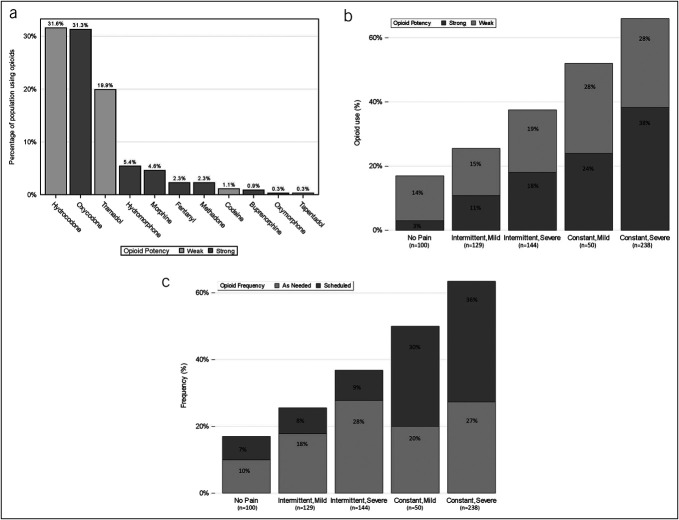
Results: A total of 681 participants (n = 364, 53% male) were included: 299 (44%) were current opioid users (22% only weak opioids and 22% at least 1 strong opioid). Increasing frequency and severity of pain was associated with increase of weak, strong, as-needed, or scheduled opioids. Neuromodulators were used by ∼40% of participants; increasing use was associated with increasing frequency and severity of pain. On multivariate analysis, independent predictors associated with strength and frequency of current opioid use were pain patterns (odds ratios [ORs] 1.84-8.32 and ORs 1.92-8.52, respectively, P < 0.001) and prior celiac plexus block (OR 3.54, 95% confidence intervals 1.82-6.87 and OR 3.42, 95% confidence intervals 1.76-6.64, respectively). Participants using opioids had higher prevalence of disability, healthcare utilization, and poorer quality of life.
Discussion: Opioid use in CP is common and associated with increased pain severity and constancy. These data provide foundational estimates for future trials that can elucidate the complex interactions between patient factors, pain, and interventions.
Keywords: chronic pain; chronic pancreatitis; neuromodulator; opioid.
Copyright © 2025 Written work prepared by employees of the Federal Government as part of their official duties is, under the U.S. Copyright Act, a “work of the United States Government” for which copyright protection under Title 17 of the United States Code is not available. As such, copyright does not extend to the contributions of employees of the Federal Government.
Conflict of interest statement
Figures


References
-
- Drewes AM, Bouwense SAW, Campbell CM, et al. Guidelines for the understanding and management of pain in chronic pancreatitis. Pancreatology 2017;17(5):720–31. - PubMed
-
- Phillips AE, Faghih M, Drewes AM, et al. Psychiatric comorbidity in patients with chronic pancreatitis associates with pain and reduced quality of life. Am J Gastroenterol 2020;115(12):2077–85. - PubMed
-
- Bilal M, Chatila A, Siddiqui MT, et al. Rising prevalence of opioid use disorder and predictors for opioid use disorder among hospitalized patients with chronic pancreatitis. Pancreas 2019;48(10):1386–92. - PubMed
-
- Nusrat S, Yadav D, Bielefeldt K. Pain and opioid use in chronic pancreatitis. Pancreas 2012;41(2):264–70. - PubMed
MeSH terms
Substances
Grants and funding
- U01 DK108288/DK/NIDDK NIH HHS/United States
- U01 DK108332/DK/NIDDK NIH HHS/United States
- U01 DK 108288/DK/NIDDK NIH HHS/United States
- U01 DK 108300/DK/NIDDK NIH HHS/United States
- U01 DK108328/DK/NIDDK NIH HHS/United States
- U01DK108327/DK/NIDDK NIH HHS/United States
- R01DK 127042/DK/NIDDK NIH HHS/United States
- U01DK108320/DK/NIDDK NIH HHS/United States
- U01 DK108323/DK/NIDDK NIH HHS/United States
- R01 DK127042/DK/NIDDK NIH HHS/United States
- U01 DK108326/DK/NIDDK NIH HHS/United States
- U01DK108332/DK/NIDDK NIH HHS/United States
- U01 DK108306/DK/NIDDK NIH HHS/United States
- U01 DK108300/DK/NIDDK NIH HHS/United States
- U01DK 108326/DK/NIDDK NIH HHS/United States
- U01 DK108314/DK/NIDDK NIH HHS/United States
- U01 DK108327/DK/NIDDK NIH HHS/United States
- U01DK108306/DK/NIDDK NIH HHS/United States
- U01 DK108320/DK/NIDDK NIH HHS/United States
LinkOut - more resources
Full Text Sources
Medical
Miscellaneous
