. 2025 Feb;195(1):91-101.
doi: 10.1007/s00360-025-01604-5. Epub 2025 Feb 5.

In renal proximal tubular epithelial cells of the hibernator Syrian hamster, anoxia-reoxygenation-induced reactive oxygen species bursts do not trigger a DNA damage response and cellular senescence

Affiliations

In renal proximal tubular epithelial cells of the hibernator Syrian hamster, anoxia-reoxygenation-induced reactive oxygen species bursts do not trigger a DNA damage response and cellular senescence

Georgios Pissas et al. J Comp Physiol B. 2025 Feb.

Abstract

Ischemia-reperfusion (I-R) injury represents a predominant etiology of acute kidney injury (AKI), for which effective treatments remain unavailable. In contrast, hibernating mammals exhibit notable resistance to cell death induced by I-R injury. However, the impact of I-R injury on cellular senescence-an important factor in AKI-has not been extensively studied in these species. Comparative biology may offer novel therapeutic insights. Renal proximal tubular epithelial cells (RPTECs) from the native hibernator Syrian hamster or mouse RPTECs were subjected to anoxia-reoxygenation. Proteins involved in DNA damage response (DDR) and cellular senescence were assessed using western blotting, reactive oxygen species (ROS) levels and cell death were quantified colorimetrically, and IL-6 with ELISA. Anoxia-reoxygenation induced oxidative stress in both mouse and hamster RPTECs; however, cell death was observed exclusively in mouse cells. While anoxia-reoxygenation elicited a DDR and subsequent senescence in mouse RPTECs, such responses were not detected in hamster RPTECs. Thus, RPTECs from the Syrian hamster exhibited increased ROS production upon reoxygenation but did not show DDR or cellular senescence. Further research is required to elucidate the specific protective molecular mechanisms in hibernators, which could potentially lead to the development of novel therapeutic approaches for I-R injury in non-hibernating species, including humans.

Keywords: Acute kidney injury; DNA damage response; Hibernation; Ischemia-reperfusion; Senescence.


Conflict of interest statement

Declarations. Research involving human participants and/or animals: The study did not involve Human participants or animals. Competing interests: The authors declared no potential conflicts of interest with respect to the research, authorship, and/or publication of this article.

Figures

Fig. 1
Fig. 1
Anoxia-reoxygenation increases ROS and lipid peroxidation in both mouse and hamster RPTECs, but hamster cells survive. Anoxia-reoxygenation increased ROS and 4-HNE-modified proteins in mouse RPTECs (A, B, and C) and induced cell death (D). In hamster RPTECs, anoxia-reoxygenation similarly elevated ROS and 4-HNE-modified proteins (E, F, and G), but did not impact cell survival (H). White bars correspond to control conditions, while gray bars indicate anoxia-reoxygenation conditions. Error bars represent the standard error of the mean (SEM), and asterisks denote statistical significance with 𝑝<0.05
Fig. 2
Fig. 2
Anoxia-reoxygenation elicits a DDR in mouse but not in hamster RPTECs. In mouse RPTECs, anoxia-reoxygenation triggered a DDR, as indicated by elevated levels of γH2AX, p-ATM, p-p53, and total p53 (A and B). In contrast, anoxia-reoxygenation did not induce a DDR in hamster RPTECs, as the levels of γH2AX, p-ATM, p-p53, and p53 remained unchanged (C and D). White bars correspond to control conditions, while gray bars indicate anoxia-reoxygenation conditions. Error bars represent the standard error of the mean (SEM), and asterisks denote statistical significance with 𝑝<0.05
Fig. 3
Fig. 3
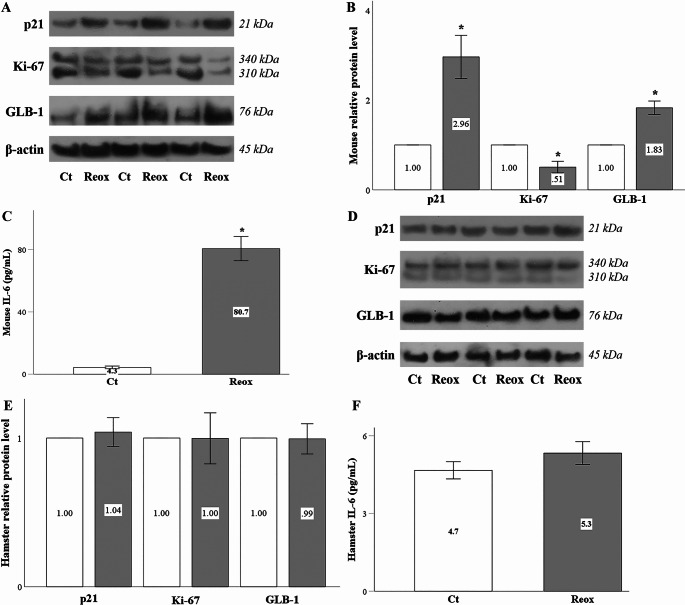
Anoxia-reoxygenation induces cellular senescence in mouse but not in hamster RPTECs. In mouse RPTECs, anoxia-reoxygenation triggered cellular senescence, as indicated by elevated levels of the cell cycle inhibitor p21, reduced expression of the proliferative marker Ki-67, and increased expression of the senescence-associated marker GLB-1 (A and B), accompanied by enhanced production of IL-6 (C).In contrast, anoxia-reoxygenation did not induce cellular senescence in hamster RPTECs, as indicated by the stable levels of p21, Ki-67, GLB-1 and IL-6 production (D, E, and F). White bars correspond to control conditions, while gray bars indicate anoxia-reoxygenation conditions. Error bars represent the standard error of the mean (SEM), and asterisks denote statistical significance with 𝑝<0.05

References

    1. Andrienko TN, Pasdois P, Pereira GC, Ovens MJ, Halestrap AP (2017) The role of succinate and ROS in reperfusion injury– A critical appraisal. J Mol Cell Cardiol 110:1–14. 10.1016/j.yjmcc.2017.06.016 - PMC - PubMed
    1. Baisantry A, Berkenkamp B, Rong S, Bhayadia R, Sörensen-Zender I, Schmitt R, Melk A (2019) Time-dependent p53 inhibition determines senescence attenuation and long-term outcome after renal ischemia-reperfusion. Am J Physiology-Renal Physiol 316(6):F1124–F1132. 10.1152/ajprenal.00333.2018 - PubMed
    1. Bakthavachalam P, Shanmugam PST (2017) Mitochondrial dysfunction - silent killer in cerebral ischemia. J Neurol Sci 375:417–423. 10.1016/j.jns.2017.02.043 - PubMed
    1. Blanco MB, Dausmann KH, Faherty SL, Yoder AD (2018) Tropical heterothermy is cool: the expression of daily torpor and hibernation in primates. Evolutionary Anthropology: Issues News Reviews 27(4):147–161. 10.1002/evan.21588 - PubMed
    1. Bogren LK, Drew KL (2014) Ischemia/reperfusion injury resistance in hibernators is more than an effect of reduced body temperature or winter season. Temp (Austin) 1(2):87–88. 10.4161/temp.29761 - PMC - PubMed

LinkOut - more resources