


The Effects of MyChoices and LYNX Mobile Apps on HIV Testing and Pre-Exposure Prophylaxis Use by Young US Sexual Minority Men: Results From a National Randomized Controlled Trial
- PMID: 39908084
- PMCID: PMC11840373
- DOI: 10.2196/63428
The Effects of MyChoices and LYNX Mobile Apps on HIV Testing and Pre-Exposure Prophylaxis Use by Young US Sexual Minority Men: Results From a National Randomized Controlled Trial
Abstract
Background: Young sexual minority men have among the highest rates of HIV in the United States; yet, the use of evidence-based prevention strategies, including routine HIV testing and pre-exposure prophylaxis (PrEP), remains low. Mobile apps have enormous potential to increase HIV testing and PrEP use among young sexual minority men.
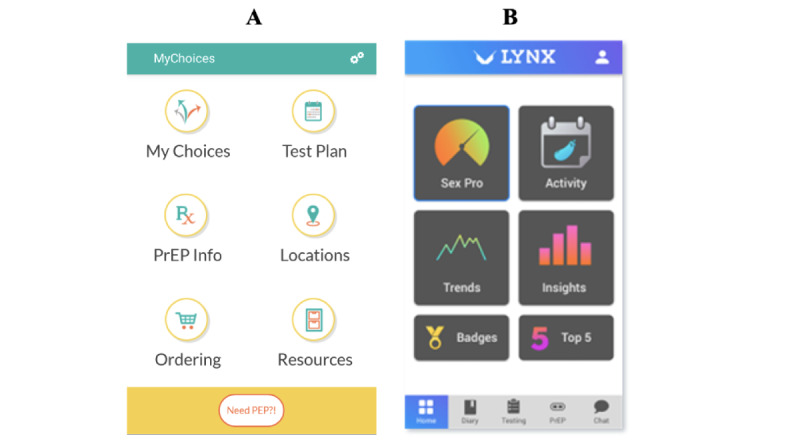
Objective: This study aims to assess the efficacy of 2 theory- and community-informed mobile apps-LYNX (APT Mobility) and MyChoices (Keymind)-to improve HIV testing and PrEP initiation among young sexual minority men.
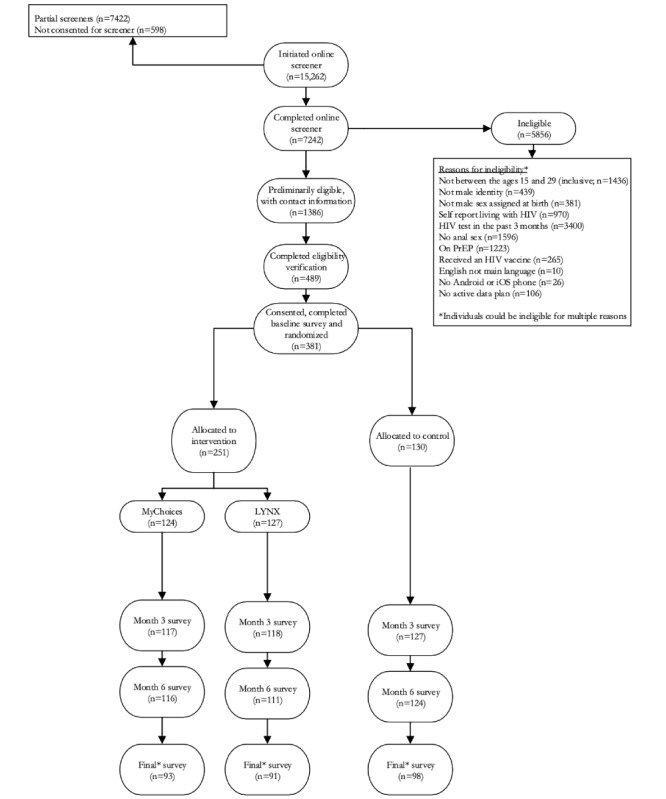
Methods: Between October 2019 and May 2022, we implemented a 3-arm, parallel randomized controlled trial in 9 US cities to test the efficacy of the LYNX and MyChoices apps against standard of care (SOC) among young sexual minority men (aged 15-29 years) reporting anal sex with cisgender male or transgender female in the last 12 months. Randomization was 1:1:1 and was stratified by site and participant age; there was no masking. The co-primary outcomes were self-reported HIV testing and PrEP initiation over 6 months of follow-up.
Results: A total of 381 young sexual minority men were randomized. The mean age was 22 (SD 3.2) years. Nearly one-fifth were Black, non-Hispanic (n=67, 18%), Hispanic or Latino men (n=67, 18%), and 60% identified as gay (n=228). In total, 200 (53%) participants resided in the Southern United States. At baseline, participants self-reported the following: 29% (n=110) had never had an HIV test and 85% (n=324) had never used PrEP. Sociodemographic and behavioral characteristics did not differ by study arm. Compared to SOC (n=72, 59%), participants randomized to MyChoices (n=87, 74%; P=.01) were more likely to have received at least 1 HIV test over 6 months of follow-up; those randomized to LYNX also had a higher proportion of testing (n=80, 70%) but it did not reach the a priori threshold for statistical significance (P=.08). Participants in both MyChoices (n=23, 21%) and LYNX (n=21, 20%) arms had higher rates of starting PrEP compared to SOC (n=19, 16%), yet these differences were not statistically significant (P=.52).
Conclusions: In addition to facilitating earlier treatment among those who become aware of their HIV status, given the ubiquity of mobile apps and modest resources required to scale this intervention, a 25% relative increase in HIV testing among young sexual minority men, as seen in this study, could meaningfully reduce HIV incidence in the United States.
Trial registration: ClinicalTrials.gov NCT03965221; https://clinicaltrials.gov/study/NCT03965221.
Keywords: HIV care; HIV infection; HIV prevention; HIV testing; LYNX; MyChoices; United States; adolescents; behavioral health; efficacy; mHealth; mobile apps; mobile phones; pre-exposure prophylaxis; public health; randomized controlled trial; sexual minority; sexual minority men; sociodemographic; transmission; youths.
©Katie B Biello, Kenneth H Mayer, Hyman Scott, Pablo K Valente, Jonathan Hill-Rorie, Susan Buchbinder, Lucinda Ackah-Toffey, Patrick S Sullivan, Lisa Hightow-Weidman, Albert Y Liu. Originally published in JMIR Public Health and Surveillance (https://publichealth.jmir.org), 05.02.2025.
Conflict of interest statement
Conflicts of Interest: None declared.
Figures
References
-
- Agwu A. Sexuality, sexual health, and sexually transmitted infections in adolescents and young adults. Top Antivir Med. 2020;28(2):459–462. https://europepmc.org/abstract/MED/32886466 - PMC - PubMed
-
- HIV Surveillance Supplemental Report: Estimated HIV incidence and prevalence in the United States, 2017?2021. Centers for Disease Control and Prevention. 2023. [2024-09-12]. https://stacks.cdc.gov/view/cdc/149080 .
-
- DiNenno EA, Prejean J, Irwin K, Delaney KP, Bowles K, Martin T, Tailor A, Dumitru G, Mullins MM, Hutchinson AB, Lansky A. Recommendations for HIV screening of gay, bisexual, and other men who have sex with men—United States, 2017. MMWR Morb Mortal Wkly Rep. 2017;66(31):830–832. doi: 10.15585/mmwr.mm6631a3. https://doi.org/10.15585/mmwr.mm6631a3 - DOI - PMC - PubMed
-
- US Preventive Services Task Force. Barry MJ, Nicholson WK, Silverstein M, Chelmow D, Coker TR, Davis EM, Donahue KE, Jaén CR, Kubik M, Li L, Ogedegbe G, Rao G, Ruiz JM, Stevermer JJ, Tsevat J, Underwood SM, Wong JB. Preexposure prophylaxis to prevent acquisition of HIV: US Preventive Services Task Force recommendation statement. JAMA. 2023;330(8):736–745. doi: 10.1001/jama.2023.14461.2808514 - DOI - PubMed
-
- Gleason N, Serrano PA, Muñoz A, French A, Hosek S. Limited interaction targeted epidemiology of HIV in sexual and gender minority American adolescents and adults: feasibility of the keeping it LITE study. JMIR Form Res. 2021 Nov 26;5(11):e30761. doi: 10.2196/30761. https://formative.jmir.org/2021/11/e30761/ v5i11e30761 - DOI - PMC - PubMed
Publication types
MeSH terms
Associated data
Grants and funding
LinkOut - more resources
Full Text Sources
Medical
Miscellaneous
