


Microtubule inner proteins of Plasmodium are essential for transmission of malaria parasites
- PMID: 39908102
- PMCID: PMC11831158
- DOI: 10.1073/pnas.2421737122
Microtubule inner proteins of Plasmodium are essential for transmission of malaria parasites
Abstract
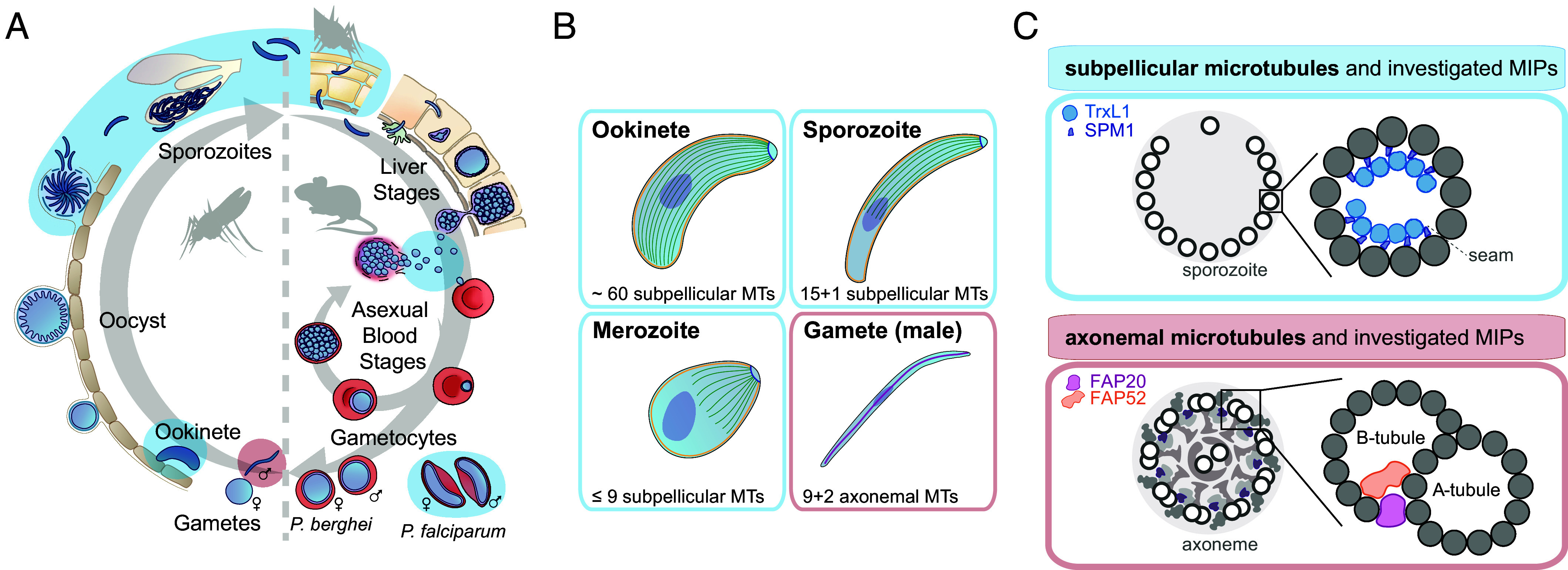
Microtubule inner proteins (MIPs) are microtubule-associated proteins that bind to tubulin from the luminal side. MIPs can be found in axonemes to stabilize flagellar beat or within cytoplasmic microtubules. Plasmodium spp. are the causative agents of malaria that feature different parasite forms across a complex life cycle with both unique and divergent microtubule-based arrays. Here, we investigate four MIPs in a rodent malaria parasite for their role in transmission to and from the mosquito. We show by single and double gene deletions that SPM1 and TrxL1, MIPs associated with subpellicular microtubules, are dispensable for transmission from the vertebrate host to the mosquito and back. In contrast, FAP20 and FAP52, MIPs associated with the axonemes of gametes, are essential for transmission to mosquitoes but only if both genes are deleted. In the absence of both FAP20 and FAP52, the B-tubule of the axoneme partly detaches from the A-tubule, resulting in the deficiency of axonemal beating and hence gamete formation and egress. Our data suggest that a high level of redundancy ensures microtubule stability in the transmissive stages of Plasmodium, which is important for parasite transmission.
Keywords: Plasmodium; malaria transmission; microtubule inner proteins.
Conflict of interest statement
Competing interests statement:The authors declare no competing interest.
Figures



References
-
- Nicastro D., et al. , The molecular architecture of axonemes revealed by cryoelectron tomography. Science 313, 944–948 (2006). - PubMed
MeSH terms
Substances
Grants and funding
LinkOut - more resources
Full Text Sources
Medical
Miscellaneous
