


Impoundments facilitate upstream invasion and introgression: Case studies of fluvial black basses (Micropterus spp.) in the southeastern USA
- PMID: 39908247
- PMCID: PMC11798496
- DOI: 10.1371/journal.pone.0315620
Impoundments facilitate upstream invasion and introgression: Case studies of fluvial black basses (Micropterus spp.) in the southeastern USA
Abstract
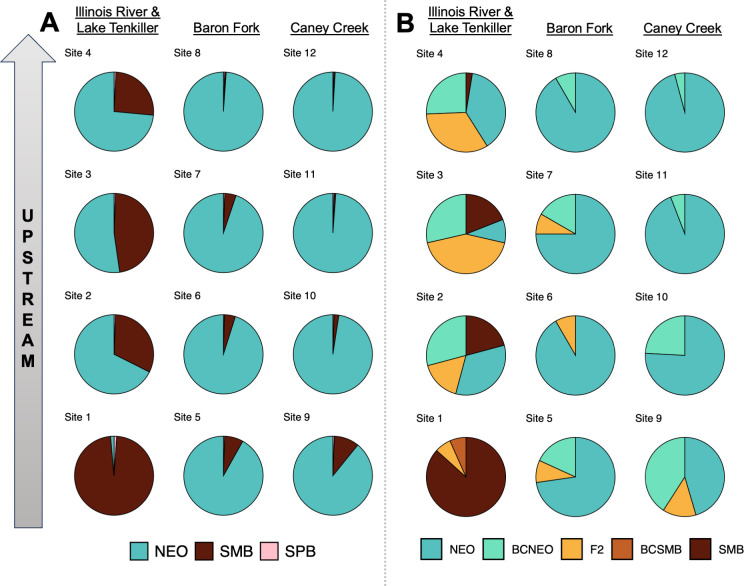
Impoundment construction has resulted in the alternation and loss of fluvial habitats, threatening the persistence of many native fishes. Compounding this threat, non-native species stocked into impoundments often invade interconnected fluvial habitats, where they may negatively affect native species. Black basses (genus Micropterus) are popular sportfishes with divergent ecologies: some taxa are tolerant of impoundments and widely stocked to create fishing opportunities, whereas others are endemic fluvial specialists that are threatened by introgression with non-native congeneric taxa. We investigated whether impoundments facilitate non-native invasion and introgression in two case study systems: Lake Lanier, Georgia, and Lake Tenkiller, Oklahoma. In both case studies, native fluvial taxa inhabited upstream tributaries and a non-native was established within the downstream impoundment. Results from longitudinal surveys of upstream tributaries provided clear evidence that non-natives invaded upstream from impoundments, and in some cases, extensive introgression with native taxa also occurred. Variation in spatial trends of invasion and directionalities of introgression across case studies provided insights into eco-evolutionary drivers. Within the riverscapes studied, proximity to impoundment appeared to influence invasion and introgression dynamics, and in one case, stream size was also influential. Introgression rates also varied markedly across the species pairs studied-from very little introgression to the onset of hybrid swarming-illustrating the importance of underlying eco-evolutionary mechanisms such as habitat alteration, propagule pressure, and reproductive isolation. Our results underscore the need to consider the upstream influences of impoundments, and the non-natives that invade from them, to create more holistic riverscape conservation plans for fluvial fishes, including native black basses.
Copyright: This is an open access article, free of all copyright, and may be freely reproduced, distributed, transmitted, modified, built upon, or otherwise used by anyone for any lawful purpose. The work is made available under the Creative Commons CC0 public domain dedication.
Conflict of interest statement
The authors have declared that no competing interests exist.
Figures




References
-
- Allan JD. Landscapes and riverscapes: the influence of land use on stream ecosystems. Annu Rev Ecol Evol Syst. 2004;35: 257–284. doi: 10.1146/annurev.ecolsys.35.120202.110122 - DOI
-
- Allan JD, Flecker AS. Biodiversity conservation in running waters. BioScience. 1993;43: 32–43. doi: 10.2307/1312104 - DOI
-
- Jelks HL, Walsh SJ, Burkhead NM, Contreras-Balderas S, Diaz-Pardo E, Hendrickson DA, et al. Conservation status of imperiled North American freshwater and diadromous fishes. Fisheries. 2008;33: 372–407. doi: 10.1577/1548-8446-33.8.372 - DOI
-
- Strayer DL, Dudgeon D. Freshwater biodiversity conservation: recent progress and future challenges. J North Am Benthol Soc. 2010;29: 344–358. doi: 10.1899/08-171.1 - DOI
-
- Ward JV, Stanford JA. The serial discontinuity concept: extending the model to floodplain rivers. Regul Rivers: Res Mgmt. 1995;10: 159–168. doi: 10.1002/rrr.3450100211 - DOI
MeSH terms
LinkOut - more resources
Full Text Sources
Miscellaneous
