


Potential improvement in spatial accessibility of methadone treatment with integration into other outpatient substance use disorder treatment programs, New York City, 2024
- PMID: 39908249
- PMCID: PMC11798429
- DOI: 10.1371/journal.pone.0317967
Potential improvement in spatial accessibility of methadone treatment with integration into other outpatient substance use disorder treatment programs, New York City, 2024
Abstract
Background: Methadone is an effective treatment for opioid use disorder; however, its provision in the US is limited to federally-regulated opioid treatment programs (OTP). Expansion of methadone treatment into non-OTP substance use disorder (SUD) treatment programs ('expanded methadone treatment access') is a promising intervention to increase access.
Methods: We performed a cross-sectional geospatial analysis of public transit times to OTPs, expanded methadone treatment access, and other healthcare facilities as of March, 2024 in New York City (NYC). We estimated one-way public transit travel time and compared travel times using population weighted paired t-tests.
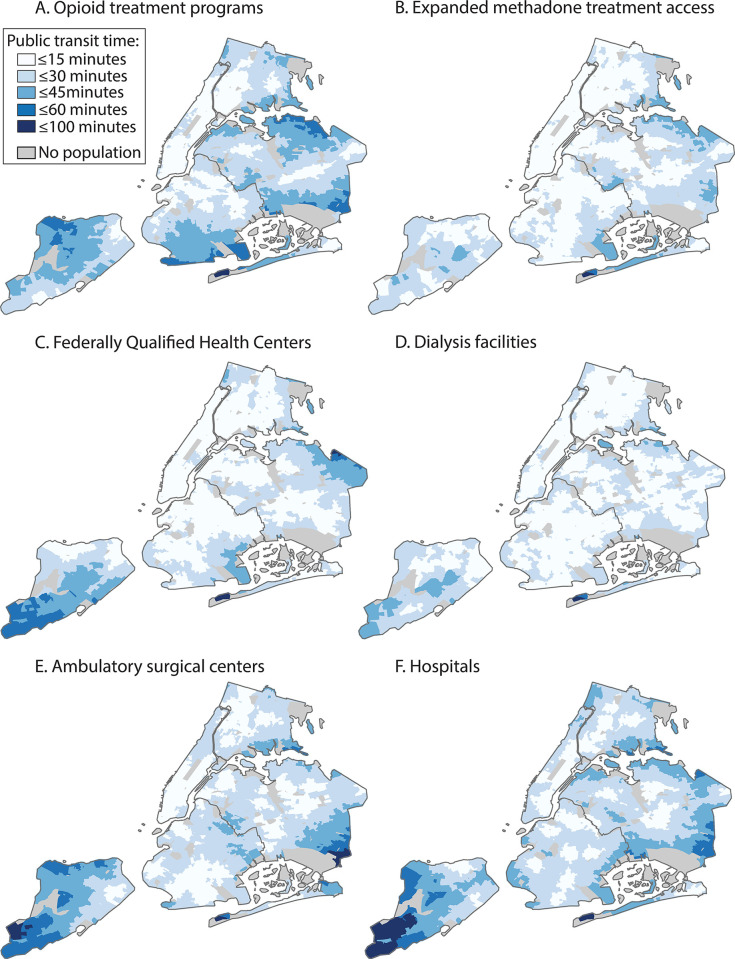
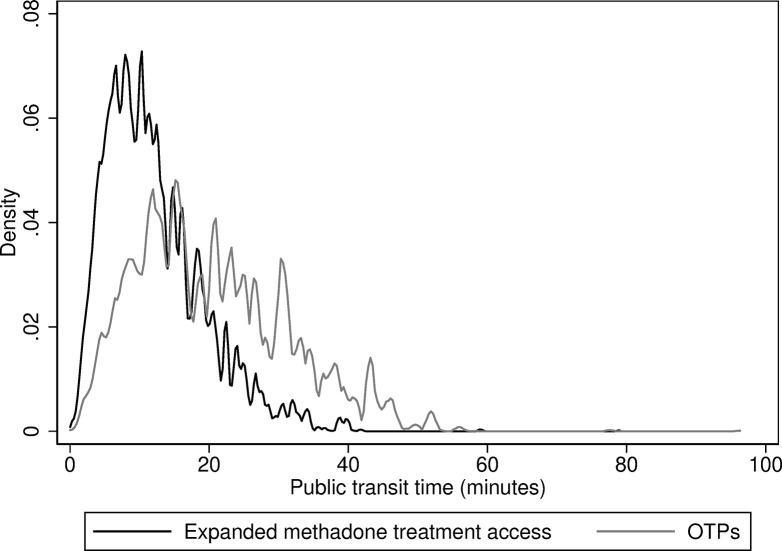
Results: For OTPs, 38.2% (95% CI: 38.0, 38.4) of the NYC population was within 15 minutes and 79.7% (95% CI: 79.5, 79.9) was within 30 minutes. For expanded methadone treatment access, 72.1% (95% CI: 71.9, 72.2) of the NYC population was within 15 minutes and 97.5% (95% CI: 97.5, 97.6) was within 30 minutes. The mean travel time was 20.4 minutes (SD: 10.9) for OTPs and 12.1 minutes (SD: 7.1) for expanded methadone treatment access (difference: -8.3 minutes [95% CI: -8.5, -8.1]; P < 0.001). The mean travel time for expanded methadone treatment access was slightly longer than the mean travel time for dialysis facilities (difference: 0.22 minutes [95% CI: 0.06, 0.39]; P = 0.009]), not significantly different than Federally Qualified Health Centers (difference: -0.06 minutes [95% CI: -0.22, 0.11]; P = 0.51), and significantly shorter than the mean travel time to ambulatory surgical centers (difference: -6.3 [95% CI: -6.5, -6.0]; P < 0.001) and hospitals (difference: -8.1 [95% CI: -8.3, -7.9]; P < 0.001).
Conclusion: Efforts to increase access to methadone treatment in the US should promote expansion to additional non-OTP outpatient SUD treatment programs. Such integration is anticipated to increase spatial accessibility of methadone treatment substantially, greatly enhancing the potential for patient access.
Copyright: © 2025 Bachhuber et al. This is an open access article distributed under the terms of the Creative Commons Attribution License, which permits unrestricted use, distribution, and reproduction in any medium, provided the original author and source are credited.
Conflict of interest statement
The authors have declared that no competing interests exist.
Figures
References
-
- Spencer MR, Garnett MF, Miniño AM. Drug overdose deaths in the United States, 2002–2022. NCHS Data Brief, no 491.: National Center for Health Statistics; 2024. Available from: doi: 10.15620/cdc:135849. - DOI
-
- Substance Abuse and Mental Health Services Administration. TIP 63: Medications for Opioid Use Disorder: Substance Abuse and Mental Health Services Administration; 2021 [March 28, 2024]. Available from: https://store.samhsa.gov/product/tip-63-medications-opioid-use-disorder/....
-
- Chhatwal J, Mueller PP, Chen Q, Kulkarni N, Adee M, Zarkin G, et al. Estimated Reductions in Opioid Overdose Deaths With Sustainment of Public Health Interventions in 4 US States. JAMA Netw Open. 2023;6(6):e2314925. Epub 2023/06/09. doi: 10.1001/jamanetworkopen.2023.14925 ; PubMed Central PMCID: PMC10257094. - DOI - PMC - PubMed
-
- Wakeman SE, Larochelle MR, Ameli O, Chaisson CE, McPheeters JT, Crown WH, et al. Comparative Effectiveness of Different Treatment Pathways for Opioid Use Disorder. JAMA Netw Open. 2020;3(2):e1920622. Epub 2020/02/06. doi: 10.1001/jamanetworkopen.2019.20622 ; PubMed Central PMCID: PMC11143463. - DOI - PMC - PubMed
-
- Nataraj N, Rikard SM, Zhang K, Jiang X, Guy GP Jr., Rice K, et al. Public Health Interventions and Overdose-Related Outcomes Among Persons With Opioid Use Disorder. JAMA Netw Open. 2024;7(4):e244617. Epub 2024/04/03. doi: 10.1001/jamanetworkopen.2024.4617 ; PubMed Central PMCID: PMC10993074. - DOI - PMC - PubMed
MeSH terms
Substances
LinkOut - more resources
Full Text Sources
Medical
