Review
. 2025 Feb 5;34(175):240112.
doi: 10.1183/16000617.0112-2024. Print 2025 Jan.

Transient tachypnoea: new concepts on the commonest neonatal respiratory disorder

Affiliations
Review

Transient tachypnoea: new concepts on the commonest neonatal respiratory disorder

Costanza Neri et al. Eur Respir Rev. .

Abstract

Transient tachypnoea of the neonate (TTN) is the commonest neonatal respiratory disorder, but it is quite mild and so has been the subject of relatively little academic and educational work. Recent animal studies and the introduction of new bedside monitoring techniques (e.g. quantitative lung ultrasound and electrical cardiometry) have clarified its pathogenesis. Given its high incidence, TTN is a relevant public health issue and its clinical management should be considered in an era of resource constraints. This review focuses on the latest data on TTN in terms of its pathophysiology, biology, diagnosis, imaging, therapy and cost-effectiveness, so as to optimise clinical care at the bedside. The need for a new pathophysiology-based definition of TTN is also highlighted and the available therapeutics are analysed considering the associated public health issues. This updated knowledge can help to improve the management of TTN and impact positively on its relevant public health consequences. This is particularly important since the mortality of TTN is virtually nil and so cannot be used to evaluate any clinical innovation. We also aim to give some practical guidance for the real-world clinical management of TTN and contribute to the training of neonatologists who care for TTN patients.


Conflict of interest statement

Conflict of interest: C. Neri has nothing to disclose. V. Sartorius has nothing to disclose. D. De Luca has received research grants and technical assistance from and has served as a lecturer and consultant for Chiesi Farmaceutici. He has also served as a consultant for Airway Therapeutics. These companies produce surfactant or its components and have nothing to do with this work.

Figures

FIGURE 1
FIGURE 1
Extravascular lung water (EVLW) in patients with transient tachypnoea of the neonate (TTN) and age-matched control neonates with no respiratory disorder. Extravascular lung water was estimated noninvasively by electrical cardiometry [29] as a) thoracic fluid content or b) weight-indexed fluid content. Data were extracted from the cardiorespiratory monitoring applied in our neonatal intensive care unit (NICU) clinical routine to neonates admitted for TTN (n=10) or for nonrespiratory problems (n=10), as previously defined [54]. Upon NICU admission, parents gave written consent for the anonymous use of monitoring data. Patients were matched for gestational (±1 week) and post-natal age (±2 days). Green and orange dots represent data from individual patients; box plots depict (from top to bottom) 95th, 75th, 50th, 25th and 5th percentiles. The raincloud curves on the right-hand side represent the density (distributions) of datapoints. Data were analysed with the Mann–Whitney test (EVLW=25 (–29) and 42 (–54) KOhm−1 in controls and TTN patients, respectively; weight-indexed EVLW=10 (–15) and 18 (–21) KOhm−1·kg−1 in controls and TTN patients, respectively).
FIGURE 2
FIGURE 2
Modern pathophysiology concepts depicted in two fictitious patients of 32 (left side) and 37 weeks’ (right side) gestation with transient tachypnoea of the neonate (TTN). a) The alveolar space (i.e. the number of alveoli) that can be filled with fluid is greater at 37 than at 32 weeks. b) The density of lung tissue (i.e. the thickness of the lung interstitium), that is the amount of tissue that should drain the fluid, is greater at 32 than at 37 weeks (illustrative sketches modified from publicly available microphotograph of autoptic lung tissues). c) Both neonates with TTN have similar lung ultrasound findings (i.e. interstitial pattern with discrete B-lines; more mature neonates may have a slightly thicker pleural line) depicting a relatively reduced air/fluid ratio (illustrative images obtained from routine lung ultrasound in neonates of 32 and 37 weeks’ gestation with TTN; upon neonatal intensive care unit admission, parents gave written consent for the anonymous use of imaging and clinical data). d) The interdependence of respiratory distress syndrome (RDS) and TTN prevalence (triangles) over gestational age; this panel is independent of the two illustrative cases affected by TTN. Darker grey corresponds to higher prevalence: RDS is more frequent at lower gestational age and prevents the occurrence of TTN given the lung collapse due to surfactant deficiency; TTN is more common at higher gestational age when surfactant deficiency is less frequent and a wider alveolar space can be filled with fluid. Mixed forms of respiratory failure with co-existing mild surfactant deficiency and fluid accumulation may also occur.
FIGURE 3
FIGURE 3
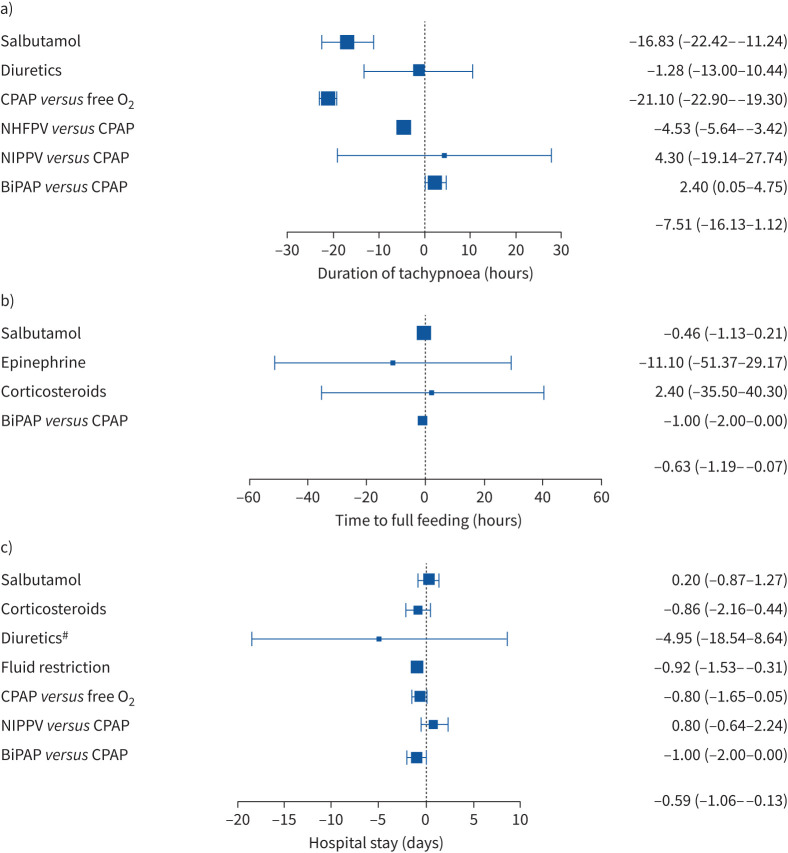
Effect size of main therapeutic interventions for transient tachypnoea of the neonate (TTN). a) Duration of tachypnoea, b) time to full feeding and c) length of hospital stay are shown. Full squares and horizontal lines represent mean differences and their 95% confidence interval, respectively. The vertical dashed line represents the absence of effect. Salbutamol was the commonest β2-agonist used in the trials, but analogous molecules were also used. Corticosteroids were given as inhaled budesonide. #: Different diuretics at different dosages have been trialled and data were aggregated for this analysis. Noninvasive high-frequency oscillatory ventilation (NHFOV) was investigated in one trial and this is not shown graphically as data were only available as medians [64]. Main data of meta-analysed trials are available in supplementary table S1. BiPAP: biphasic positive airway pressure; CPAP: continuous positive airway pressure; NHFPV: noninvasive high-frequency percussive ventilation; NIPPV: noninvasive positive-pressure ventilation.

References

    1. De Luca D. Managing neonates with respiratory failure due to SARS-CoV-2. Lancet Child Adolesc Health 2020; 4: e8. doi:10.1016/S2352-4642(20)30073-0 - DOI - PMC - PubMed
    1. De Luca D, Pezza L, Vivalda L, et al. . Critical care of severe bronchiolitis during shortage of ICU resources. EClinMed 2024; 69: 102450. doi:10.1016/j.eclinm.2024.102450 - DOI - PMC - PubMed
    1. Edwards MO, Kotecha SJ, Kotecha S. Respiratory distress of the term newborn infant. Paediatr Respir Rev 2013; 14: 29–36. doi:10.1016/j.prrv.2012.02.002 - DOI - PubMed
    1. Morrison JJ, Rennie JM, Milton PJ. Neonatal respiratory morbidity and mode of delivery at term: influence of timing of elective caesarean section. Br J Obstet Gynaecol 1995; 102: 843–844. doi:10.1111/j.1471-0528.1995.tb10860.x - DOI - PubMed
    1. Dani C, Reali MF, Bertini G, et al. . Risk factors for the development of respiratory distress syndrome and transient tachypnoea in newborn infants. Italian Group of Neonatal Pneumology. Eur Respir J 1999; 14: 155–159. doi:10.1034/j.1399-3003.1999.14a26.x - DOI - PubMed

MeSH terms

LinkOut - more resources