. 2025 Feb 5;15(1):4308.
doi: 10.1038/s41598-025-88517-z.

A parametric investigation of binaural beats for brain entrainment and enhancing sustained attention

Affiliations

A parametric investigation of binaural beats for brain entrainment and enhancing sustained attention

Anastasiia Melnichuk et al. Sci Rep. .

Abstract

Binaural beats (BBs) have garnered attention as a highly accessible, noninvasive method to enhance cognitive performance, putatively via brain entrainment. However, the few studies that have directly examined the impact of BBs on sustained attention report inconsistent findings, perhaps due to wide variation in methodology. This study experimentally varied BB parameters while testing the effects of BBs on both sustained attention and brain entrainment. 80 undergraduate participants were randomized to 1 of 16 between-subject conditions in a 2 beats frequency (beta or gamma) × 2 carrier tone (340 or 400 Hz) × 2 onset time (before or with task onset) × 2 background masking noise (present or absent) factorial design. Participants completed a 2-visit within-subjects cross-over comparison of BBs vs. control auditory stimulation. EEG data were collected to validate brain entrainment. Gamma frequency BBs with a low carrier tone and white noise background improved general attention performance but did not reduce the vigilance decrement over time, suggesting BBs may modulate other cognitive aspects rather than sustained focus. EEG results confirmed brain entrainment, though entrainment varied with BB parameters and background noise. Further research should explore the interactions between BB parameters to optimize their use for cognitive enhancement.

Keywords: Binaural beats; Brainwave entrainment; Cognitive enhancement; EEG; Sustained attention; Vigilance decrement.


Conflict of interest statement

Competing interests: The authors declare no competing interests.

Figures
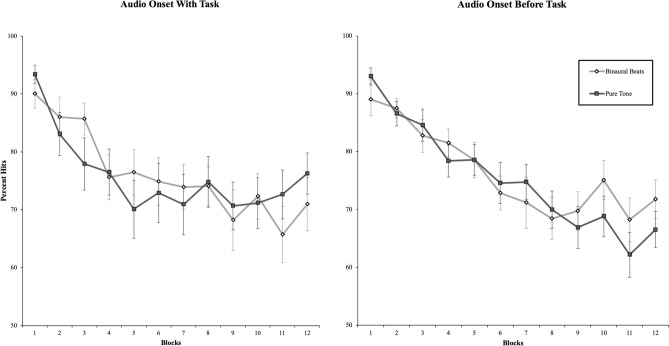
Fig. 1
Fig. 1
Average percent hits in the IP-CPT for all treatment condition (binaural beats vs. pure tone) × trial block (12) × audio onset time (with vs before task) conditions (data are averaged across levels of beats frequency, carrier tone, and white noise presence). Linear vigilance decrement was attenuated during BB compared to pure tone for participants whose audio onset was before the task but not for participants who received audio stimulation only during the task. Bars are standard errors.
Fig. 2
Fig. 2
Average percent hits in the IP-CPT for all treatment condition (binaural beats vs. pure tone) × beats frequency (beta vs. gamma) × carrier frequency (340 Hz vs. 400 Hz) conditions (data are averaged across levels of audio onset and white noise presence). Gamma beats with 340 Hz carrier tone improved average IP-CPT performance compared to pure tone control. Bars are standard deviations, *p = 0.002.
Fig. 3
Fig. 3
Average percent hits in the IP-CPT for all treatment condition (binaural beats vs. pure tone) × Masking (white noise vs no white noise) × Audio Onset Time (with vs. before task) conditions (data are averaged across levels of beats frequency and carrier tone). Audio onset with task while white noise was present improved average IP-CPT performance in the binaural beats group compared to pure tone control. Bars are standard errors, *p = 0.013.
Fig. 4
Fig. 4
Average signal-to-noise ratio of power density for all treatment condition (binaural beats vs. pure tone) × beats frequency (betas vs gamma) × masking (white noise vs no white noise) conditions (data are averaged across levels of carrier tone and audio onset). For the beta beats group, power density signal-to-noise ratio (PDS2N) was calculated at ~ 16 Hz; for the gamma beats group, PDS2N was calculated at ~ 40 Hz. Each bar thus reflects PDS2N values specifically at the frequency corresponding to that group’s binaural beat condition. Brain entrainment was stronger in the absence of white noise, especially for gamma binaural beats. Bars are standard errors, *p < 0.05, **p < 0.001.

References

    1. Colzato, L. S., Barone, H., Sellaro, R. & Hommel, B. More attentional focusing through binaural beats: evidence from the global-local task. Psychol. Res.81(1), 271–277. 10.1007/s00426-015-0727-0 (2017). - PMC - PubMed
    1. Oster, G. Auditory beats in the brain. Sci. Am.229(4), 94–103. 10.1038/scientificamerican1073-94 (1973). - PubMed
    1. Garcia, A., Santed, M. A. & Reales, J. M. Efficacy of binaural auditory beats in cognition, anxiety, and pain perception: a meta-analysis. Psychol. Res.83(2), 357–372. 10.1007/s00426-018-1066-8m (2018). - PubMed
    1. Mackworth, N. H. The breakdown of vigilance during prolonged visual search. Q. J. Exp. Psychol.1, 6–21. 10.1080/17470214808416738 (1948).
    1. Oken, B. S., Salinsky, M. C. & Elsas, S. M. Vigilance, alertness, or sustained attention: physiological basis and measurement. Clin. Neurophysiol.117(9), 1885–1901. 10.1016/j.clinph.2006.01.017 (2006). - PMC - PubMed

LinkOut - more resources
