


Behavioural components and delivery features of early childhood obesity prevention interventions: intervention coding of studies in the TOPCHILD Collaboration systematic review
- PMID: 39910407
- PMCID: PMC11796048
- DOI: 10.1186/s12966-025-01708-9
Behavioural components and delivery features of early childhood obesity prevention interventions: intervention coding of studies in the TOPCHILD Collaboration systematic review
Abstract
Background: Early childhood obesity prevention interventions that aim to change parent/caregiver practices related to infant (milk) feeding, food provision and parent feeding, movement (including activity, sedentary behaviour) and/or sleep health (i.e. target parental behaviour domains) are diverse and heterogeneously reported. We aimed to 1) systematically characterise the target behaviours, delivery features, and Behaviour Change Techniques (BCTs) used in interventions in the international Transforming Obesity Prevention for CHILDren (TOPCHILD) Collaboration, and 2) explore similarities and differences in BCTs used in interventions by target behaviour domains.
Methods: Annual systematic searches were performed in MEDLINE, Embase, Cochrane (CENTRAL), CINAHL, PsycINFO, and two clinical trial registries, from inception to February 2023. Trialists from eligible randomised controlled trials of parent-focused, behavioural early obesity prevention interventions shared unpublished intervention materials. Standardised approaches were used to code target behaviours, delivery features and BCTs in both published and unpublished intervention materials. Validation meetings confirmed coding with trialists. Narrative syntheses were performed.
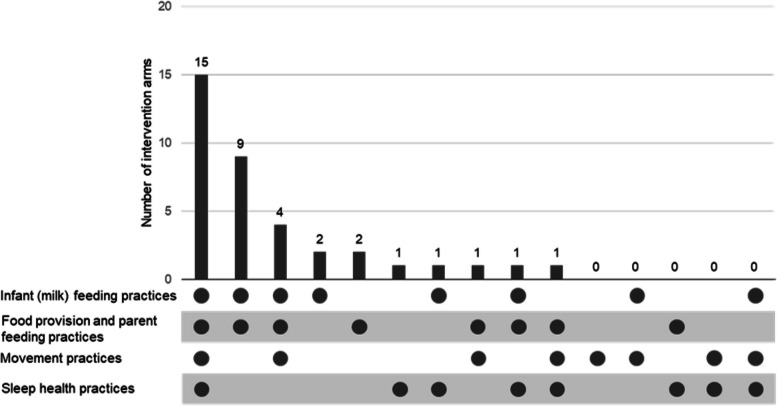
Results: Thirty-two trials reporting 37 active intervention arms were included. Interventions targeted a range of behaviours. The most frequent combination was targeting all parental behaviour domains (infant [milk] feeding, food provision and parent feeding, movement, sleep health; n[intervention arms] = 15/37). Delivery features varied considerably. Most interventions were delivered by a health professional (n = 26/36), included facilitator training (n = 31/36), and were interactive (n = 28/36). Overall, 49 of 93 unique BCTs were coded to at least one target behaviour domain. The most frequently coded BCTs were: Instruction on how to perform a behaviour (n[intervention arms, separated by domain] = 102), Behavioural practice and rehearsal (n = 85), Information about health consequences (n = 85), Social support (unspecified) (n = 84), and Credible source (n = 77). Similar BCTs were often used for each target behaviour domain.
Conclusions: Our study provides the most comprehensive description of the behaviour change content of complex interventions targeting early childhood obesity prevention available to date. Our analysis revealed that interventions targeted multiple behaviour domains, with significant variation in delivery features. Despite the diverse range of BCTs coded, five BCTs were consistently identified across domains, though certain BCTs were more prevalent in specific domains. These findings can be used to examine effectiveness of components and inform intervention development and evaluation in future trials.
Trial registration: PROSPERO registration no. CRD42020177408.
Keywords: Behaviour change techniques; Diet; Infant feeding; Infants; Intervention components; Movement; Sleep.
© 2025. The Author(s).
Conflict of interest statement
Declarations. Ethics approval and consent to participate: Ethics approval was obtained from University of Sydney Human Research Ethics Committee (project no. 2020/273) and Flinders University Social and Behavioural Research Ethics Committee (project no. HREC CIA2133-1) to perform secondary analyses. Consent for publication: Not applicable. Competing interests: Authors listed as Trial Representatives in the acknowledgements are investigators of eligible trials, however these authors were not involved in the screening, data extraction, initial coding of the interventions, analysis or drafting of the manuscript. AKV currently has an investigator-initiated research grant from Bobbie Baby, Inc. LS is advisor to Medeloop, Inc.
Figures

References
-
- Simmonds M, Llewellyn A, Owen CG, Woolacott N. Predicting adult obesity from childhood obesity: a systematic review and meta-analysis. Obes Rev. 2016;17(2):95–107. - PubMed
-
- Geserick M, Vogel M, Gausche R, Lipek T, Spielau U, Keller E, et al. Acceleration of BMI in Early Childhood and Risk of Sustained Obesity. N Engl J Med. 2018;379(14):1303–12. - PubMed
-
- Craigie AM, Lake AA, Kelly SA, Adamson AJ, Mathers JC. Tracking of obesity-related behaviours from childhood to adulthood: A systematic review. Maturitas. 2011;70(3):266–84. - PubMed
-
- Report of the commission on ending childhood obesity. Geneva, Switzerland: World Health Organization; 2016. Report No.: ISBN: 9789241510066. Available from: https://www.who.int/publications-detail-redirect/9789241510066. Cited 2024 Mar 6.
Publication types
MeSH terms
Grants and funding
LinkOut - more resources
Full Text Sources
Medical
