


Using the HBSC Symptom Checklist to measure junior secondary school students' psychosomatic complaints in the Chinese Mainland: Rasch-based validation, population-based norm, and norm-referenced scoring algorithm
- PMID: 39910596
- PMCID: PMC11796065
- DOI: 10.1186/s40359-024-02136-3
Using the HBSC Symptom Checklist to measure junior secondary school students' psychosomatic complaints in the Chinese Mainland: Rasch-based validation, population-based norm, and norm-referenced scoring algorithm
Abstract
Background: The Symptom Checklist (SCL) developed by the Health Behaviour in School‑aged Children (HBSC) study is widely used to capture the psychosomatic complaints (PSC) of non-clinical children and adolescents. Although its psychometric properties have been well established internationally, the performance of the Mandarin Chinese version remains unclear. This study evaluates the Mandarin Chinese HBSC-SCL's psychometric properties, develops its norm, and creates the corresponding scoring algorithm.
Methods: Data were collected from a two-wave cross-sectional survey conducted between June 20 and July 11, 2022, across eight Chinese Human Geography Regions (CHGRs). The sample included 3290 junior secondary school students, obtained through convenience sampling (first wave) and multistage, stratified, cluster sampling (second wave). The surveys were administered anonymously in the school setting, using a paper-and-pencil, self-administered questionnaire. The Mandarin Chinese HBSC-SCL's unidimensionality was verified using confirmatory factor analysis (CFA), and its psychometric properties were comprehensively evaluated using the partial credit model (PCM) of the Rasch measurement method. Based on the above scientific evidence, the population-based norm and norm-referenced scoring algorithm were developed and created.
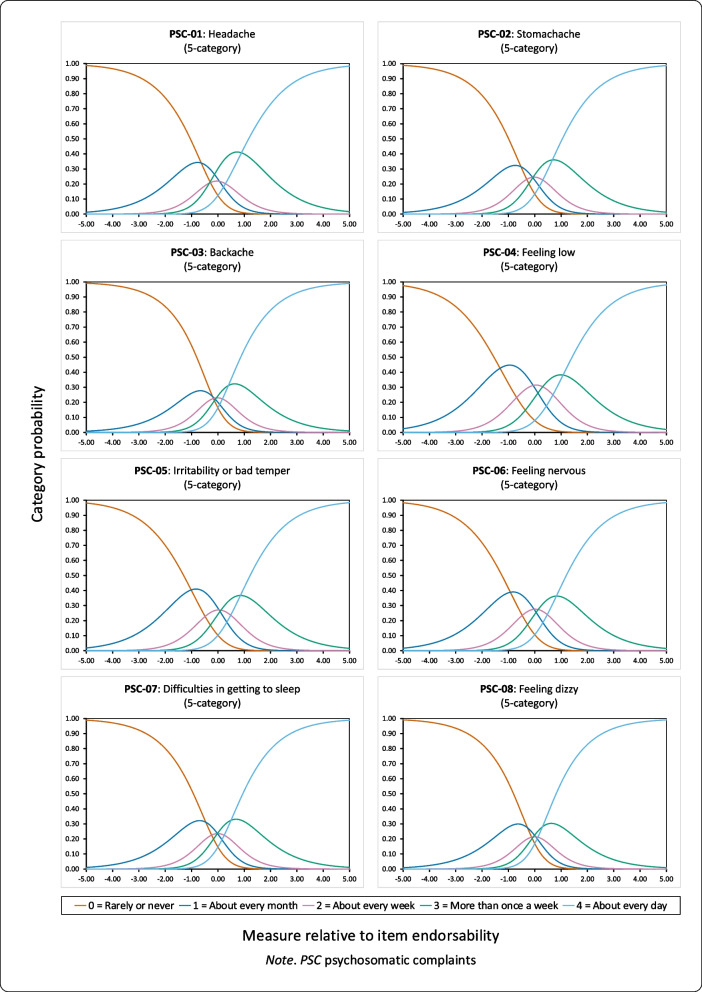
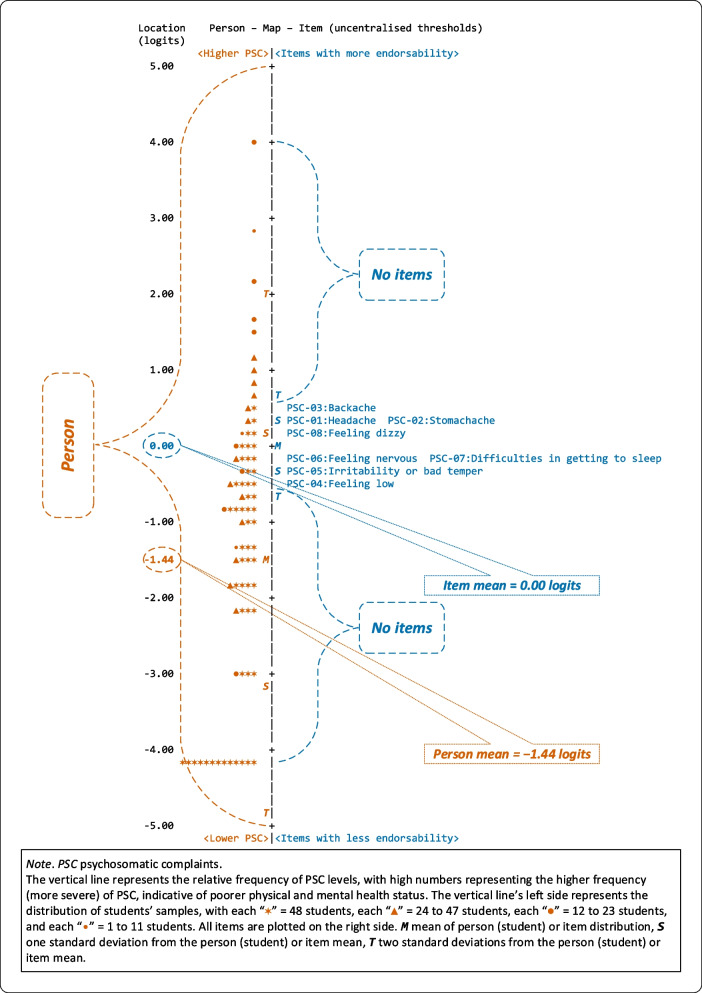
Results: The CFA confirmed that the HBSC-SCL can be considered unidimensional in the Chinese Mainland. Evidence-based on the six features of the Rasch model indicated that the Mandarin Chinese HBSC-SCL has satisfactory psychometric properties. All 5-category rating scales of eight items appropriately differentiated the students' PSC and demonstrated strong goodness-of-fit. This version also exhibited good unidimensionality and local independence. The Rasch model generated two kinds of reliability indicators, with the item indicators performing well. The person-item map demonstrated acceptable person and item matches, and provided new perspectives for future improvements. Additionally, no substantial uniform differential item functioning (UDIF) was detected across 13 groups (e.g., survey waves, gender, chronological age).
Conclusions: The Mandarin Chinese HBSC-SCL demonstrates satisfactory psychometric properties and performs well in the Chinese Mainland context. It provides concise self-reported PSC measures for junior secondary school students, potentially applicable to a broader Chinese-speaking population. Its ease of administration, scoring, and interpretation makes it suitable for routine school monitoring, large-scale population surveys, and clinical applications. Additionally, the population-based norm and norm-referenced scoring algorithm support the broader application of this version and offer new insights for interpreting PSC sum scores.
Keywords: HBSC Symptom Checklist; Health Behaviour in School‑aged Children; Junior secondary school students; Mandarin Chinese; Norm-referenced scoring algorithm; Population-based norm; Psychometric properties; Psychosomatic complaints; Rasch measurement method.
© 2025. The Author(s).
Conflict of interest statement
Declarations. Ethics approval and consent to participate: All procedures performed in this study involving human participants were in accordance with the ethical standards of the institutional and/or national research committee and with the 1964 Helsinki declaration and its later amendments or comparable ethical standards. The Medical Ethics Committee of Weifang Medical University (now known as Shandong Second Medical University) approved the study protocol (Ethics Approval No. 2022YX-50). Informed consent was obtained from all participating students and their parent(s) or guardian(s) included in the study. The collection and transfer of data were carried out according to strict security and data encryption. Consent for publication: Not applicable. Competing interests: The authors declare no competing interests.
Figures

References
-
- Haugland S, Wold B. Subjective health complaints in adolescence—reliability and validity of survey methods. J Adolesc. 2001;24(5):611–24. 10.1006/jado.2000.0393. - PubMed
-
- Wahlström J, Östberg V, Åhlén J, Låftman SB. Psychosomatic complaints at age 15–16 and later educational achievement in upper secondary school. Eur J Public Health. 2023;33(Suppl 2):ckad160.833. 10.1093/eurpub/ckad160.833.
Publication types
MeSH terms
LinkOut - more resources
Full Text Sources
Research Materials
Miscellaneous
