


Clinical outcomes for pleomorphic xanthoastrocytoma patients
- PMID: 39917756
- PMCID: PMC11798600
- DOI: 10.1093/nop/npae074
Clinical outcomes for pleomorphic xanthoastrocytoma patients
Abstract
Background: Report our institutional experience with pleomorphic xanthoastrocytoma (PXA) to contribute to limited data on optimal management.
Methods: Patients with pathologically confirmed PXA treated at our institution between 1990 and 2019 were identified. Demographic information, tumor grade, treatment variables, and clinical outcomes were collected from patient charts. Kaplan-Meier estimates were used to summarize 2 primary outcome measurements: progression-free survival (PFS) and overall survival (OS). Outcomes were stratified by tumor grade and extent of resection. Cox regression and log-rank testing were performed.
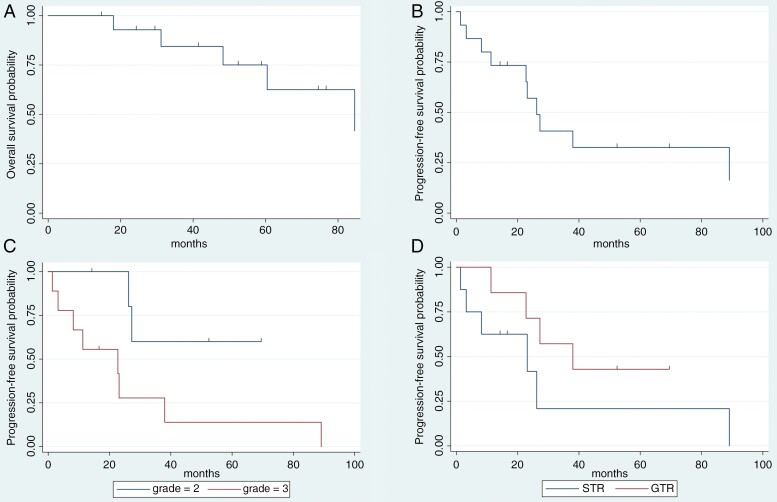
Results: We identified 17 patients with pathologically confirmed PXA. Two patients were excluded due to incomplete treatment information or <6 m of follow-up; 15 patients were analyzed (median follow-up 4.4 years). Six patients had grade 2 PXA and 9 had grade 3 anaplastic PXA. The 2- and 5-year PFS for the cohort was 57% and 33%, respectively; 2- and 5-year OS was 93% and 75%, respectively. Patients with grade 2 tumors exhibited superior PFS compared to those with grade 3 tumors (2-year PFS: 100% vs. 28%, 5-year PFS: 60% vs. 14%), hazard ratio, 5.09 (95% CI: 1.06-24.50), P = .02. Undergoing a gross total resection was associated with numerical longer survival but this was not of statistical significance (hazard ratio: 0.38, P = .15). All but one (89%) of the grade 3 patients underwent RT.
Conclusions: The poor survival of the cohort, especially with grade 3 tumors, suggests the need for more aggressive treatment, including maximal resection followed by intensive adjuvant therapy. Better prognostics of tumor recurrence are needed to guide the use of adjuvant therapy.
Keywords: BRAF V600E mutation; anaplastic; pleomorphic xanthoastrocytoma; radiotherapy; surgery.
© The Author(s) 2024. Published by Oxford University Press on behalf of the Society for Neuro-Oncology and the European Association of Neuro-Oncology. All rights reserved. For commercial re-use, please contact reprints@oup.com for reprints and translation rights for reprints. All other permissions can be obtained through our RightsLink service via the Permissions link on the article page on our site—for further information please contact journals.permissions@oup.com.
Conflict of interest statement
None declared.
Figures

Update of
-
Clinical outcomes for pleomorphic xanthoastrocytoma patients: an institutional experience.Res Sq [Preprint]. 2023 Feb 3:rs.3.rs-2535551. doi: 10.21203/rs.3.rs-2535551/v1. Res Sq. 2023. Update in: Neurooncol Pract. 2024 Aug 10;12(1):45-50. doi: 10.1093/nop/npae074. PMID: 36778274 Free PMC article. Updated. Preprint.
References
-
- Kepes JJ, Rubinstein LJ, Eng LF.. Pleomorphic xanthoastrocytoma: a distinctive meningocerebral glioma of young subjects with relatively favorable prognosis. A study of 12 cases. Cancer. 1979;44(5):1839–1852. - PubMed
-
- Gallo P, Cecchi PC, Locatelli F, et al. Pleomorphic xanthoastrocytoma: Long-term results of surgical treatment and analysis of prognostic factors. Br J Neurosurg. 2013;27(6):759–764. - PubMed
-
- Rutkowski MJ, Oh T, Niflioglu GG, et al. Pleomorphic xanthoastrocytoma with anaplastic features: Retrospective case series. World Neurosurg. 2016;95:368–374. - PubMed
LinkOut - more resources
Full Text Sources
Research Materials
