. 2025 Mar 11;20(3):102398.
doi: 10.1016/j.stemcr.2025.102398. Epub 2025 Feb 6.

An acidic residue within the OCT4 dimerization interface of SOX17 is necessary and sufficient to overcome its pluripotency-inducing activity

Affiliations

An acidic residue within the OCT4 dimerization interface of SOX17 is necessary and sufficient to overcome its pluripotency-inducing activity

Sik Yin Ho et al. Stem Cell Reports. .

Abstract

SOX17 directs the differentiation toward endoderm and acts as a human germline specifier. We previously found that the replacement of glutamate at position 57 of the high-mobility group (HMG) box with the basic lysine residue in SOX2 alters interactions with OCT4 and turns SOX17 into a pluripotency factor. Here, we systematically interrogated how mutations at this critical position affect the cellular reprogramming activity of SOX17 in mouse and human. We found that most mutations turn SOX17 into a pluripotency factor regardless of their biophysical properties except for acidic residues and proline. The conservative mutation to an aspartate allows the SOX17E57D protein to maintain a self-renewing endodermal state. We showed that only the glutamate in the wild-type protein blocks the formation of an SOX17/OCT4 dimer at composite DNA elements in pluripotency enhancers. Insights into how modifications of an ultra-conserved residue affect functions of developmental transcription factors provide avenues to advance cell fate engineering.

Keywords: SOX17; SOX2; XEN; engineered proteins; iPSCs; pioneer factors; pluripotency; reprogramming.


Conflict of interest statement

Declaration of interests This paper includes results of the doctoral thesis entitled “Systematic analysis of the sequence-function relationship underlying differentiation and dedifferentiation activity of SOX17” submitted by S.Y.H. to the Li Ka Shing Faculty of Medicine, The University of Hong Kong, in 2024.

Figures

None
Graphical abstract
Figure 1
Figure 1
Most SOX17E57 variants are capable of generating bona fide induced pluripotent stem cells (A) Schematic diagram of pluripotency reprogramming of MEFs. (B and C) (B) Microscope images and (C) whole well scans of reprogramming GFP+ colonies on day 14. Scale bar, 80 μm. (D and E) (D) Heatmap and (E) boxplot of reprogramming competence of SOX17E57 variants. Data were shown from three independent replicates, each done in two technical replicates (identical colors indicate technical replicates). Statistical significance was determined using the Mann-Whitney U test, with p values adjusted using the Benjamini-Hochberg method. p > 0.05, n.s.; p < 0.05, ; p < 0.01, ∗∗. (F) Immunocytochemistry of representative miPSC clonal lines. Scale bar, 20 μm. (G) Representative immunocytochemistry of spontaneously differentiated miPSCs. Scale bar, 40 μm. Experiments shown here were performed for at least two independent replicates.
Figure 2
Figure 2
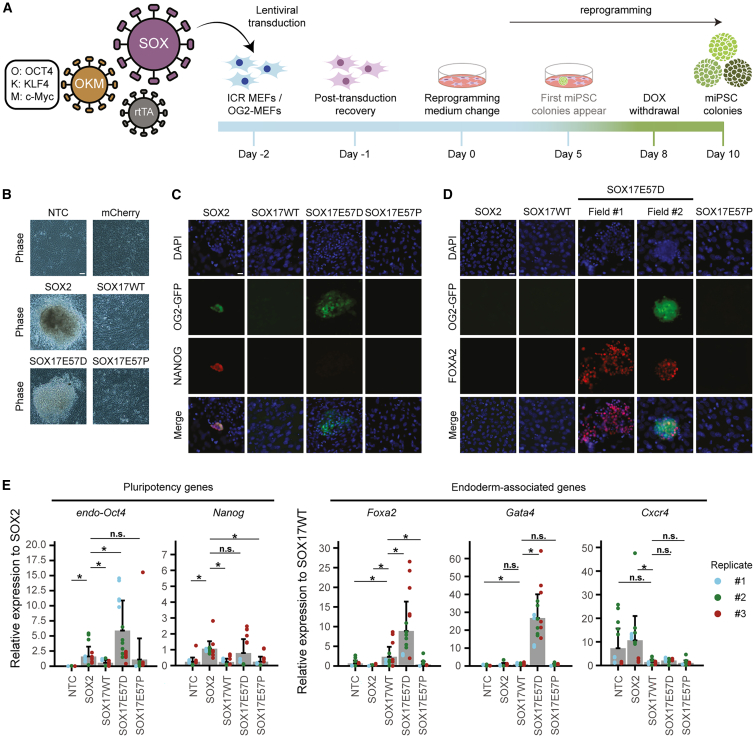
SOX17E57D simultaneously upregulated pluripotency and endodermal genes (A) Schematic diagram of the reprogramming experiment. (B) Microscope images of reprogramming cultures on day 10. Scale bar, 80 μm. (C and D) Immunocytochemistry of reprogramming cultures on day 10 for (C) NANOG and (D) FOXA2. Scale bar, 40 μm. (E) RT-qPCR of bulk reprogramming cultures on day 10. NTC, non-transduced control MEFs. Barplot shows the mean ± SD from three independent experiments with six technical replicates per independent sample (dots with identical colors are technical replicates). Statistical significance was determined using the Mann-Whitney U test, with p values adjusted using the Benjamini-Hochberg method. p > 0.05, n.s.; p < 0.05, .
Figure 3
Figure 3
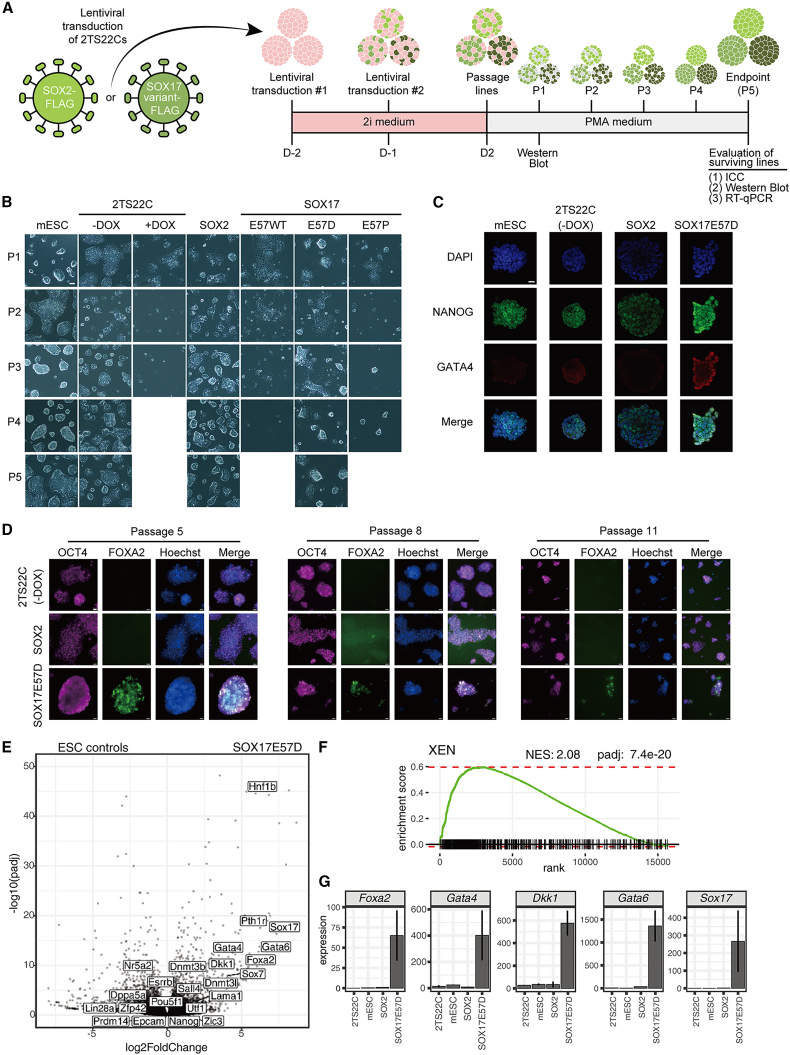
SOX17E57D maintained pluripotency marker expression while upregulating endodermal genes (A) Schematic diagram of the pluripotency maintenance assay. (B) Microscope images of cultures over five passages. Scale bar, 80 μm. The assay was performed in at least three independent experiments per factor. (C) Microscope images of cell lines co-stained with NANOG and GATA4 at passage #11. Scale bar, 20 μm. (D) Representative images of cell lines co-stained with OCT4 and FOXA2 at passages #5, #8, and #11. Scale bar, 20 μm. (E) Volcano plot showing differentially expressed genes in SOX17E57D compared with ESCs at passage #10 from bulk RNA-seq experiments performed in duplicates. Selected genes are labeled. (F) Gene set enrichment analysis on SOX17E57D-transduced 2TS22Cs using an XEN reference dataset (Parenti et al., 2016). (G) Mean RNA-seq expression of selected XEN-associated genes.
Figure 4
Figure 4
SOX17E57D heterodimerizes differently with OCT4 (A) Whole-cell extract EMSAs using HEK293T cells transduced with SOX2, SOX17WT, SOX17E57D, and SOX17E57P binding with or without OCT4. (B) Quantification of the binding affinity of SOX2, SOX17WT, SOX17E57D, and SOX17E57P to either the canonical or the compressed motif. Data shown as mean ± SD from three independent experiments. Statistical significance was determined using the Mann-Whitney U test, with p values adjusted using the Benjamini-Hochberg method. p < 0.05, . (C) Sequence logo generated from metazoan SoxF HMG box sequence. The deeply conserved position 57 was underlined in green. (D) OCT4-SOX17WT bound to the canonical motif. (E) OCT4-SOX17E57D bound to the canonical motif. (D) and (E) were generated with University of California San Francisco (UCSF) ChimeraX software and the swapaa function using the SOX17/OCT4/DNA model from Merino et al., 2014.

References

    1. Aksoy I., Jauch R., Chen J., Dyla M., Divakar U., Bogu G.K., Teo R., Leng Ng C.K., Herath W., Lili S., et al. Oct4 switches partnering from Sox2 to Sox17 to reinterpret the enhancer code and specify endoderm. EMBO J. 2013;32:938–953. - PMC - PubMed
    1. Chang Y.K., Srivastava Y., Hu C., Joyce A., Yang X., Zuo Z., Havranek J.J., Stormo G.D., Jauch R. Quantitative profiling of selective Sox/POU pairing on hundreds of sequences in parallel by Coop-seq. Nucleic Acids Res. 2017;45:832–845. - PMC - PubMed
    1. Chen D., Liu W., Zimmerman J., Pastor W.A., Kim R., Hosohama L., Ho J., Aslanyan M., Gell J.J., Jacobsen S.E., Clark A.T. The TFAP2C-Regulated OCT4 Naive Enhancer Is Involved in Human Germline Formation. Cell Rep. 2018;25:3591–3602.e5. - PMC - PubMed
    1. Gao Y., Tan D.S., Girbig M., Hu H., Zhou X., Xie Q., Yeung S.W., Lee K.S., Ho S.Y., Cojocaru V., et al. The emergence of Sox and POU transcription factors predates the origins of animal stem cells. Nat. Commun. 2024;15:9868. - PMC - PubMed
    1. Hu H., Ho D.H.H., Tan D.S., MacCarthy C.M., Yu C.-H., Weng M., Schöler H.R., Jauch R. Evaluation of the determinants for improved pluripotency induction and maintenance by engineered SOX17. Nucleic Acids Res. 2023;51:8934–8956. - PMC - PubMed

Publication types

MeSH terms