


Understanding the impact of plasma functionalized MWCNTs on the structure, physicochemical and mechanical properties of PEMA
- PMID: 39922864
- PMCID: PMC11807198
- DOI: 10.1038/s41598-025-88246-3
Understanding the impact of plasma functionalized MWCNTs on the structure, physicochemical and mechanical properties of PEMA
Abstract
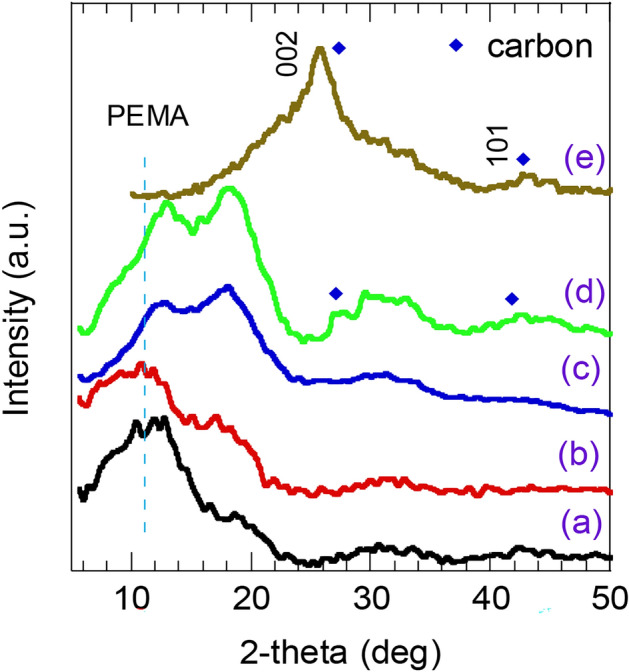
In this study, plasma functionalized multiwalled carbon nanotubes, f-MWCNTs, were incorporated into a poly(ethyl methacrylate), PEMA, polymer matrix at different wt.% (0.005, 0.01, and 0.02 wt.%) to prepare nanocomposite films using the traditional solution casting method. The XRD, Raman spectroscopy, XPS, TGA, mechanical analysis and UV-Vis spectroscopy techniques were employed to investigate the effects of the wt.% of f-MWCNTs on the structure, spectroscopic and other physiochemical properties of the synthesized films. XRD analysis showed a monotonic change in the PEMA structure upon incorporation of f-MWCNTs at different wt.%. The XPS results showed an increase of oxygen-based functional groups C-O and O-C-O on the PEMA/f-MWCNTs/ composite films compared to pure PEMA. Raman spectroscopy results consistent with the XRD and XPS findings, confirming the homogeneous distribution of f-MWCNTs in the PEMA matrix. Thermal stability of f-MWCNTs/PEMA improved as the f-MWCNTs content increased. Optical studies showed a reduction in the bandgap energy as the f-MWCNTs content increased, accompanied by significant improvements in optical properties such as refractive index (n), extinction coefficient (k), dielectric constants (ε' and ε″), and optical conductivity (σopt). Mechanical testing revealed enhancements in breaking strength, Young's modulus, yield stress, and elongation at break with increasing f-MWCNTs concentrations. Furthermore, the AC electrical conductivity of the films also improved, demonstrating better charge transport capabilities. These synergistic enhancements in optical, thermal, mechanical, and electrical properties make PEMA/f-MWCNTs nanocomposites promising candidates for advanced applications, including optoelectronic devices, optical components, and conductive packaging materials.
Keywords: AC conductivity; Mechanical; Optical; PEMA; Thermal stability; f-MWCNTs.
© 2025. The Author(s).
Conflict of interest statement
Declarations. Competing interests: The authors declare no competing interests.
Figures


References
-
- Ates, M., Eker, A. A. & Eker, B. Carbon nanotube-based nanocomposites and their applications. J. Adhes. Sci. Technol.31(18), 1977–1997 (2017).
-
- Zhou, Y. et al. Branched carbon nanotube/carbon nanofiber composite for supercapacitor electrodes. Mater. Lett.246, 174–177 (2019).
-
- Awad, S., El-Gamal, S., El-Sayed, A. M. & Abdel-Hady, E. E. Characterization, optical, and nanoscale free volume properties of Na-CMC/PAM/CNT nanocomposites. Polym. Adv. Technol.31, 114–125 (2020).
-
- Jyoti, J. et al. Stretchable and lightweight MWCNTs/TPU composites films with excellent electromagnetic interference shielding and dynamic mechanical properties. J. Polym. Res.30(8), 322 (2023).
-
- Sanchez, A. G. et al. Chitosan-hydroxyapatite-MWCNTs nanocomposite patch for bone tissue engineering applications. Mater. Today Commun.28, 102615 (2021).
LinkOut - more resources
Full Text Sources
