


Opioid consumption frequency and its associations with potential life problems during opioid agonist treatment in individuals with prescription-type opioid use disorder: exploratory results from the OPTIMA Study
- PMID: 39923043
- PMCID: PMC11806552
- DOI: 10.1186/s12954-025-01157-4
Opioid consumption frequency and its associations with potential life problems during opioid agonist treatment in individuals with prescription-type opioid use disorder: exploratory results from the OPTIMA Study
Abstract
Background: Traditional treatment approaches for prescription-type opioid use disorder (POUD), centered on abstinence, have limitations and hinder the development of interventions that meet the needs of people with POUD. Reduction in use without complete abstinence presents a promising avenue for intervention enhancement, but supporting data is scarce regarding its translation into positive patient outcomes. This study explores whether reducing opioid use frequency (OUF) during opioid agonist treatment correlates with reduced potential life problems in individuals with POUD, including those using fentanyl.
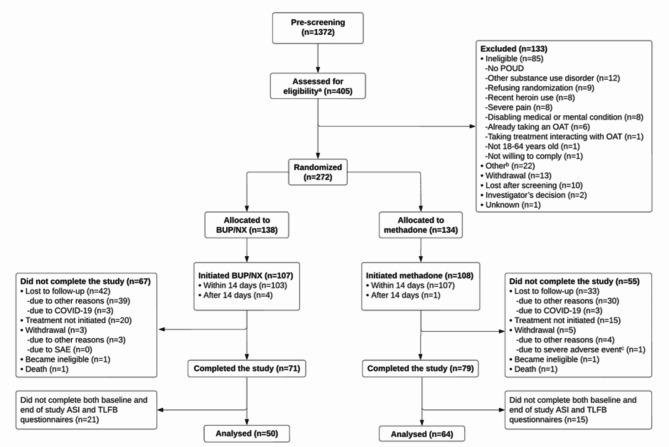
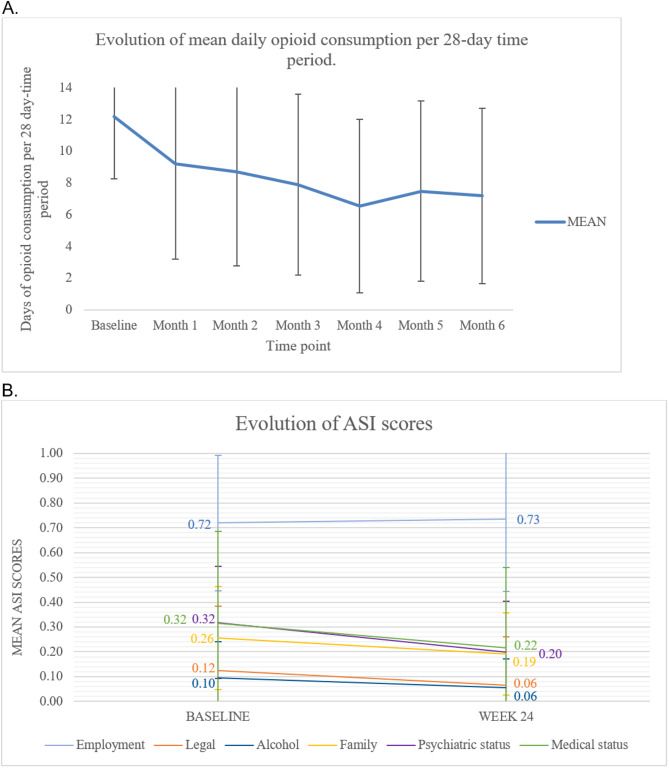
Methods: This study is an exploratory analysis of the OPTIMA trial, a pragmatic, open-label, randomized controlled study comparing the effectiveness of flexible take-home dosing of buprenorphine/naloxone and supervised methadone in reducing opioid use amongst individuals with POUD. OUF was assessed every two weeks for 24 weeks after treatment initiation using the Timeline Followback. Potential life problems were evaluated at baseline and study completion using the Addiction Severity Index Self-Report. The 114 participants who completed both baseline and end-of-study questionnaires were included. A repeated-measures generalized linear mixed model (GLMM) was used to evaluate the influence of OUF on potential life problems.
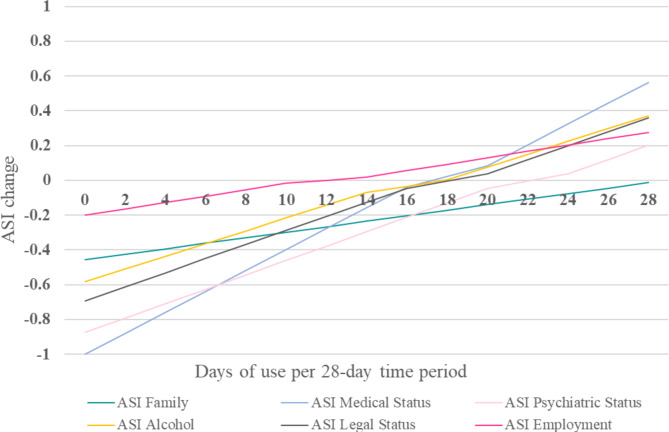
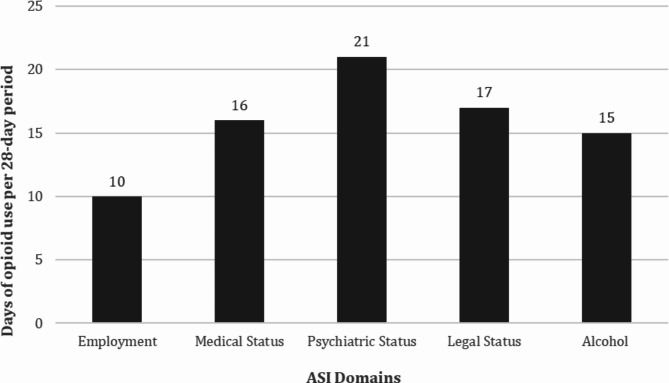
Results: Reducing OUF was significantly associated with fewer problems related to medical status (p = 0.049), psychiatric status (p = 0.019), and alcohol problem severity (p = 0.001). The interaction was non-significant for employment (p = 0.264), family status (p = 0.352) and legal status (p = 0.050). Life improvements emerged with ≤ 21 days of opioid use per 28-day period.
Conclusion: Findings underscore the significance of harm reduction goals focusing on opioid use reduction, which translated in improvements across many life domains.
Trial registration: Study was registered with ClinicalTrials.gov (NCT03033732) prior to participant enrollment.
Keywords: Harm reduction; Opioid agonist treatment; Opioid use disorder; Opioid use frequency; Patient-centered outcomes; Potential life problems.
© 2025. The Author(s).
Conflict of interest statement
Declarations. Competing interests: The authors declare the following financial interests/personal relationships, none of these organizations were involved in this study. BLF has obtained funding from Pfizer Inc., Indivior, Canopy Growth Corporation, Bioprojet Pharma, Alcohol Countermeasure Systems (ACS), Alkermes and Universal Ibogaine. Dr. Le Foll has in-kind donations of cannabis products from Aurora Cannabis Enterprises Inc. and study medication donations from Pfizer Inc. (varenicline for smoking cessation) and Bioprojet Pharma. He was also provided a coil for a Transcranial magnetic stimulation (TMS) study from Brainsway. BLF has received in kind donations of nabiximols from GW Pharmaceuticals for past studies funded by CIHR and NIH. He has participated in a session of a National Advisory Board Meeting (Emerging Trends BUP-XR) for Indivior Canada and is part of Steering Board for a clinical trial for Indivior. He has been consultant for Shinogi. He got travel support to attend an event by Bioprojet. MES received funding from Indivior Investigator Initiated program paid to her institution for work outside this study. DJA received study materials from Cardiol Therapeutics and Exka for clinical trials which is not related to the topic of the present manuscript.
Figures
References
-
- FDA. Timeline of Selected FDA Activities and Significant Events Addressing Substance Use and Overdose Prevention. 2023. Available from: https://www.fda.gov/drugs/information-drug-class/timeline-selected-fda-a...
-
- Meier B. Pain killer: an empire of deceit and the origin of America’s opioid epidemic. Random House; 2018.
-
- Center for Disease Control and Prevention NCfHS. Wide-ranging online data for epidemiologic research (WONDER) 2022. Available from: http://wonder.cdc.gov
-
- Hedegaard H, Miniño AM, Spencer MR, Warner M. Drug overdose deaths in the United States, 1999–2020. 2021. - PubMed
Publication types
MeSH terms
Substances
Associated data
Grants and funding
LinkOut - more resources
Full Text Sources
Medical
