. 2025 Feb 10;15(1):4256.
doi: 10.1038/s41598-025-87921-9.

Sigma-2 receptor modulator CT1812 alters key pathways and rescues retinal pigment epithelium (RPE) functional deficits associated with dry age-related macular degeneration (AMD)

Affiliations

Sigma-2 receptor modulator CT1812 alters key pathways and rescues retinal pigment epithelium (RPE) functional deficits associated with dry age-related macular degeneration (AMD)

Britney N Lizama et al. Sci Rep. .

Abstract

Trafficking defects in retinal pigmented epithelial (RPE) cells contribute to RPE atrophy, a hallmark of geographic atrophy (GA) in dry age-related macular degeneration (AMD). Dry AMD pathogenesis is multifactorial, including amyloid-β (Aβ) accumulation and oxidative stress-common features of Alzheimer's disease (AD). The Sigma-2 receptor (S2R) regulates lipid and protein trafficking, and S2R modulators reverse trafficking deficits in neurodegeneration in vitro models. Given overlapping mechanisms contributing to AD and AMD, S2R modulator effects on RPE function were investigated. The S2R modulator CT1812 is in clinical trials for AD, dementia with Lewy bodies, and GA. Leveraging AD trials testing CT1812, unbiased analyses of patient biofluid proteomes revealed that proteins altered by CT1812 associated with GA and macular degeneration disease ontologies and overlapped with proteins altered in dry AMD. Differential expression analysis of RPE transcripts from APP-Swedish/London mutant transgenic mice, a model featuring Aβ accumulation, revealed reversal of autophagy/trafficking transcripts in S2R modulator-treated animals versus vehicle toward healthy control levels. Photoreceptor outer segment (POS) trafficking in human RPE cells showed deficits in response to Aβ1-42 or hydrogen peroxide compared to vehicle. S2R modulators normalized stressor-induced POS trafficking deficits, resembling healthy control. Taken together, S2R modulation may provide a novel therapeutic strategy for dry AMD.


Conflict of interest statement

Declarations. Competing interests: BNL, EC, NK, VD, AOC, and MEH are employees of Cognition Therapeutics, Inc. GL is a consultant to Cognition Therapeutics, Inc. EW, EMM, and LW are former employees of Cognition Therapeutics, Inc. BNL, EC, NK, LW, EW, GL, VD, AOC, and MEH are shareholders of Cognition Therapeutics, Inc. All the remaining authors declare no conflict of interest.

Figures
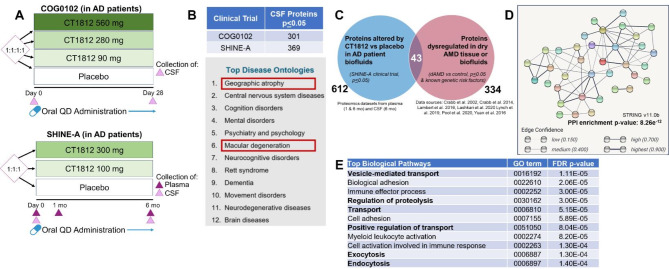
Fig. 1
Fig. 1
Clinical proteomics data from aged cohorts indicate CT1812 impacts dry AMD. (A) Proteome-wide clinical biomarker analyses of cerebrospinal fluid (CSF) from individuals with mild to moderate Alzheimer’s disease participating in two clinical trials, COG0102 (NCT02907567; N = 14; baseline and 28 day) and COG0201 Part-A (SHINE-A, NCT03507790; N = 18; baseline and 6 month), was performed. (B) Differentially expressed proteins were identified (p ≤ 0.05). Unbiased disease ontology meta-analysis across trials was performed from significantly differentially expressed proteins (p ≤ 0.05) identifying the predesignated functional disease ontologies most significantly impacted by CT1812 treatment versus placebo (MetaCore v20.3.70200). Listed are the top diseases in rank order of significance. (C) Venn diagram illustrates comparative analyses examining the overlap of proteins significantly altered in CSF or plasma with CT1812 versus placebo (p ≤ 0.05, blue circle) from the SHINE-A trial, with genetic risk factors and proteins known to be disrupted in dry AMD or GA compared to age-matched controls (red circle). (D) STRING protein interaction analysis indicated this set of 43 overlapping proteins had a highly significant protein-protein interaction score (PPI score p = 8.26e−12, disconnected nodes hidden; STRING v11.0b). (E) The topmost significant gene ontology (GO) biological processes in which these 43 proteins participate were identified. Pathways of interest are indicated in bold text.
Fig. 2
Fig. 2
S2R modulators alter pathways and biological processes disrupted in dry AMD in vivo. Volcano plots were generated from differentially expressed genes (DEGs) comparing (A) hAPPsl transgenic (Tg)-CT1812 vs. vehicle (459 total DEGs p ≤ 0.05; 208 decreased and 251 increased), and (B) Tg-CT2168 vs. vehicle (1445 total DEGs p ≤ 0.05; 280 decreased and 1165 increased). Each dot represents a transcript, where gray indicates unaltered expression (p > 0.05), blue and red indicate decreased and increased expression (p ≤ 0.05), respectively. MetaCore pathway analysis (v. 23.2.71300) was performed using the significant DEGs identified in each contrast (p ≤ 0.05; 459 in Tg-CT1812 vs. vehicle, 1445 in Tg-CT2168 vs. vehicle). Listed are the top 6 most significant pathway maps (p ≤ 0.05), with pathways of interest related to S2R biology indicated in bold text, and pathways relevant to dry AMD indicated with references to the following: a. Shu et al.; b. Pikuleva IA & Curcio CA 2014 ; c. Bhattacharya et al. ; d. Sparrow JR 2016 ; (e) Tebbe L, et al. ; (f) Kwok MCM, et al. . N.B. Non-relevant tissue-specific pathways were omitted from list.
Fig. 3
Fig. 3
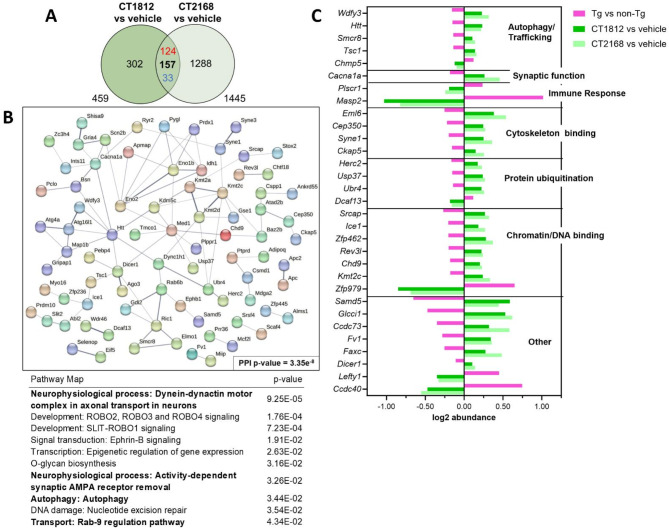
Chemically distinct S2R modulators exhibit overlapping gene expression changes and reverse genetic expression patterns in the hAPPsl-Tg mouse RPE. Comparative analysis was performed between CT1812- and CT2168-treated Tg groups, and 157 overlapping significant differentially expressed genes (DEGs) were identified (A, p ≤ 0.05). Red indicates significantly upregulated; blue indicates significantly downregulated. Top 10 increased or decreased DEGs are listed in Supplementary Table S2. (B) STRING protein interaction analysis indicated this set of 157 overlapping DEGs had a highly significant protein-protein interaction score (PPI score p = 3.35e−8, disconnected nodes hidden; STRING v.12.0). MetaCore top pathways are listed below, with pathways of interest indicated in bold text. (C) Forest plot illustrates the log2 abundance of 31 significant DEGs (p ≤ 0.05), grouped by similar GO terms.
Fig. 4
Fig. 4
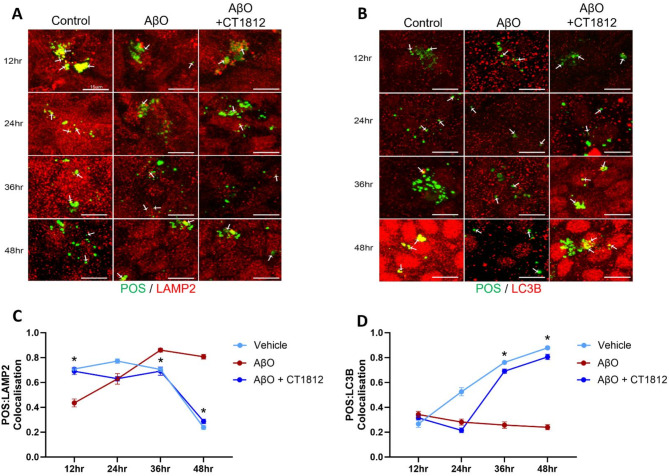
CT1812 rescues Aβ-mediated deficits in POS trafficking. ARPE-19 cells were treated with 1 µM AβO for 3 h, in the presence of CT1812 or vehicle (DMSO) for a total of 24 h. Cells were pulsed with POS-FITC (4 µg/cm2), fixed 12–48 h after POS addition, and assessed for LAMP2 and LC3 via ICC. Confocal microscopy was used to measure colocalization (yellow) of LAMP2 (A, red) and LC3 (B, red) with POS (green) at the indicated timepoints. Arrows point to colocalization (yellow) or lack thereof (green). Scale bars correspond to 15 μm. An unbiased algorithm was used to quantify (C) LAMP2 or (D) LC3B and POS colocalization. A significant reduction in LAMP2-POS colocalization towards control levels was observed with CT1812 at 12, 36, and 48 h (* p ≤ 0.0001, CT1812 compared to stressor). A significant increase in LC3B-POS colocalization towards control levels was observed with CT1812 at 36 and 48 h (* p ≤ 0.0001, CT1812 compared to stressor). Statistical significance was assessed via 2-way ANOVA and Tukey’s post-hoc test (n = 5 wells from 2 experiments). Data are expressed as mean ± standard error of the mean (SEM).
Fig. 5
Fig. 5
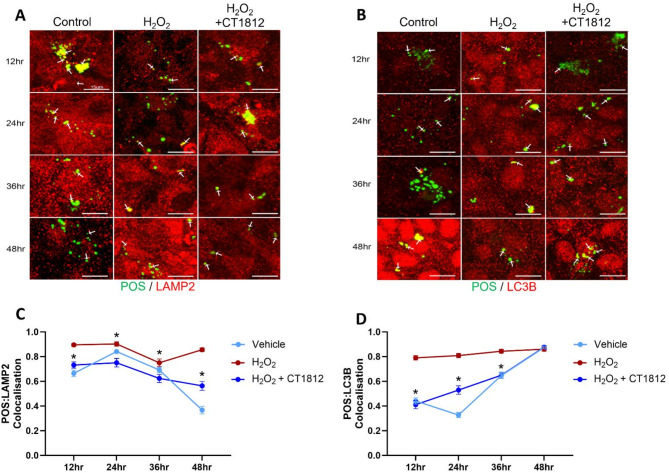
CT1812 rescues oxidative stress-mediated defects in POS trafficking. ARPE-19 cells were treated with 100 µM H2O2 in the presence of CT1812 or vehicle (DMSO) for a total of 24 h. Cells were pulsed with POS-FITC (4 µg/cm2), fixed 12–48 h after POS addition, and assessed for LAMP2 and LC3 via ICC. Confocal microscopy was used to measure colocalization (yellow) of LAMP2 (A, red) and LC3 (B, red) with POS (green) at the indicated timepoints. Arrows point to colocalization (yellow) or lack thereof (green). Scale bars correspond to 15 μm. An unbiased algorithm was used to quantify (C) LAMP2 or (D) LC3B and POS colocalization. A significant reduction in LAMP2-POS colocalization towards control levels was observed with CT1812 at 12, 24, 36, and 48 h (*p ≤ 0.01, CT1812 compared to stressor). A significant reduction in LC3B-POS colocalization towards control levels was observed with CT1812 at 12, 24, and 36 h (* p ≤ 0.0001, CT1812 compared to stressor). Statistical significance was assessed via 2-way ANOVA and Tukey’s post-hoc test (n = 5 wells from 2 experiments). Data are expressed as mean ± standard error of the mean (SEM).

References

    1. Liste, S. Blindness and vision impairment. World Health Organ.. https://www.who.int/news-room/fact-sheets/detail/blindness-and-visual-im... (2022).
    1. Wong, W. L. et al. Global prevalence of age-related macular degeneration and disease burden projection for 2020 and 2040: a systematic review and meta-analysis. Lancet Glob Heal. 2, e106–e116 (2014). - PubMed
    1. Schultz, N. M., Bhardwaj, S., Barclay, C., Gaspar, L. & Schwartz, J. Global Burden of Dry Age-Related Macular Degeneration: a targeted literature review. Clin. Ther.43, 1792–1818 (2021). - PubMed
    1. Wei, Y., Liao, H. & Ye, J. Therapeutic effects of various therapeutic strategies on non-exudative age-related macular degeneration. Med. (Baltim).97, e10422 (2018). - PMC - PubMed
    1. Heier, J. S. et al. Pegcetacoplan for the treatment of geographic atrophy secondary to age-related macular degeneration (OAKS and DERBY): two multicentre, randomised, double-masked, sham-controlled, phase 3 trials. Lancet402, 1434–1448 (2023). - PubMed

MeSH terms

LinkOut - more resources