


Broadening the Scope of Neural Network Potentials through Direct Inclusion of Additional Molecular Attributes
- PMID: 39933873
- PMCID: PMC12131224
- DOI: 10.1021/acs.jctc.4c01625
Broadening the Scope of Neural Network Potentials through Direct Inclusion of Additional Molecular Attributes
Abstract
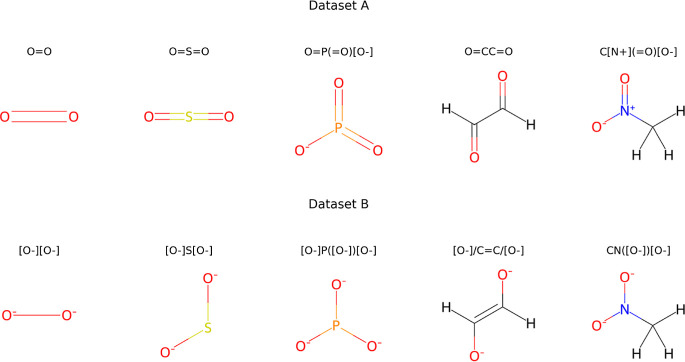
Most state-of-the-art neural network potentials do not account for molecular attributes other than atomic numbers and positions, which limits its range of applicability by design. In this work, we demonstrate the importance of including additional electronic attributes in neural network potential representations with a minimal architectural change to TensorNet, a state-of-the-art equivariant model based on Cartesian rank-2 tensor representations. By performing experiments on both custom-made and public benchmarking data sets, we show that this modification resolves input degeneracy issues stemming from the use of atomic numbers and positions alone, while enhancing the model's predictive accuracy across diverse chemical systems with different charge or spin states. This is accomplished without tailored strategies or the inclusion of physics-based energy terms, while maintaining efficiency and accuracy. These findings should furthermore encourage researchers to train and use models incorporating these additional representations.
Figures
References
Grants and funding
LinkOut - more resources
Full Text Sources