


Changes in drinking levels and metabolic dysfunction-associated steatotic liver disease: a longitudinal study from the China multi-ethnic cohort study
- PMID: 39934719
- PMCID: PMC11817541
- DOI: 10.1186/s12889-025-21752-1
Changes in drinking levels and metabolic dysfunction-associated steatotic liver disease: a longitudinal study from the China multi-ethnic cohort study
Abstract
Background: Little is known about the associations of changes in drinking levels with the newly defined metabolic dysfunction-associated steatotic liver disease (MASLD). We therefore sought to estimate the associations between changes in drinking levels and MASLD in less developed regions of China.
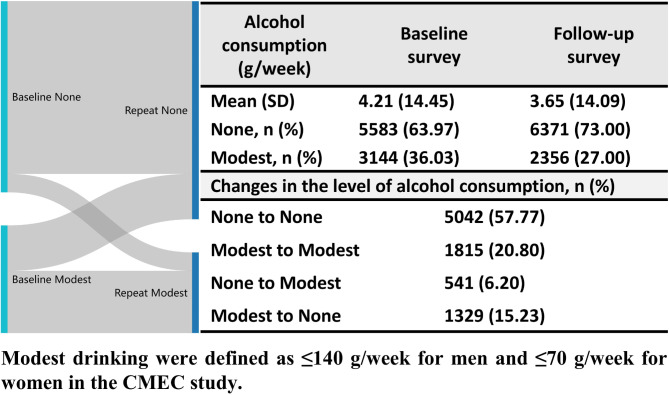
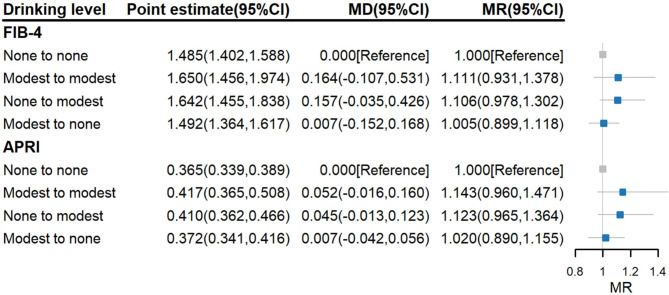
Methods: This longitudinal study included 8727 participants from the China Multi-Ethnic Cohort (CMEC) in less developed regions, all participating in baseline and a follow-up survey. MASLD was defined as hepatic steatosis, along with the presence of at least one of five cardiometabolic risks, in addition to limiting excessive alcohol consumption. We applied the parametric g-formula to evaluate the association between changes in drinking levels and MASLD. We further estimated the association between changes in drinking levels and fibrosis scores (AST-to-platelet ratio and fibrosis-4 index) in patients with MASLD.
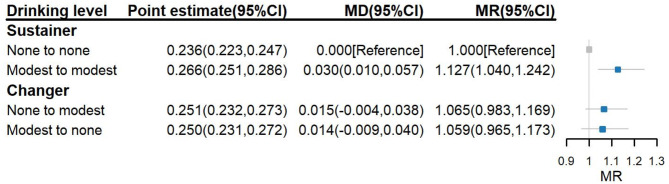
Results: Compared with sustained non-drinking, sustained modest drinking was associated with a higher risk of MASLD (Mean Ratio (MR): 1.127 [95% CI: 1.040-1.242]). Compared to sustained non-drinking, the MR for those transitioning from non-drinking to modest drinking was 1.065 [95% CI: 0.983-1.169], while the MR for those changing from modest drinking to non-drinking was 1.059 [95% CI: 0.965, 1.173]. Non-invasive fibrosis scores tended to increase with modest drinking compared to sustained non-drinking.
Conclusion: In the less developed regions of China, sustained moderate drinking was associated with the risk of MASLD compared with sustained non-drinking. Increased drinking showed a trend towards a higher risk of MASLD. This study can inform drinking policies related to MASLD and liver fibrosis in less developed regions.
Keywords: Changes in drinking levels; MASLD; Modest alcohol consumption; NAFLD.
© 2025. The Author(s).
Conflict of interest statement
Declarations. Ethics approval and consent to participate: Ethical approvals were obtained by the Sichuan University Medical Ethical Review Board for the CMEC study. The ethical approval was done in accordance with the Declaration of Helsinki. Informed consent to participate was obtained from all of the participants in the study. Consent for publication: Not applicable. Competing interests: The authors declare no competing interests. Informed consent: Informed consent was obtained from all individual participants included in the study.
Figures
References
-
- Eslam M, Newsome PN, Sarin SK, et al. A new definition for metabolic dysfunction-associated fatty liver disease: an international expert consensus statement. J Hepatol Jul. 2020;73(1):202–9. 10.1016/j.jhep.2020.03.039. - PubMed
-
- Powell EE, Wong VW, Rinella M. Non-alcoholic fatty liver disease. Lancet Jun. 2021;5(10290):2212–24. 10.1016/s0140-6736(20)32511-3. - PubMed
-
- Younossi ZM. Non-alcoholic fatty liver disease - A global public health perspective. J Hepatol Mar. 2019;70(3):531–44. 10.1016/j.jhep.2018.10.033. - PubMed
-
- Younossi ZM, Rinella ME, Sanyal AJ, et al. From NAFLD to MAFLD: implications of a premature change in terminology. Hepatol Mar. 2021;73(3):1194–8. 10.1002/hep.31420. - PubMed
-
- Rinella ME, Lazarus JV, Ratziu V, et al. A multi-society Delphi consensus statement on new fatty liver disease nomenclature. J Hepatol Jun. 2023;20. 10.1016/j.jhep.2023.06.003. - PubMed
MeSH terms
Grants and funding
LinkOut - more resources
Full Text Sources
Medical
