Feasibility, acceptability and preliminary effectiveness of the Hospital to Home discharge and follow-up programme in rural Uganda: a mixed-methods intervention study
- PMID: 39939110
- PMCID: PMC11822387
- DOI: 10.1136/bmjgh-2024-015945
Feasibility, acceptability and preliminary effectiveness of the Hospital to Home discharge and follow-up programme in rural Uganda: a mixed-methods intervention study
Abstract
Introduction: Over 60% of premature infants are born in Africa or South Asia. Infants born early, small or who become sick after birth have a higher risk of death, poor growth and developmental impairments. Innovative interventions tailored for low- and middle-income countries are essential to help these newborns survive and develop optimally. This study evaluated the feasibility, acceptability and preliminary effectiveness of Hospital to Home (H2H), a discharge and follow-up programme for small and sick newborns in rural Uganda.
Methods: We compared two cohorts of high-risk hospitalised neonates in Uganda: a historical-comparison cohort receiving standard facility-based care and an intervention cohort that received the H2H programme, a hospital and community spanning package of interventions designed to improve neurodevelopmental outcomes. We compared 6-month corrected neurodevelopmental, growth, nutritional and vaccination outcomes between the cohorts complemented by qualitative interviews of caregivers, community health workers and health facility staff.
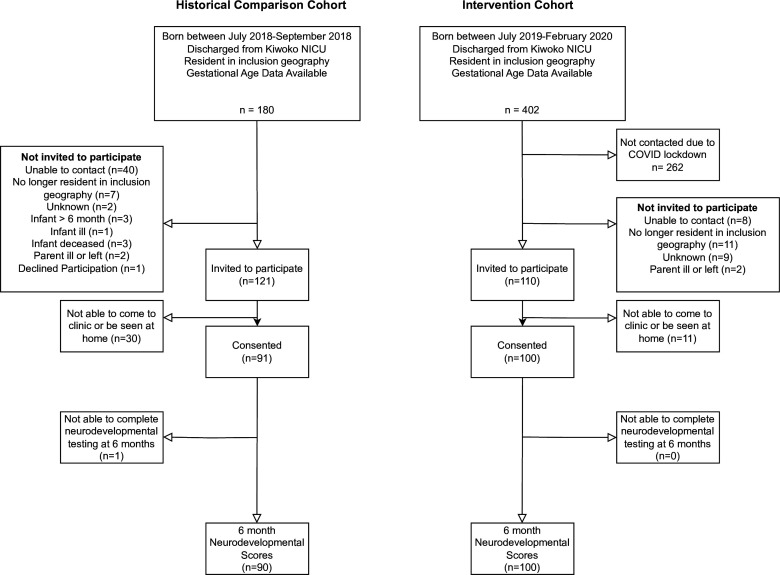
Results: We recruited 191 participants: 91 historical-comparison cohort (born between July and September 2018), and 100 intervention cohort (born July 2019 to February 2020). No statistically significant difference was seen in neurodevelopmental outcomes (adjusted OR 0.68; 95% CI: 0.32 to 1.46). Improved vaccination completion (88.5% intervention vs 76.9% comparison, p=0.041), and exclusive breastfeeding rates (42% vs 6.6%, p<0.001) were seen. Caregivers and healthcare workers reported the intervention to be acceptable and feasible in this rural Ugandan setting.
Conclusion: The H2H programme was feasible and acceptable to caregivers and healthcare providers. Improved vaccination and exclusive breastfeeding rates were seen in the intervention group when compared with a historical comparison cohort in this rural Ugandan setting. Further investigation on the short and long-term effectiveness of the H2H programme in a government health services setting is warranted.
Trial registration number: ISRCTN51636372.
Keywords: Child health; Global Health.
© Author(s) (or their employer(s)) 2025. Re-use permitted under CC BY-NC. No commercial re-use. See rights and permissions. Published by BMJ Group.
Conflict of interest statement
Competing interests: None declared.
References
-
- Paulson KR, Kamath AM, Alam T, et al. Global, regional, and national progress towards Sustainable Development Goal 3.2 for neonatal and child health: all-cause and cause-specific mortality findings from the Global Burden of Disease Study 2019. The Lancet. 2021;398:870–905. doi: 10.1016/S0140-6736(21)01207-1. - DOI - PMC - PubMed
MeSH terms
Grants and funding
LinkOut - more resources
Full Text Sources
Medical