


Application of Global Warming Potential Star (GWP*) Values to the AUSNUT 2011-13 Food Composition Database: Creation of the GWP*-AUSNUT 2011-13 Database
- PMID: 39940322
- PMCID: PMC11820119
- DOI: 10.3390/nu17030464
Application of Global Warming Potential Star (GWP*) Values to the AUSNUT 2011-13 Food Composition Database: Creation of the GWP*-AUSNUT 2011-13 Database
Abstract
Background/objectives: The Global Warming Potential Star (GWP*) refers to the amount of carbon dioxide equivalents produced by food items, with values available for n = 232 Australian food products. The aim of this study was to apply GWP* values to the AUSNUT 2011-13 food composition database to facilitate the calculation of the climate footprint of Australian dietary data.
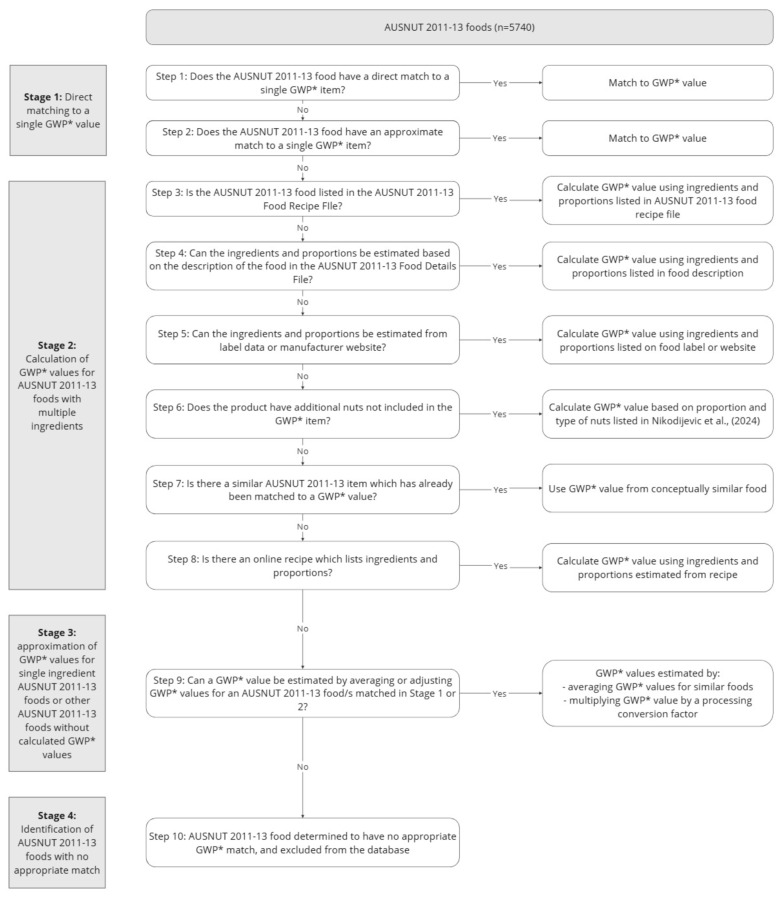
Methods: To create the GWP*-AUSNUT 2011-13 database, all n = 5740 food and beverage items in AUSNUT 2011-13 were reviewed and GWP* values applied or calculated via a systematic approach. Direct or approximate matches to a single GWP* value were prioritised. GWP* values were then calculated for composite foods with multiple ingredients. Finally, GWP* values were approximated based on food group, adjusted using other GWP* values, or foods were excluded if no appropriate match could be found.
Results: A total of n = 5502 (95.85%) AUSNUT 2011-13 foods were matched to a GWP* value, with the majority requiring calculation based on multiple ingredients. Mean ± standard deviation GWP* values ranged from 0.18 ± 0.12 kg CO2e/kg ('Dairy and meat substitutes') to 5.63 ± 7.55 kg CO2e/kg ('Meat, poultry and game products and dishes').
Conclusions: The GWP*-AUSNUT 2011-13 database can be applied to Australian dietary data to identify the climate footprint of different dietary patterns or to provide insight into dietary changes required to decrease greenhouse gas emissions. Future research is now required to develop new GWP* values for a broader range of foods and to update this database when new Australian food composition databases are released.
Keywords: AUSNUT 2011-13; climate change; food composition database; global warming potential star; sustainability.
Conflict of interest statement
The authors declare no conflicts of interest.
Figures
References
-
- Intergovernmental Panel on Climate Change, editor. Climate Change 2022—Mitigation of Climate Change: Working Group III Contribution to the Sixth Assessment Report of the Intergovernmental Panel on Climate Change. Cambridge University Press; Cambridge, UK: 2023.
-
- Allen M.R., Shine K.P., Fuglestvedt J.S., Millar R.J., Cain M., Frame D.J., Macey A.H. A solution to the misrepresentations of CO2-equivalent emissions of short-lived climate pollutants under ambitious mitigation. NPJ Clim. Atmos. Sci. 2018;1:16. doi: 10.1038/s41612-018-0026-8. - DOI
MeSH terms
Substances
LinkOut - more resources
Full Text Sources
