


Gambling Disorder in Parkinson's Disease: A Scoping Review on the Challenge of Rehabilitation Strategies
- PMID: 39941408
- PMCID: PMC11818531
- DOI: 10.3390/jcm14030737
Gambling Disorder in Parkinson's Disease: A Scoping Review on the Challenge of Rehabilitation Strategies
Abstract
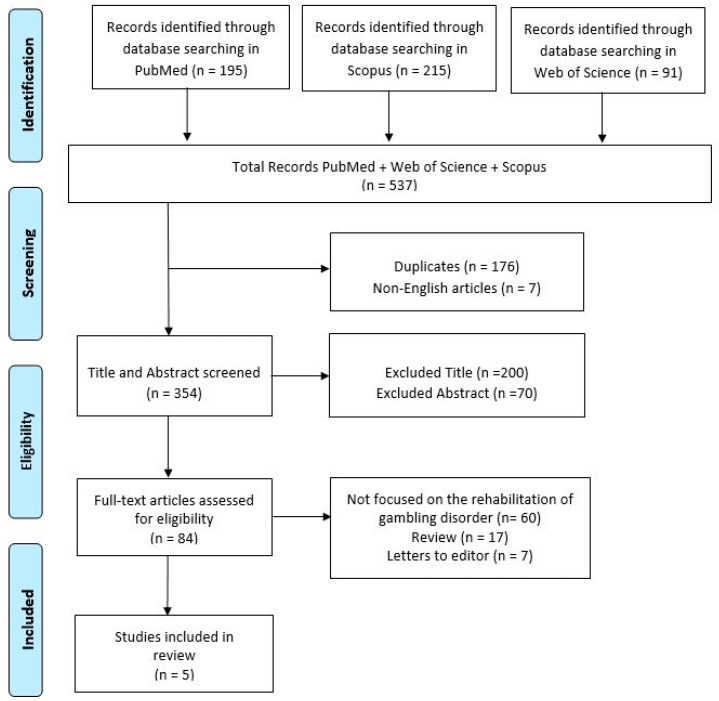
Background: Pathological gambling (PG) is a significant non-motor complication in Parkinson's disease (PD), often linked to dopaminergic therapies. PG impacts the quality of life of patients and their families, presenting unique challenges due to its interplay with motor symptoms and cognitive impairments in PD. This scoping review synthesized current evidence on rehabilitation strategies for PG in PD. Methods: A systematic review was conducted across the PubMed, Web of Science, Embase, and Scopus databases to identify studies addressing pharmacological, psychological, and neuromodulatory approaches. The scoping objective was to map the available evidence on treatment strategies and identify research gaps. Results: Of 537 studies, 5 met the inclusion criteria. Pharmacological strategies included dopamine agonist adjustments, naltrexone, and amantadine, which showed partial efficacy but were often limited by significant side effects. Neuromodulation via deep brain stimulation (DBS) demonstrated potential by modulating limbic circuits, though risks like apathy and transient symptom exacerbation were noted. Psychological interventions, particularly cognitive-behavioral therapy (CBT), were the most effective in modifying gambling behaviors, though adaptations are needed for PD-specific cognitive and psychiatric challenges. Conclusions: Effective rehabilitation for PG in PD requires a multidisciplinary approach to balance motor symptom management with impulse control disorders. While pharmacological, psychological, and neuromodulatory interventions show promise, gaps remain regarding their long-term efficacy, combined use, and tailoring to PD-specific needs. The lack of large-scale, comparative studies and limited exploration of novel therapeutic combinations underscore the need for further research to optimize patient outcomes and develop comprehensive treatment frameworks.
Keywords: CBT; DBS; Parkinson; gambling disorder; rehabilitation.
Conflict of interest statement
The authors declare no conflicts of interest.
Figures
References
-
- Lee J.-H. Understanding Parkinson’s Disorders: Classification and Evaluation Methods, Movement Disorders, and Treatment Methods. Int. J. Adv. Cult. Technol. 2023;11:9–17. doi: 10.17703/IJACT.2023.11.3.9. - DOI
-
- Dawson-Squibb J.-J., Davids E.L., Viljoen M., Rice K., Stein D.J. Handbook of Clinical Child Psychology: Integrating Theory and Research into Practice. Springer International Publishing; Cham, Switzerland: 2023. The WHO International Classification of Diseases 11th Revision (ICD-11) pp. 53–78. - DOI
-
- Tran L.T., Wardle H., Colledge-Frisby S., Taylor S., Lynch M., Rehm J., Volberg R., Marionneau V., Saxena S., Bunn C., et al. The Prevalence of Gambling and Problematic Gambling: A Systematic Review and Meta-Analysis. Lancet Public Health. 2024;9:e594–e613. doi: 10.1016/S2468-2667(24)00126-9. - DOI - PubMed
Publication types
Grants and funding
LinkOut - more resources
Full Text Sources
Miscellaneous
