


Predicting Response to Treatment and Survival in Advanced Ovarian Cancer Using Machine Learning and Radiomics: A Systematic Review
- PMID: 39941708
- PMCID: PMC11815807
- DOI: 10.3390/cancers17030336
Predicting Response to Treatment and Survival in Advanced Ovarian Cancer Using Machine Learning and Radiomics: A Systematic Review
Abstract
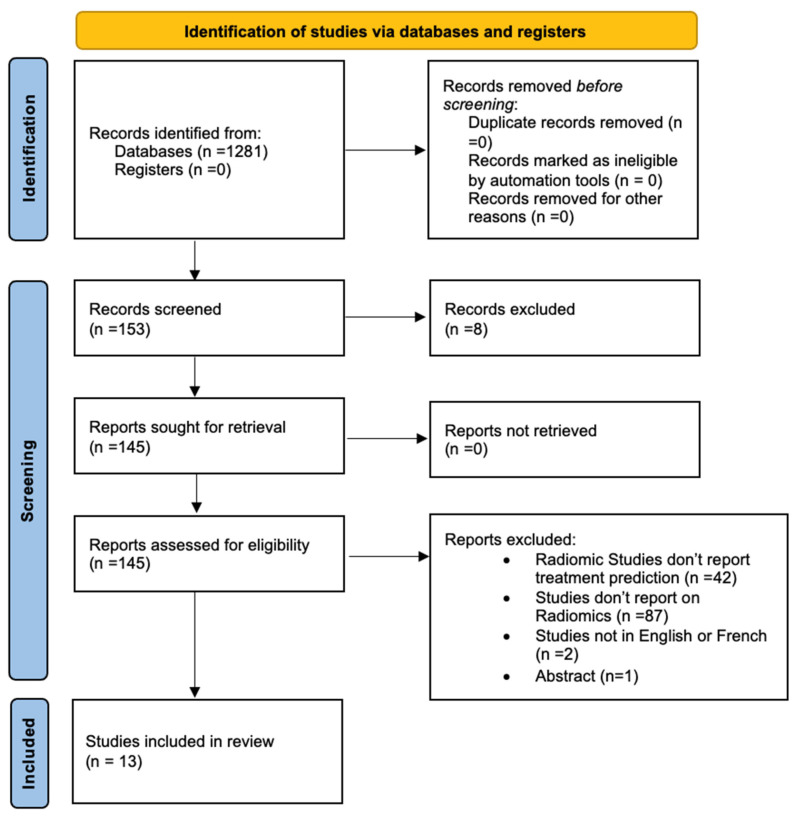
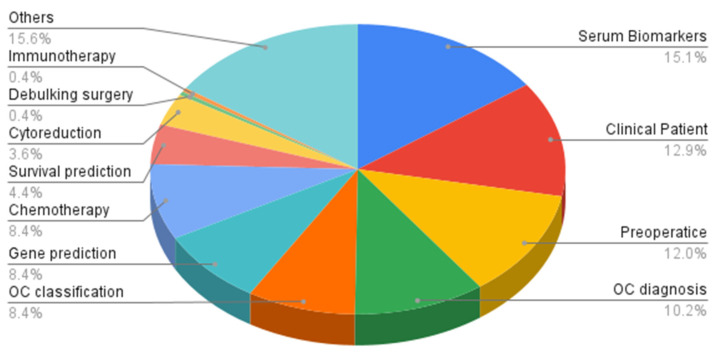
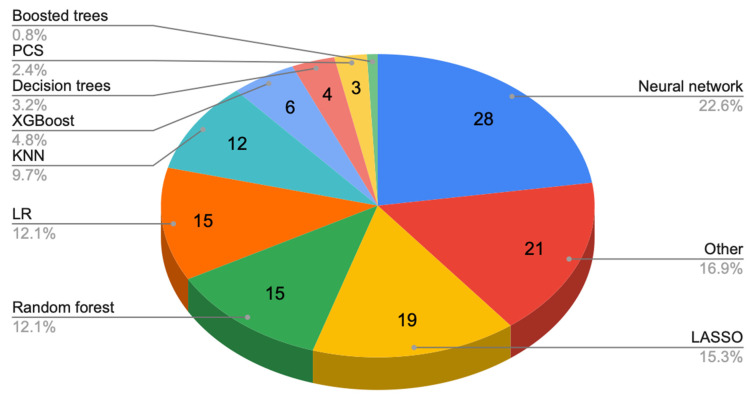
Background and Objective: Machine learning and radiomics (ML/RM) are gaining interest in ovarian cancer (OC) but only a few studies have used these methods to predict treatment response. The objective of this study was to review the literature on the applications of ML/RM in OC assessments, specifically focusing on studies describing algorithms to predict treatment response and survival. Methods: This is a systematic review of the published literature from January 1985 to December 2023 on the use of ML/RM in OC An extensive search of electronic library databases was conducted. Two independent reviewers screened the articles initially by title then by full text. Quality was assessed using the MINORS criteria. p-values were generated using the Pearson's Chi-squared (x2) test to compare the performances of ML/RM models with traditional statistics. Results: Of the 5576 screened articles, 225 studies were included. Between 2021 and 2023, 49 studies were published, highlighting the rapidly growing interest in ML/RM. Median-quality scores using the MINORS scale were similar between studies published between 1985-2021 and 2021-2023 (both 8). Neural Networks (22.6%) and LASSO (15.3%) were the most common ML/RM algorithms in OC. Among these studies, 13 focused specifically on prediction of treatment response using radiomics. A total of 5113 patients were analyzed. The most common algorithms were Random Forest (4/13) followed by Neural Networks (3/13) and Support Vectors (3/13). Radiomic analysis was used to predict response to neoadjuvant chemotherapy in seven studies, with a median AUC of 0.77 (range 0.72-0.93), while the median AUC was 0.82 (range 0.77-0.89) in the six studies assessing the prediction of optimal or complete cytoreduction. Median model accuracy reported in 7/13 studies was 73% (range 66-98%). Additionally, four studies investigated the use of ML/RM for survival prediction for OC. The XGBoost model had 80.9% accuracy in predicting 5-year survival compared to linear regression, which achieved 79% accuracy. The Random Forest model has 93.7% accuracy in predicting 12-month progression-free survival, compared to 82% for linear regression. Conclusions: In conclusion, we found that the use of ML/RM algorithms is becoming a more frequent method to predict responses to treatment of OC. These models should be validated in a prospective multicenter trial prior to integration into clinical use.
Keywords: machine learning; ovarian cancer; radiomics; treatment prediction.
Conflict of interest statement
The authors declare no conflicts of interest.
Figures
References
-
- Penny S.M. Ovarian Cancer: An Overview. Radiol. Technol. 2020;91:561–575. - PubMed
Publication types
LinkOut - more resources
Full Text Sources
