


Relationship Between Signals from Cerebral near Infrared Spectroscopy Sensor Technology and Objectively Measured Cerebral Blood Volume: A Systematic Scoping Review
- PMID: 39943547
- PMCID: PMC11819900
- DOI: 10.3390/s25030908
Relationship Between Signals from Cerebral near Infrared Spectroscopy Sensor Technology and Objectively Measured Cerebral Blood Volume: A Systematic Scoping Review
Abstract
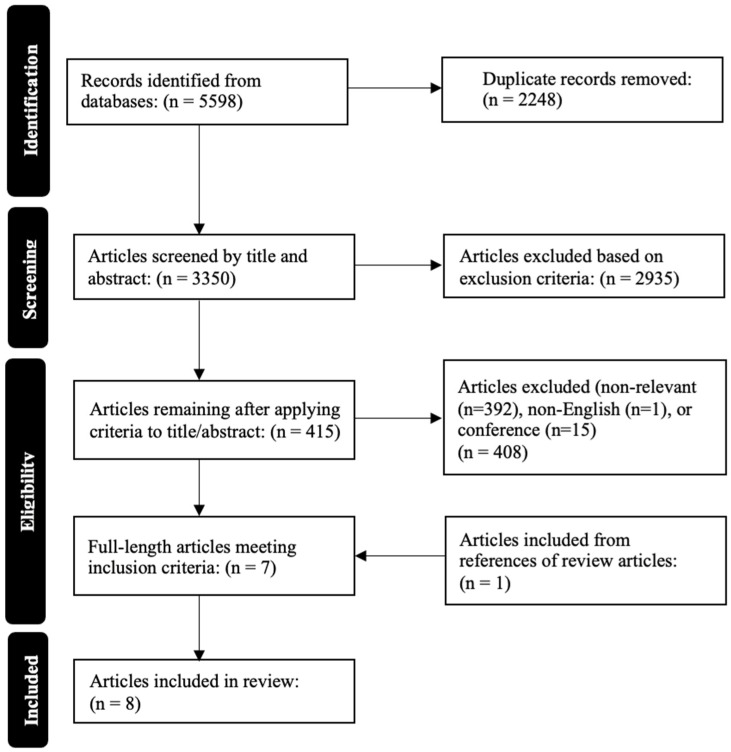
Cerebral blood volume (CBV) is an essential metric that indicates and evaluates various healthy and pathologic conditions. Most methods of CBV measurement are cumbersome and have a poor temporal resolution. Recently, it has been proposed that signals and derived metrics from cerebral near-infrared spectroscopy (NIRS), a non-invasive sensor, can be used to estimate CBV. However, this association remains vastly unexplored. As such, this scoping review aimed to examine the literature on the relationship between cerebral NIRS signals and CBV. A search of six databases was conducted conforming to the Preferred Reporting Items for Systematic Reviews and Meta-Analyses guidelines to assess the following search question: What are the associations between various NIRS cerebral signals and CBV? The database search yielded 3350 unique results. Seven of these articles were included in this review based on the inclusion and exclusion criteria. An additional study was identified and included while examining the articles' reference sections. Overall, the literature for this systematic scoping review shows extreme variation in the association between cerebral NIRS signals and CBV, with few sources objectively documenting a true statistical association between the two. This review highlights the current critical knowledge gap and emphasizes the need for further research in the area.
Keywords: CBV; NIRS; cerebral blood volume; cerebral near-infrared spectroscopy.
Conflict of interest statement
The authors declare that they have no conflicts of interest.
Figures
References
-
- Lewis P.M., Smielewski P., Rosenfeld J.V., Pickard J.D., Czosnyka M. A Continuous Correlation Between Intracranial Pressure and Cerebral Blood Flow Velocity Reflects Cerebral Autoregulation Impairment During Intracranial Pressure Plateau Waves. Neurocritical Care. 2014;21:514–525. doi: 10.1007/s12028-014-9994-7. - DOI - PubMed
Publication types
MeSH terms
Grants and funding
- N/A/University of Manitoba Endowed Manitoba Public Insurance (MPI) Chair in Neuroscience
- ALLRP-578524-22/Natural Sciences and Engineering Research Council of Canada
- N/A/University of Manitoba Graduate Fellowship - Human Anatomy and Cell Sciences
- DGECR-2022-00260/Natural Sciences and Engineering Research Council of Canada
- RGPIN-2022-03621/Natural Sciences and Engineering Research Council of Canada
- ALLRP-576386-22/Natural Sciences and Engineering Research Council of Canada
- I2IPJ 586104-23/Natural Sciences and Engineering Research Council of Canada
- ALLRP 586244-23/Natural Sciences and Engineering Research Council of Canada
- ALLRP-590680-2023/Natural Sciences and Engineering Research Council of Canada
- ALLRP 597442-24/Natural Sciences and Engineering Research Council of Canada
- ALLRP-597708-24/Natural Sciences and Engineering Research Council of Canada
- N/A/CAPMC/ CIHR/Canada
- N/A/MPI Neuroscience Research Operating Fund
- N/A/Health Sciences Centre Foundation Winnipeg
- 38583/Canada Foundation for Innovation
- 3906/Research Manitoba
- 5429/Research Manitoba
- 5914/Research Manitoba
- N/A/Pan Am Clinic Foundation of Winnipeg
- CGS D-579021-2023/Natural Sciences and Engineering Research Council of Canada CGS-D program
- N/A/University of Manitoba R.G. and E.M. Graduate Fellowship (Doctoral) in Biomedical Engineering
- N/A/University of Manitoba MD/PhD program
- N/A/University of Manitoba Graduate Fellowship - Biomedical Engineering
- N/A/University of Manitoba Graduate Enhancement of Tri-Agency Stipends (GETS) program
- N/A/Natural Sciences and Engineering Research Council of Canada CGS-M program
LinkOut - more resources
Full Text Sources
Medical
Research Materials
Miscellaneous
